| Piú votate |

Saturn-V2-PIA00030_modest.jpgSaturn from approx. 33.900.000 Km - Voyager 261 visiteCaption NASA originale:"NASA's Voyager 2 took this 'true color' photograph of Saturn on July 21, 1981, when the spacecraft was 33.900.000 Km from the planet. Two bright, presumably convective cloud patterns are visible in the mid-northern hemisphere and several dark spoke-like features can be seen in the broad B-ring (left of planet). The moons Rhea and Dione appear as blue dots to the south and southeast of Saturn, respectively. Voyager 2 made its closest approach to Saturn on Aug. 25, 1981".
(9 voti)
|
|

Saturn_s Clouds-HST-PIA01464_modest.jpgSaturn's Clouds from Hubble Space Telescope57 visiteCaption NASA originale:"This NASA Hubble Space Telescope image of the ringed planet Saturn shows a rare storm that appears as a white arrowhead-shaped feature near the planet's equator. The storm is generated by an upwelling of warmer air, similar to a terrestrial thunderhead. The east-west extent of this storm is equal to the diameter of the Earth (about 7,900 miles). Hubble provides new details about the effects of Saturn's prevailing winds on the storm. The new image shows that the storm's motion and size have changed little since its discovery in September, 1994".
(9 voti)
|
|

Saturn_s Clouds-V2-PIA01958_modest.jpgSaturn's Clouds from Voyager 258 visiteCaption NASA originale:"In this Voyager 2 observation of Saturn’s northern mid-latitudes is seen a strangely curled cloud attached by a thin ribbon to the bright white cloud region to the north. The cloud has been monitored for seven rotations around the planet. It appears to be forming a closed loop. Other discrete clouds are seen to the east. Also evident is the “ribbonlike” structure at 47 north latitude in the white cloud region. The spacecraft took this image from a distance of about 9.300.000 Km".
(9 voti)
|
|

Jupiter-V1-PIA01518_modest.jpgThe "Plume"60 visiteCaption NASA originale:"Reconstruction of a plume on Jupiter, photographed on March 1st, 1979".
Nota: in questo frangente per "plume" si intende uno 'sbuffo' di nuvole bianche e vaporose le quali si distinguono nettamente dal resto del paesaggio circostante.
L'espressione "plume", di regola, viene invece impiegata per indicare il 'pennacchio' di fumo che caratterizza i vulcani in fase eruttiva (innumerevoli sono, infatti, le "plumes" che vediamo sul piccolo - ma attivissimo! - Io).
(9 voti)
|
|

Jupiter-V2-PIA01527_modest.jpgThe "Red Spot" of Jupiter60 visiteCaption NASA originale:"The region of white clouds now extends from east of the Red Spot and around its northern boundary, preventing small cloud vortices from circling the feature. The disturbed region west of the Red Spot has also changed since the equivalent Voyager 1 image. It shows more small scale structure and cloud vortices being formed out of the wave structures. The picture was taken on July 3, 1979, from about 6 MKM".
(9 voti)
|
|

Saturn-HST-Oct.2000-PIA03162_modest.jpgSaturn from Hubble Space Telescope (Oct. 2000)60 visitenessun commento
(9 voti)
|
|
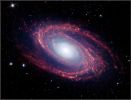
M-081-5.jpgM 81 - Spiral Galaxy (SST)86 visite"...God's Order is constant. Each time I reflect on Divine Order, I feel serene. My heart beats in a perfect rhythm and I breathe deeply and evenly. Immersed in Divine Order, I am restored: in my mind, in my body and in my soul..."
(9 voti)
|
|

SOU-SOL004-Deimos_from_Pathfinder-PIA00996_modest.jpgDeimos, from Pathfinder - Sol 4180 visiteCaption NASA originale: "Mars' outermost natural satellite, Deimos, is seen from the Planet's surface in this Pathfinder image taken at night on Sol 4. This picture was acquired by the Imager for Mars Pathfinder (IMP) camera. Using IMP images of Deimos and its companion moon, Phobos, the spectral characteristics of the satellites and properties of the Martian atmosphere are determined".
(9 voti)
|
|

Ganymede-PIA00353~0.jpgGanymede from 2,6 MKM63 visiteThis picture was taken on March 4, 1979 at 2:30 A.M. PST by Voyager 1 from a distance of about 2,6 MKM (such as about 1,6 MMs). Ganymede is Jupiter's largest satellite with a radius of about 2600 Km which means about 1,5 times that of our Moon. Ganymede has a bulk density of only approximately 2,0 g/cc (almost half that of the Moon).
In the light of the above, Ganymede is probably composed of a mixture of rock and ice. The features here, the large dark regions, in the northeast quadrant, and the white spots, resemble features found on the Moon, mare and impact craters respectively. The long white filaments resemble rays associated with impacts on the lunar surface. The various colors of different regions probably represent differing surface materials. There are several dots on the picture of single color (blue, green, and orange) which are the result of markings on the camera used for pointing determinations and are not physical markings.
(9 voti)
|
|

Europa-Lineae-Minos_Linea-PIA00275.jpgEuropa: Minos Linea (detail mgnf) - false colors91 visiteFalse color has been used here to enhance the visibility of certain features in this composite of 3 images of the Minos Linea region on Jupiter's moon Europa taken on 28 June 1996 Universal Time by the Solid State Imaging Camera on NASA's Galileo spacecraft. Triple bands, lineae and mottled terrains appear in brown and reddish hues, indicating the presence of contaminants in the ice. The icy plains, shown here in bluish hues, subdivide into units with different albedos at infrared wavelengths probably because of differences in the grain size of the ice.
The composite was produced using images with effective wavelengths at 989, 757 and 559 nnmts. The spatial resolution in the individual images ranges from 1,6 to 3,3 Km (about 1 to 2 miles) per pixel.
The area covered, centered at 45° North and 221° West, is about 1.260 Km (approx. 780 miles) across.
(9 voti)
|
|

Io-Plumes-PIA01081.jpgMore "Plumes" on Io60 visitenessun commento
(9 voti)
|
|

Io-PIA00740.jpgThe "face" of Io60 visitenessun commento
(9 voti)
|
|
| 25332 immagini su 2111 pagina(e) |
 |
|
|
|
|
170 | |
|
|
|
|





