| Piú votate |

Craters-Crater_Cluster-Meridiani_Planum-PIA07151_modest-00.jpgCrater Cluster in Meridiani Planum (Original NASA/MGS/MSSS b/w Frame)121 visiteUna piccola porzione di Meridiani Planum, caratterizzata da un grande ed antico cratere (in alto) e da una moltitudine di crateri più piccoli che tanto ci ricordano il Cratere Endurance. certo, sarebbe bello andare a dare un'occhiata a questo strano paesaggio dal basso ma...Opportunity è troppo lontana e, in questa zona, quasi certamente, non ci arriverà mai.
Ma poi, in fondo, chissà...
(9 voti)
|
|
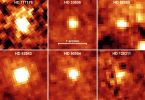
Various HD Class Stars-PIA07098_modest.jpgSuns like our Sun...59 visiteNASA's Spitzer Space Telescope recently captured these infrared images of six older stars with known planets. The yellow, fuzzy blobs are stars circled by disks of dust, or "debris disks," like the one that surrounds our own Sun. Though astronomers had predicted that stars with planets would harbor debris disks, they could not detect such disks until now: Spitzer was able to sense these dusty disks via their warm infrared glows. Specifically, the presence of the disks was inferred from an excess amount of infrared emission relative to what is emitted from the parent star alone. The stars themselves are similar in age and temperature to our Sun. In astronomical terms, they are stellar main sequence stars, with spectral types of F, G or K. These planet-bearing stars have a median age of 4 billion years. For reference, our Sun is classified as a G star, with an age of approximately 5 billion years. The disks surrounding these planetary systems are comprised of cool material, with temperatures less than 100 Kelvin (-173 degrees Celsius). They are10 times farther away from their parent stars than Earth is from the Sun, and are thought to be analogues of the comet-filled Kuiper Belt in our solar system.
(9 voti)
|
|

Titan-PIA06997_modest.jpgHaze Silhouettes Against Titan's Glow59 visite"A high-altitude haze layer residing some 400 Km above the surface of Titan is seen here traced along the limb of Titan as silhouetted against the glow of Titan's atmosphere produced by the fluorescence of methane gas. This detached haze layer can be seen as a dark lane imbedded within the gold-colored fluorescent layers of Titan. This image of Titan's limb and surface was obtained on Dec. 13, 2004 from a vantage point some 158.000 Km above the night side of Titan, at a phase angle of 161°. Beneath the fluorescence, Titan's surface at the extreme limb can be seen in blue color, illuminated by 5-micron wavelength sunlight that penetrates the thick atmosphere and hazes to reflect off the limb of Titan. The darkness of the silhouetted haze layer comprised of relatively small particles suggests that the particles themselves absorb strongly at the fluorescent wavelength and thus are possibly comprised of relatively complex hydrocarbon aerosols generated by photochemical processes in Titan's upper atmosphere".
(9 voti)
|
|
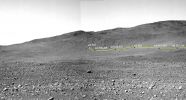
SOL149-PancamLabeled-A334R1.jpgSpirit's ascent on to "Husband Hill" (edited) - Sol 149115 visiteCaption NASA originale:"This view from where Spirit stood on its 149th martian day (June 3, 2004) shows, on the hillside at the center of the image, the terrain that the Rover is crossing six months later. The view is a mosaic of several frames taken with Spirit's panoramic camera.
NASA's Mars Exploration Rover Spirit has left the West Spur of the Columbia Hills and crossed a flatter saddle to the main body of Husband Hill. The Rover's course from the 313th to 330th Sol, of its mission (Nov. 19 to Dec. 6, 2004) is indicated on a mosaic view made from images taken with Spirit's panoramic camera on Sol 149 (June 3, 2004)".
(9 voti)
|
|

ZZ-Z-On Earth.jpgApollo 13 - Mission Overview233 visiteApollo 13 (Odyssey and Aquarius)
Saturn V
April 11-17, 1970
James A. Lovell, Jr.
John L. Swigert, Jr.
Fred W. Haise, Jr.
05 days, 22 hours, 54 minutes
Third lunar landing attempt. Mission aborted after rupture of service module oxygen tank. Classed as "successful failure" because of experience in rescuing crew. Spent upper stage successfully impacted on the Moon.
(9 voti)
|
|

Saturn-W00002927.jpgSaturn from approx. 1.600.000 Km59 visiteUna splendida ripresa di Saturno che ci permette di familiarizzare con il "Signore degli Anelli". Il particolare di maggiore interesse, secondo noi (ed anche se non siamo certi che si tratti di un oggetto reale), è costituito dal corpuscolo luminoso, dalla forma vagamente allungata, visibile sul margine superiore degli anelli, verso la Sn dell'Osservatore. Si tratta di una Luna minore, di un "clump", o di un difetto dell'immagine (e cioè un "artifact")?...
(9 voti)
|
|

ZZ-Near Moon, Far Moon (3).jpgNear Moon, far Moon (3)112 visitenessun commento
(9 voti)
|
|

ZZ-Near Moon, Far Moon (2).jpgNear Moon, far Moon (2)115 visitePer meglio apprezzare la sensibile differenza di diametro apparente che caratterizza la Luna in queste due fasi del suo ciclo, Vi precisiamo che le 5 istantanee che la ritraggono sono state tutte quante riprese impiegando lo stesso telescopio, il medesimo ingrandimento e la stessa fotocamera.
(9 voti)
|
|
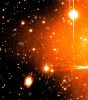
VE-Caliban.jpgCaliban71 visiteUna "Luna Minore" di Urano, Calibano, persa fra le stelle ed individuabile solo grazie alla "cerchiatura" bianca inserita in questa (comunque molto bella) immagine.
(9 voti)
|
|
IP Pegasi.jpgIP Pegasi87 visite"...Quando il fascino ed il carisma di un qualsiasi Scienziato riescono a raggiungere - o a superare! - il fascino ed il carisma della Scienza che lui ha il compito di insegnare, allora è giunto il tempo non solo di ascoltarlo con il doppio dell'interesse ed il triplo dell'attenzione, ma è anche arrivato il momento di valutarne criticamente ogni sua parola con il decuplo della passione.
Vi dico questo, cari Discepoli, poichè in Natura vi è un curioso rapporto di proporzionalità inversa fra la crescita dell'Immagine Esteriore degli Uomini di Scienza e la credibilità della Scienza che loro stessi insegnano..."
P.C. Floegers - "In the Paradox"
(9 voti)
|
|

AA-Neptune-HST-PIA01285_modest.jpgNeptune from HST58 visitePer incominciare il nostro breve viaggio verso l'ultimo dei Giganti Gassosi, ci sembra giusto mostrarVi due serie di immagini del "Re dei Mari" che sono state ottenute dall'Hubble Space Telescope. Nettuno ci appare come un disco dal colorito azzurro vivo, sul quale spiccano - ora bianche, ora con colori e sfumature diverse - le grandi formazioni nuvolose che attraversano rapidamente gli strati alti dell'atmosfera del Pianeta.
Nettuno, per gli amanti della fotografia spaziale, è un obbiettivo difficile ed al confine estremo di visibilità dalla Terra, allorchè si faccia uso di strumenti amatoriali. A "fuoco diretto", usando un buon telescopio (tipo C-8), esso appare leggermente più definito di una stella, la forma sferica è appena percepibile ed il colorito, purtroppo, grigio-azzurrato, molto lontano - purtroppo - dal suo colore naturale, come vedremo sia nelle foto HST, sia nelle foto Voyager.
(9 voti)
|
|

SOL265-2N149895126EFF8900P0634R0M1.jpgSpirit is looking around... (1)56 visiteSiamo giunti al Sol 265 e Spirit, ormai da parecchio tempo, si sta "guardando attorno" alla ricerca - crediamo - di un percorso relativamente sicuro. Speriamo che il Controllo Missione operi scelte intelligenti ed oculate perchè la "Passeggiata Marziana" si sta facendo sempre più interessante e sarebbe un peccato buttare via tutto ora...
(9 voti)
|
|
| 25332 immagini su 2111 pagina(e) |
 |
|
|
|
|
168 | |
|
|
|
|





