| Piú votate |

Volcanoes-Olympus_Mons.jpgOlympus Mons (Natural Colors; NASA/JPL/MSSS)62 visitenessun commento
(9 voti)
|
|

01-Lunar Orbiter 1.jpgCrescent Earth from the Lunar Orbiter 1118 visiteCaption NASA originale:"Lunar Orbiter 1 new of the Moon and crescent Earth. This is the first good image of the Earth taken from the vicinity of the Moon, 380.000 km away. The Earth sunset terminator runs through Odessa, Istanbul and slightly west of Capetown. The center of the Lunar Surface corresponds to the location of the crater Pasteur, just on the eastern farside at 10° S,105° E, but the high sun angle makes it hard to see the craters. The horizon covers about 550 Km and north is to the right in this west facing image. (LO1 - frame 102; H1, H2, H3)".
Location & Time Information
Date/Time (UT): 1966-08-23 T 16:36:23
Distance/Range (km): 1476
Central Latitude/Longitude (deg): -14.68/104.34
(9 voti)
|
|

Comets-Wild_2-02.jpgWild 2 - stereo image pair63 visitenessun commento
(9 voti)
|
|

Comets-Wild_2-05.jpgWild 266 visiteCaption NASA originale:"This image is the closest short exposure of the comet, taken at an 11,4° phase angle (phase angle is the angle between the camera, the comet and the Sun).
(9 voti)
|
|

Comets-Wild_2-04.jpgThe map of Comet Wild 261 visiteUna mappa - non particolarmente dettagliata ma comunque idonea a farci vedere e riconoscere le aree maggiormente importanti - della Cometa Wild 2. La mappa in oggetto è stata ottenuta sulla base delle riprese della cometa effettuate dalla Sonda "Stardust" il 2 Gennaio 2004 e, in particolare, impiegando il frame che Vi mostriamo nel quadro successivo.
I nomi indicati per le diverse aree di Wild 2 sono quelli utilizzati dallo "Stardust Team".
Da notare, infine, che il "bacino Shoemaker" potrebbe (a dispetto delle apparenze) NON aver avuto origine da un impatto.
(9 voti)
|
|

Mimas-N00026588.jpgOne half of Mimas60 visitenessun commento
(9 voti)
|
|

Japetus-PIA07002_modest.jpgJapetus' surface composition (organic material?!?)59 visiteCaption NASA originale:"The three colors used in the mosaic correspond to 1.01, 3.21, and 3.80 microns. The different colors represent vastly different surface compositions. The upper bright blue region is rich in water ice, while the lower, dark brown region is composed mainly of a substance rich in organic material. The yellow region consists of a mixture of ice and organics, suggesting a gradual change in composition on the surface. This pattern suggests Iapetus swept up the dark material, which may have come from debris created from meteoritic impacts onto the small, outer satellites of Saturn".
(9 voti)
|
|

Japetus-PIA06170_modest.jpgJapetus in HR58 visiteCaption NASA originale:"This oblique view of Saturn's moon Japetus from high latitude shows how the dark, heavily cratered terrain of Cassini Regio transitions to a bright, icy terrain at high latitudes. In this mosaic of 2 HR images taken during Cassini's New Year's Eve 2004 flyby of Japetus, the direction toward the north pole is approximately 15° below the horizontal on the right. At the equator terrains are uniformly covered with a dark mantle of material that has a reflectivity of about 4%. At latitudes toward the pole of about 40°, the dark deposits become patchy and diffuse as the surface transitions to a much brighter, icy terrain near the pole. The brightest icy materials exhibit visual reflectivity over 60%. Superimposed on the bright terrain is a subtle, ghostly pattern of crudely parallel, north-south trending wispy streaks. The streaks, which were discovered during this flyby of Iapetus, are typically a few kilometers wide and sometimes tens of kilometers long. Their appearance and orientation may be connected with the emplacement of dark materials that cover Cassini Regio. The dark materials might represent the gradual accumulation of dark debris falling from space, or alternatively, may represent fallout from plume-style eruptions that may have accompanied the formation of Iapetus's enigmatic equatorial ridge (see PIA 06166)".
(9 voti)
|
|

Rhea-PIA06555_modest.jpgRhea's craters60 visiteCaption NASA originale: "The sunlight angle in this sharp view of Saturn's second-largest moon, Rhea, highlights the moon's crater-strewn surface. Cassini will fly past Rhea on Nov. 26, 2005, at a distance of only 500 Km (such as 311 miles) and will obtain very high resolution images at that time. Rhea's diameter is 1.528 Km(or 949 miles).
This view shows mainly the hemisphere of Rhea that faces away from Saturn. The image was taken in visible light with the Cassini spacecraft narrow angle camera on Nov. 1, 2004, at a distance of 1,6 MKM (or 994.000 miles) from Rhea and at a Sun-Rhea-spacecraft, or phase, angle of 102°. North is up. The image scale is about 10 Km (6 miles) per pixel. The image has been slightly contrast enhanced to aid visibility of surface features.
(9 voti)
|
|

Japetus-N00026373.jpgANOMALY - Japetus and a "streak" of light73 visiteNon ci vuole certo un "Cacciatore di Anomalie" per notare la ENORME Anomalia riscontrabile in questo frame: c'è un oggetto luminoso, infatti, in movimento sostanzialmente lineare e che emana una luce costante il quale sta transitando nelle vicinanze di questo pianetino. Molte immagini di Giapeto, come Voi stessi potrete constatare, contengono phographic artifacts di varia natura e che vanno dai "dead pixels" alle "strisciature" da raggi cosmici ad imperfezioni vere e proprie dell'immagine causate da un vizio nella trasmissione dei dati. Però, a nostro modo di vedere, questa "striscia" di luce è qualcosa di diverso. Ne abbiamo già incontrata una, nello Spazio di Saturno, qualche mese fa...ve ne ricordate? Era identica a questa!
(9 voti)
|
|

Japetus-N00026216.jpgJapetus (and the "Pentagon") from about 180.000 Km (1)117 visiteUna serie di immagini ravvicinate di Giapeto, la "Luna Nera" di Saturno: un corpo celeste strano, per una metà simile a tante altre lune (sia di Saturno, sia di altri Pianeti del Sistema Solare) e per un'altra metà completamente diverso: nero, buio, indefinibile. Non sappiamo da che cosa dipenda l'oscurità che domina su una metà abbondante della superficie di questo gelido mondo, anche se sono state formulate tante ipotesi al riguardo.
La più verosimile, a nostro avviso, è quella che fa risalire la mancanza di riflessione della luce che colpisce questo mondo al materiale che lo forma e/o lo ricopre in buona parte. Carbone, molto probabilmente (o polveri carbonifere) oppure qualche altro minerale dalle caratteristiche simili. La luce, se osservate le fotografie di Giapeto (in particolar modo quelle riprese da una certa distanza), sembra "affogare" sulla superficie di questa luna: essa viene - semplicemente - catturata da Giapeto e non riflessa. Un altro mistero da esaminare, dunque...
(9 voti)
|
|
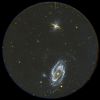
M-081-3.jpgM 81 and M 82 - Spiral Galaxies (full field)64 visite"...How does it feel,
How does it feel,
To be on your own,
With no directions home,
Like a complete unknown,
Like a rolling stone..."
Bob Dylan - "Like a rolling stone"
(9 voti)
|
|
| 25332 immagini su 2111 pagina(e) |
 |
|
|
|
|
167 | |
|
|
|
|





