| Piú votate |

Prometheus-PIA07582.jpgCrossing the Rings...58 visiteOriginal caption:"Prometheus has just passed - and gravitationally disturbed - some of the fine particulate material in the F-Ring, creating the sheared gap visible in the inner strands of the Ring. This view looks down from about 10° above the ringplane. Prometheus and the Rings are sunlit from below. At lower right lies the outermost part of the A-Ring, which grows suddenly brighter outside of the 42-Km-wide (such as about 26-miles) Keeler Gap.
The image was taken in visible green light with the Cassini spacecraft narrow-angle camera on Aug. 2, 2005, at a distance of approximately 632.000 Km (approx. 392.000 miles) from Prometheus and at a Sun-Prometheus-spacecraft, or phase, angle of 122°. Image scale is 4 Km (about 2 miles) per pixel".
(9 voti)
|
|

Rings-PIA03556.jpg"Clumps" in the A-Ring60 visiteOriginal NASA caption:"The left image is a false-color view of Saturn's A-Ring from the Ultraviolet Imaging Spectrograph aboard Cassini.
The A-Ring is the bluest in the center, where the gravitational clumps are the largest. The thickest black band in the Ring is the "Encke-Gap" while the thin black band further to the right is the "Keeler-Gap".
The right image is a computer simulation about 150 mt (about 490 feet) across illustrating a "clumpy region" of particles in the A-Ring. And, there and that is the 'real surprise'...The particles are moving counterclockwise, from bottom to top!".
(9 voti)
|
|

Enceladus~1.jpgEnceladus' "Tiger Stripes"58 visiteDa "NASA - Picture of the Day" del 6 Settembre 2005:"The Tiger Stripes on Saturn's moon Enceladus might be active. Even today, they may be spewing ice from the Moon's icy interior into space, creating a cloud of fine ice particles over the Moon's South Pole and creating Saturn's mysterious E-Ring. Recent evidence for this has come from the Cassini spacecraft. Cassini detected a marked increase in particle collisions during its July flyby only 270 Km over a South Polar Region of Enceladus. Pictured above, a HR image of Enceladus is shown from the close flyby. The unusual surface features dubbed "Tiger Stripes" are visible on the left in false-color blue. Why Enceladus is active remains a mystery, as the neighboring moon Mimas, approximately the same size, appears quite dead".
(9 voti)
|
|
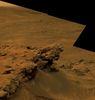
SOL497-Gusev_Crater8-PIA04179.jpgGusev Crater's Horizon - Soles 497/500 (Approximate True Colors; credits: NASA/JPL-Caltech)75 visiteOrmai, come Lettori di Lunar Explorer, avrete compreso che la nostra fissazione sui "Colori di Marte" trascende la problematica in sè ed arriva a toccare i tasti, molto più delicati, della "coerenza" e della "omogeneità". Coerenza (di ipotesi ed elementi circostanziali) ed Omogeneità (di dati ed informazioni di contorno) che la NASA, purtroppo - riguardo ai MER e ad altre precedenti Missioni verso il Red Planet -, non riesce proprio più a dare.
Qualcuno potrebbe pensare alla mala-fede ed al cover-up; qualche altro, magari, ad una sorta di incompetenza. A noi, in fondo, piace pensare che questo "caos cromatico" che coinvolge Marte (e, con esso, quasi tutta la fotografia spaziale) dipenda dal fatto che:
in 1mo luogo, la Verità, come ovvio, non la conosce ancora nessuno;
in 2do luogo i dati che abbiamo sono ancora insufficienti (e, forse, in parte anche fra loro contraddittori);
in 3zo luogo - ed infine - alcune informazioni, per essere valide, devono essere acquisite "da occhi umani".
Voi che dite?!?
(9 voti)
|
|
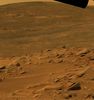
SOL497-Gusev_Crater7-PIA04179.jpgGusev Crater's Horizon - Soles 497/500 (Approximate True Colors; credits: NASA/JPL-Caltech)58 visitenessun commento
(9 voti)
|
|

SOL497-Gusev_Crater6-PIA04179.jpgGusev Crater's Horizon - Soles 497/500 (Approximate True Colors; credits: NASA/JPL-Caltech)57 visitenessun commento
(9 voti)
|
|

SOL497-Gusev_Crater5-PIA04179.jpgGusev Crater's Horizon - Soles 497/500 (Approximate True Colors; credits: NASA/JPL-Caltech)56 visitenessun commento
(9 voti)
|
|

SOL497-Gusev_Crater4-PIA04179.jpgGusev Crater's Horizon - Soles 497/500 (Approximate True Colors; credits: NASA/JPL-Caltech)58 visitenessun commento
(9 voti)
|
|

SOL497-Gusev_Crater3-PIA04179.jpgGusev Crater's Horizon - Soles 497/500 (Approximate True Colors; credits: NASA/JPL-Caltech)63 visiteForse è una conseguenza del fatto che questo panorama gigantesco è stato ottenuto combinando le immagini di 5 Soles, o forse è solo una nostra impressione ma, a differenza del bellissimo paesaggio relativo al Sol 519 di Spirit, questa serie di sezioni - che, insieme, formano il "Whale Panorama" - ci sembrano ancora una volta peccare di realismo. Il cielo, in particolare, è davvero improbabile e tutta la superficie di Marte, più che rossa o arancione - come appare nei frames in true colors ("colori veri" o "approssimativamente veri" a detta della NASA, badate bene...) i quali ora mostravano target ravvicinati (tipo Adirondack) ora panorami (tipo Bonneville Crater e Santa Anita) -, sembra essere diventata verdastra.
Premesso che ognuno deve fare le proprie valutazioni noi, per coerenza, non possiamo far altro che stigmatizzare ancora la scarsa attendibilità di questa visione di Marte con quello che la NASA stessa, in altri casi, ha detto essere i 'veri' (o quasi) colori del Pianeta Rosso (o presunto tale)...
(9 voti)
|
|

SOL497-Gusev_Crater2-PIA04179.jpgGusev Crater's Horizon - Soles 497/500 (Approximate True Colors; credits: NASA/JPL-Caltech)61 visiteOriginal NASA caption:"In this case, scientists have also been studying the mineral and chemical differences, which show that some rocks have been more highly altered than others.
In the foreground, in the middle of the image mosaic, Spirit is shown with the scientific instruments at the end of its robotic arm positioned on a rock target known as "Ahab". The Rover was busy collecting elemental chemistry and mineralogy data on the rock at the same time that it was taking 50 individual snapshots with its five PanCam filters to create this stunning view of the martian scenery. The twin tracks of the Rover's all-terrain wheels are clearly visible on the left. This mosaic of images spans about 220° from left to right and is an approximate true-color rendering of the Mars terrain acquired through the PanCam's 750-, 530-, and 430-nnmt filters. Spirit collected these images from its 497th Sol, through its 500th Sol (May 27 through May 30, 2005)".
(9 voti)
|
|
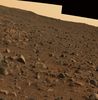
SOL519-Husband3-PIA04180.jpgLooking at Husband's Summit - Sol 519 (Natural Colors; credits: NASA/JPL-Caltech)61 visite"...This mosaic of images is an approximate true-color rendering of snapshots taken by the Rover's Panoramic Camera using 750-, 530-, and 430-nanometer filters. Spirit took these images at approximately 3 p.m. Local True Solar Time in Gusev Crater on Mars. The Rover then continued to climb throughout July, making numerous scientific investigations of martian rocks along the way".
(9 voti)
|
|

SOL519-Husband2-PIA04180.jpgLooking at Husband's Summit - Sol 519 (Natural Colors; credits: NASA/JPL-Caltech)67 visite... (sebbene occorra portare l'immagine sino a full-size e quindi bisogna analizzarla operando su quadranti delimitati e quadrante per quadrante) delle aree leggermente 'offuscate' le quali, tuttavia, vanno sempre a confondere le rocce - diciamo così - più 'bizzarre' e poste, rispetto alla PanCam del Rover, ad una distanza che stimiamo tra i 15 ed i 25 metri.
Comunque sia, la validità - a fini non solo "artistici", ma anche di ricerca - di questo composite-frame è, sempre a nostro parere, decisamente superiore alla media degli ultimi 8/9 mesi.
Questa è la caption NASA originale:"Not long after conducting extensive investigations of tilted martian rock layers along its path, NASA's Spirit Rover prepared to resume the trek to the top of the Columbia Hills in June. This panorama, nicknamed Sunset Ridge, shows the terrain that lay ahead of the Rover on Spirit's 519th Sol (June 19, 2005). On the left is the summit of Husband Hill, Spirit's objective at that time".
(9 voti)
|
|
| 25332 immagini su 2111 pagina(e) |
 |
|
|
|
|
162 | |
|
|
|
|





