| Piú votate |
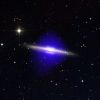
NGC-5746.jpgNGC 5746 - Spiral Galaxy59 visite“...Se fuggi il suono
sei suono lo stesso,
spettro di armonia,
fumo di grido e canto...”
F.G. LORCA

(9 voti)
|
|
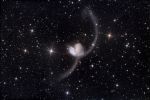
NGC-4038_and_NGC-4039-3.jpgNGC 4038 and 4039: The "Antennae" Colliding Galaxies58 visite"...Ambition is the last resort of failure..."
(Oscar Wilde)
Caption NASA originale:"Some 60 million LY away in the southerly constellation Corvus, two large galaxies have collided. But stars in the two galaxies - NGC 4038 and NGC 4039 - don't collide in the course of the ponderous, billion year or so long event. Instead, their large clouds of molecular gas and dust do, triggering furious episodes of star formation.
Spanning about 500.000 LY, this stunning view reveals new star clusters and matter flung far from the scene of the accident by gravitational tidal forces. Of course, the visual appearance of the far-flung arcing structures gives the galaxy pair their popular name - "The Antennae". Recorded in this deep image of the region at the tip of the upper arc is a tidal dwarf galaxy NGC 4038S, formed in the cosmic debris".
(9 voti)
|
|

Moon and Pleiades.jpgOld Moon...73 visiteDa "NASA - Picture of the Day" del 29 Giugno 2006:"An old crescent Moon shares the Eastern Sky over Menton, France, with the Sister Stars of the Pleiades cluster in this early morning skyscape recorded just last Friday, June 23rd. (Bright Venus was also near the Eastern horizon, but is not pictured here.) Astronomical images of the well-known Pleiades often show the cluster's alluring blue reflection nebulae, but they are washed out here by the bright moonlight. Still, while the crescent Moon is overexposed, surface features can be seen on the dim lunar night side illuminated by earthshine - light from sunlit planet Earth. Of course, you can spot a young crescent Moon in the early evening sky tonight.
Having left the Pleiades behind, a lovely lunar crescent now appears in the West, lining up with planets Mars, Saturn and Mercury along the Solar System's Ecliptic Plane".
(9 voti)
|
|

M-057-1.jpgM 57 - The "Ring Nebula"107 visite"...If you have run with the footmen, and they have wearied you, then how can you contend with horses?..."
- Jeremiah 12:5
(9 voti)
|
|

ZZ-ZZ-ZZ-ZZ-ZZ-ZZ-ZZ-ZZ-ZZ-ZZ-ZZ-ZZ-APOLLO 16 AS 16-116-18603 HR.jpgAS 16-116-18603 (HR) - Extremely Controversial Lunar "Artifacts"282 visiteDa questa coppia di particolari, individuata - ancora una volta! - dal Dr Gianluigi Barca, si può estrarre nuova linfa per due correnti di pensiero le quali, sebbene fortemente osteggiate da Lunar Explorer (e cioè Richard Hoagland - Manufatti Lunari - Civiltà Lunari Estinte e Bill Kaysing - "Moon Hoax"), difronte a simili evidenze acquisiscono, quasi automaticamente, una propria "dignità" (dobbiamo ammetterlo, anche se "ci costa", se non altro per una questione di onestà intellettuale).
Cerchiatura Verde: roccia (anzi no: diciamo 'oggetto') a forma squadrata, apparentemente liscio, con angoli smussati e profilo regolare, il quale presenta un rilievo, visibile sulla sua Dx (Sx dell'Osservatore), che pare assomigliare ad una sorta di staffa. Da notare che detta "staffa" avvolge l'oggetto, ma NON è a diretto contatto con la sua superficie (un elevato ingrandimento mostra che la staffa non poggia sul corpo principale);
Cerchiatura Fucsia: un'autentica Anomalìa di Superficie. Si tratta di una struttura colonnare regolare, la cui pianta ci mostra - anche senza fare ingrandimenti - l'esistenza di una zigrinatura/dentellatura sui bordi ed un "perno" centrale.
Questa descrizione, ci preme sottolinearlo, NON è un'interpretazione di tipo speculativo: è il prodotto di una semplice osservazione che OGNUNO di VOI può fare.
Eccezionale il lavoro del Dr Barca.
(9 voti)
|
|

005.jpgSpace Heat-Shields - The Heat-Shield (detail mgnf)217 visite5 - LA MISSIONE
Apparentemente sembrerebbe tutto in ordine, ma c’è un primo elemento che non torna.
Come si vede dalla pianta 3D di Bonneville (frame 3), Spirit lo avrebbe fotografato dal Sol 65 al Sol 86, praticamente girellando su sè stesso per 21 giorni e scattando foto SEMPRE dalla stessa posizione. Tutto ciò sembra assurdo. Pensateci: Spirit avrebbe prima viaggiato per milioni di chilometri nello spazio, poi rotolato per 2 mesi lungo una pianura (apparentemente) desolata e infine avrebbe stazionato per 3 settimane di fronte alla prima vera scoperta senza nemmeno tentare di entrarvi o di circumnavigarla, per poi andarsene via con un’allegorica alzata di spalle “perché non c’era niente da vedere”!
Premesso che un tale approccio non è credibile, avanziamo 2 ipotesi sull'accaduto:
A) Il percorso denunciato è vero e l’esplorazione è stata limitata per motivi di sicurezza (del Rover);
B) Il percorso denunciato è falso e dell’esplorazione di Bonneville non sono state diffuse le immagini vere.
(9 voti)
|
|

004.jpgSpace Heat-Shields - The edge of Bonneville and the "wreck"203 visite4 - LA POSIZIONE
Tralasciando per il momento le altre indicazioni, prendiamo in esame la posizione 1 che, come abbiamo visto, identificherebbe l'area di impatto del (presunto) Heat-Shield con il margine del Bonneville Crater, rapportandola con la ripresa della stessa area effettuata dalla PANCAM di Spirit.
Guardate bene.
(9 voti)
|
|

Sagittarius Region~0.jpgThe Sagittarius "Triplet"58 visite"...I declare what I have seen in the Father's presence; as for you, you should do what you have heard from the Father..."
John 8:38
(9 voti)
|
|

NGC-5866-HST-1.jpgNGC 5866 - Spiral Galaxy57 visite"...Aperta odia, armaque palam depelli; (sed) fraudem et dolum obscura eoque inevitabilia..."
(Tacito)
"...Gli odi che sìano palesi, al pari delle aggressioni armate, possono essere affrontati (e respinti), (ma) contro subdoli inganni ed oscure trame non c'è difesa..."
(9 voti)
|
|

Moon from Hawaii.jpgHaleakala's Moon88 visiteDa "NASA - Picture of the Day" del 10 Giugno 2006:"A waxing crescent Moon shines over the caldera of dormant volcano Haleakala and observatory domes in this dramatic view from above the clouds.
Looking West from Maui, Hawaii on May 31st, the scene also records the lights of Honolulu on the horizon. Near the strongly overexposed crescent, is bright planet Saturn, but included in the skyscape are planet Mars and the Gemini stars Castor and Pollux.
Of course, skywatchers also found star cluster M 44, The Beehive Cluster, in this early evening sky, wedged between Saturn and the Moon. In fact, as it closes with Saturn, Mars will pass in front of the Beehive on June 15, so just keep looking West".
(9 voti)
|
|

ZZ-ZZ-ZZ-ZZ-ZZ-Gamma-Ray Moon.jpgGamma Ray Moon128 visiteDa "NASA - Picture of the Day" del 27 Maggio 2006:"If you could see Gamma Rays - photons with a million or more times the energy of visible light - the Moon would appear brighter than the Sun! The startling notion is demonstrated by this image of the Moon from the Energetic Gamma Ray Experiment Telescope (EGRET) in orbit on NASA's Compton Gamma Ray Observatory from April 1991 to June 2000. Then, the most sensitive instrument of its kind, even EGRET could not see the quiet Sun which is extremely faint at gamma-ray energies. So why is the Moon bright? High energy charged particles, known as cosmic rays, constantly bombard the unprotected lunar surface generating gamma-ray photons. EGRET's Gamma-Ray vision was not sharp enough to resolve a lunar disk or any surface features, but its sensitivity reveals the induced gamma-ray moonglow. So far unique, the image was generated from eight exposures made during 1991-1994 and covers a roughly 40° wide field of view with gamma-ray intensity represented in false colors".
(9 voti)
|
|

IMAGE069-AS16-107-17419 HR.jpgAS 16-107-17419 (HR) - Summary (labeled)156 visitenessun commento
(9 voti)
|
|
| 25332 immagini su 2111 pagina(e) |
 |
|
|
|
|
156 | |
|
|
|
|





