| Piú votate |
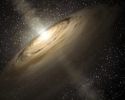
PIA03243.jpgThe way we were...62 visiteThis artist's concept illustrates a solar system that is a much younger version of our own. Dusty disks, like the one shown here circling the star, are thought to be the breeding grounds of planets, including rocky ones like Earth. Astronomers using NASA's Spitzer Space Telescope spotted some of the raw ingredients for DNA and protein in one such disk belonging to a star called IRS 46. The ingredients, gaseous precursors to DNA and protein called acetylene and hydrogen cyanide, were detected in the star's inner disk, the region where scientists believe Earth-like planets would be most likely to form.
(9 voti)
|
|

GALEX Portrait-PIA03295.jpgPortrait of the Universe60 visiteFrom sparkling blue rings to dazzling golden disks, Galaxy Evolution Explorer (Galex) scientists are handing out a collection of their finest galactic treasures at the January 2006 American Astronomical Society meeting in Washington, D.C.
Mined from the mission's Survey of Nearby Galaxies data, these cosmic gems were collected with the telescope's sensitive ultraviolet instruments. The gallery of galaxies has been made into a poster for meeting attendees visiting the mission's booth. Organized from far-ultraviolet to near-ultraviolet bright galaxies, this poster encapsulates the heart of the mission to study how galaxies and star formation rates have changed over the past 10 billion years.
Events in space take millions or billions of years to unfold, which means that astronomers can't watch individual galaxies and stars age over time. Luckily, because the physics of light travel dictates that the farther away an object is from Earth, the longer it takes for its light to travel to us, the universe can be thought of as a time machine. By building telescopes sensitive enough to capture objects that are 10 billion light-years away, astronomers can essentially see an object the way it looked 10 billion years ago. Galex astronomers are using this phenomenon to their advantage by taking snapshots of different galaxies at various distances in space. By comparing portraits of numerous objects at various times in the universe's history, the team can begin to piece together the life cycle of stars and galaxies.
For the poster, Galex scientists organized 196 different nearby galaxies in bins of increasing ultraviolet color. By placing the various snapshots side by side, astronomers can see how galaxies age differently. When viewed in ultraviolet, active star-forming regions in galaxies can be seen as glittering blue structures, while a soft, golden glow indicates the presence of older stars.
The 196 galaxies represented in the poster were selected from more than 1,000 galaxies in the "Ultraviolet Atlas of Nearby Galaxies." So far, the Galex mission has surveyed more than 100 million galaxies.
(9 voti)
|
|

ORIGINAL NASA - APOLLO 15 - AS 15-96-13048.JPGAS 15-96-13048 - Rimae Prinz Region62 visite
(9 voti)
|
|
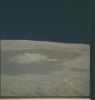
ORIGINAL NASA - APOLLO 15 - AS 15-91-12383.JPGAS 15-91-12383 - Tsiolkovsky Crater62 visite
(9 voti)
|
|
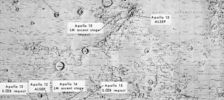
001-AS15-Page8-6.jpg001 - Moon-quakes: imagination, science-fiction or just a "fact"?68 visite
(9 voti)
|
|

002-The Moon and Planets from Clem.JPG020 - The Moon and a few planets62 visiteThe Startracker imaged this spectacular shot of the sunrise, planets, and Moon. This color-enhanced image shows, from right to left, the Moon lit by the Earth, the terminator - or boundary between light and dark - into the dark side with the solar corona just rising over the limb, and the bright planets Saturn, Mars, and Mercury. Several dimmer stars can also be seen. The Startracker algorithm achieved a star match, realizing that the Sun and planets were not in the correct position to be stars, and ignored them.
(9 voti)
|
|

018-The Moon from Clem-WestLimb-PIA00305.jpg004 - The western limb of the Moon: Mare Orientale and Oceanus Procellarum61 visiteThe so-called Mare Orientale (ringed feature just below image center) is just visible from Earth on the extreme western edge of the Near-Side of the Moon.
Oceanus Procellarum (large dark albedo area in upper right of image) is a familiar Near-Side feature as seen from Earth.
(9 voti)
|
|

APOLLO 15 AS 15-85-11375HR.jpgAS 15-85-11375 (HR)61 visite
(9 voti)
|
|

APOLLO 15 AS 15-85-11374.jpgAS 15-85-1137461 visite
(9 voti)
|
|

APOLLO 15 AS 15-85-11372.jpgAS 15-85-1137261 visite
(9 voti)
|
|

APOLLO 15 AS 15-85-11356HR.jpgAS 15-85-11356 (HR)65 visite
(9 voti)
|
|

APOLLO 15 AS 15-84-11248HR.jpgAS 15-84-11248 (HR)64 visite
(9 voti)
|
|
| 25332 immagini su 2111 pagina(e) |
 |
|
|
|
|
153 | |
|
|
|
|





