| Piú votate |
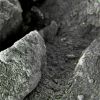
000-SOL166.jpgIs There Life On Mars?78 visiteIs there Life on Mars? Questa domanda, che è anche il titolo di un grande (e datato!) successo di David Bowie (...o "l'Uomo che cadde sulla Terra", come dicono molti dei suoi Fans...), non può, a questo punto della Storia di Lunar Explorer Italia, non diventare oggetto di una Galleria ad hoc.
Curata dal Dr Gianluigi Barca (Presidente di Lunexit, Sez. Liguria e Piamonte) e dal Dr Marco Faccin (Tecnico dell'Immagine e Ricercatore Senior), con la collaborazione del Dr Paolo C. Fienga (Presidente di Lunexit, Direz. Generale), questa Galleria mostrerà un quantitativo - riteniamo - impressionante di frames Spirit ed Opportunity che, una volta processati usando la Tecnica che abbiamo battezzato "Superdefinizione" e, talvolta, ulteriormente elaborati attraverso il Processo - Made by Lunexit - conosciuto come "MULTISPECTRUM", Vi mostreranno Marte come - REALMENTE - non lo avevate MAI visto prima.
La Superdefinizione, una Tecnica "semi-artigianale" di Elaborazione delle immagini originariamente adottata dalla NASA per migliorare la qualità visiva dei primi frames "Marziani" (siamo nel periodo delle Missioni Viking e Pathfinder), è stata ridisegnata nelle sue linee essenziali (e quindi, in un certo senso, "reinventata" per meglio servire i nostri scopi) dal Dr Marco Faccin ed è poi anche stata ulteriomente raffinata dal Dr Gianluigi Barca.
Ad essa, talvolta (ed al sussistere delle necessarie condizioni), potrà anche essere aggiunto il MULTISPECTRUM Processing il quale conferirà all'immagine nella sua versione "definitiva" le caratteristiche di colorazione e texture necessarie affinchè quanto ripreso possa essere visto dal Lettore "con Occhi Marziani" (ossìa il Lettore vedrà il Paesaggio di Marte ed i suoi dettagli "come se si trovasse in loco").
A tal riguardo - e per ottenere il massimo realismo - il processing addizionale alla Superdefinizione (ergo il MULTISPECTRUM Processing) considera, per ogni frame pubblicato, l'Ora Locale di Scatto (la quale, insieme alla Stagione in corso ed alla Opacità Atmosferica del momento - se conosciuta - diventa una funzione essenziale per stabilire le condizioni effettive di illuminazione del particolare ripreso).
Attraverso questo Lavoro (che non è "facile" nemmeno in teoria - figurateVi in pratica...) siamo giunti ad evidenziare dei particolari, in fondo ricorrenti in tutte le immagini, ma DECISAMENTE più evidenti nei frames ottenuti attraverso il Microscopic Imager di cui sono dotati entrambi i Rover, i quali, pur se non possono rispondere in maniera definitiva al nostro Quesito Origianale, certo lasceranno tanti LEGITTIMI dubbi agli Interpreti e, in ogni caso, aiuteranno (o, almeno, questo è quanto speriamo...) i Ricercatori e gli Appassionati di Marte & Dintorni a "VEDERE" cose che la NASA non si è mai neppure (pubblicamente, come ovvio...) sognata di mostrare.
Dunque Buon Viaggio e, che dite? Is There Life On Mars?!?...MareKromium
(9 voti)
|
|

PercivalLovell_sChannels.jpgPercival's Dream... (by Roberto Tremolada)84 visiteUn Omaggio al Grandissimo Sir Percival Lovell, da parte del nostro Amico "Artista dello Spazio", Roberto Tremolada.MareKromium
(9 voti)
|
|

Enceladus-IMG003035.jpgNot for Human Eyes... (by Karl Kofoed)59 visiteCaption NASA:"In this artist's rendering, a distant Sun forms a halo (refracted sunlight by ice crystals) amid streamers of pure water ice particles, which spew into space from cracks in the South Polar surface of Saturn's tiny moon Enceladus". MareKromium
(9 voti)
|
|

Enceladus-IMG003036.jpgThe Fountains of Enceladus (by Karl Kofoed)61 visiteCaption NASA:"This artist's painting of the South Polar Region of Saturn's tiny moon Enceladus shows massive jets of water ice being blasted into space. The moon's lack of atmosphere and low gravity prevents the jets from fanning out quickly as they might on a more massive world. These plumes feed the extensive E-Ring of Saturn". MareKromium
(9 voti)
|
|

Martian_Rocks_(Roberto_Tremolada).jpgFretted Terrain and Distant Mountains (by Roberto Tremolada)75 visitenessun commentoMareKromium
(9 voti)
|
|

Craters-Pollack_Crater_and_White_Rock-20020419a-PCF-LXTT.jpgPollack Crater and "White Rock" (Slightly Saturated Absolute Natural Colors; credits for the additional process. and color.: Dr Paolo C. Fienga - Lunexit Team)59 visiteCaption NASA:"White Rock is the unofficial name for this unusual landform which was first observed during the Mariner 9 Mission in the early 70's. As later analysis of additional data sets would show, White Rock is neither white nor dense rock. Its apparent brightness arises from the fact that the material surrounding it is so dark. Images from the Mars Global Surveyor MOC camera revealed dark sand dunes surrounding White Rock and on the floor of the troughs within it.
Some of these dunes are just apparent in the THEMIS image. Although there was speculation that the material composing White Rock could be salts from an ancient dry lakebed, spectral data from the MGS TES instrument did not support this claim. Instead, the White Rock deposit may be the erosional remnant of a previously more continuous occurrence of air fall sediments, either volcanic ash or windblown dust.
The THEMIS image offers new evidence for the idea that the original deposit covered a larger area.
Approximately 10 Km to the South-East of the main deposit are some tiny knobs of similarly bright material preserved on the floor of a small crater. Given that the eolian erosion of the main White Rock deposit has produced isolated knobs at its edges, it is reasonable to suspect that the more distant outliers are the remnants of a once continuous deposit that stretched at least to this location.
The fact that so little remains of the larger deposit suggests that the material is very easily eroded and simply blows away".MareKromium
(9 voti)
|
|
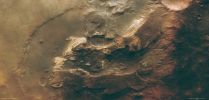
Craters-Terby_Crater.jpgTerby Crater (Natural Colors + MULTISPECTRUM; credits: ESA & Lunexit)62 visiteThe High Resolution Stereo Camera (HRSC) on board ESA’s Mars Express Orbiter imaged the Terby Crater on Mars on 13 April 2007 during orbit 4199.
The Region is of great scientific interest as sediments there hold information on the role of water in the history of the Planet. Eye-catching finger-shaped plateaux extend in the North-South direction. They rise up to 2000 mt above the surrounding terrain. The relatively old crater was filled with sediments in the past, which formed plateaux on erosion.
The flanks of the plateaux clearly exhibit layering of different-coloured material. Differences in colour usually indicate changes in the composition of the material and such layering is called ‘bedding’. Bedding structures are typical of sedimentary rock, which has been deposited either by wind or water. Different rock layers erode differently, forming terraces.
The valleys exhibit gullies, or channels cut in the ground by running liquid, mainly in the Northern part of the image.
These gullies and the rock-bedding structure indicate that the region has been affected by water.
MareKromium
(9 voti)
|
|

M-055-0.jpgM 55 - Globular Star Cluster100 visite"...Impedit ira animum, ne possit cernere verum..."
(Catone)
"...L'ira inibisce l'animo, così da non permettergli di vedere la Verità..." (l'ira acceca)MareKromium
(9 voti)
|
|

SOU-SOL027-82358_full.jpg"Highly Reflective Surface Feature" - Sol 27 (MULTISPECTRUM; credits: Lunexit)153 visiteIl Prof. Hoagland, a proposito di questo "rilievo superficiale ad elevata riflettenza", parlò di "Cristal Remnant". O, se Vi piace di più, di "prova" (sic!) dell'esistenza di "rovine artificiali" nei pressi del Landing Site della Sonda Soujourner-Pathfinder.
Noi, che siamo un pizzico più razionali (e meno - commercialmente - motivati...), Vi diciamo che questo rilievo ad "elevata riflettenza" è, effettivamente, curioso (tanto curioso che pure gli Amici di Pasadena lo hanno fotografato più volte...). Ma da qui a fare le speculazioni (assurde) di Hoagland... ce ne passa!
Diciamo che si tratta di qualcosa di "strano" e di "intrigante". Forse è (davvero) un grosso cristallo (?). Forse è l'Heat-Shield di Soujourner-Pathfinder (la Back-Shell, già individuata, è molto vicina al luogo di Landing della Sonda).
O forse non è nulla di tutto ciò (magari - chissà... - è un "qualcosa di non locale"...).
La Verità, si sa, va "guadagnata". Non la si può "divinare", anche se - qualche volta - la si può intuire.
Noi suggeriamo di guardare con "occhi chiari" e "mente open" quello che i frames ci mostrano. Guardare, studiare, ipotizzare (possibilmente senza "sparare a caso"...) e poi...E poi attendere.
Il resto, le risposte - se risposte ci saranno - è nelle mani del Futuro.MareKromium
(9 voti)
|
|

SOL317-2N154514768EFF9400P0645L0M1.jpgPanorama from Sol 317 (natural colors; credits: Lunexit)59 visitenessun commentoMareKromium
(9 voti)
|
|

Oblivion.jpgOblivion (by Roberto Tremolada)87 visite"...Il prezzo che dobbiamo pagare per la nostra inevitabile Immortalità, è l'Oblìo..."
P.C. Floegers - "Conversations for Tomorrow"MareKromium
(9 voti)
|
|

OPP-SOL111-1.jpgMartian "Trapdoor" - Sol 111 (True Colors + MULTISPECTRUM; credits: Dr G. Barca & Lunexit)59 visitenessun commentoMareKromium
(9 voti)
|
|
| 25332 immagini su 2111 pagina(e) |
 |
|
|
|
|
144 | |
|
|
|
|





