| Piú votate |

Landing on Titan.jpgLanding on Titan109 visiteBecause it's in a deep freeze state, Titan's atmosphere is thought to contain chemicals similar to those found on Earth's early days. Data from the Huygens probe combined with Cassini's measurements may offer clues about how life began on Earth. 
(10 voti)
|
|

Centaurus A-SST-PIA06007_modest.jpgCentaurus A - SST98 visite"...An elliptical galaxy located 11 million light-years from Earth, Centaurus A is one of the brightest sources of radio waves in the sky. These radio waves indicate the presence of a supermassive black hole, which may be "feeding" off the leftover galactic meal.
A high-speed jet of gas can be seen shooting above the plane of the galaxy (the faint, fuzzy feature pointing from the center toward the upper left)..."
(10 voti)
|
|

Ganymede-PIA00706.jpgCrescent Ganymede from Galileo61 visiteView of Ganymede from the Galileo spacecraft during its first encounter with the Jovian Satellite. North is to the top of the picture and the Sun illuminates the surface from the right. The finest details that can be discerned in this picture are about 6,7 Km across. It is 8:45:09 UT on June 26, 1996.
(10 voti)
|
|

Ganymede-V1-PIA02233_modest.jpgGanymede in HR (Voyager 1)60 visiteThis picture of Ganymede was taken on the afternoon of March 5, from a range of about 272.000 Km. The center of the picture lies at 13° Lat. and 359° Long. Many bright impact craters are shown that have radial ejecta patterns. These rays lie across and therefore are younger than the bright and dark background material. Many older impact craters are shown that have lost their rays probably by impact erosion. The bright background areas contain grooves and ridges that may be caused by faulting of the surface materials.
(10 voti)
|
|
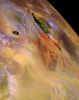
Io-Zal Patera-PIA02527.jpgZal Patera (False Colors; credits: NASA/JPL)61 visitenessun commento
(10 voti)
|
|

Io-Zal Region-PIA02554.jpgZal Region on Io61 visiteThis image shows one of many intriguing mountains on Jupiter's moon Io. The image was made by combining a recent high-resolution, black and white image with earlier low-resolution color data to provide a high-resolution, color view. NASA's Galileo spacecraft took both images.
The 240-kilometer (150-mile) long mountain in the image is south of the volcanic hot spot named Zal. The black and white version of this image was useful for showing the shape of the mountain and the small fans of debris piled against the base of its tall, steep cliffs. However, when colorized the relationship between different types of materials becomes apparent. For example, the bright, red material is believed to contain a compound of sulfur that forms when sulfur is boiled at a high temperature. Active eruptions of molten rock (lava) are the most likely source for the heat. Thus we see red sulfur where lava reaches the surface. Other sulfur compounds cover the yellow areas, and the black areas are fresh silicate lava that has not yet been coated by the yellow sulfurous materials. The green patches are still somewhat mysterious; they appear to form when red sulfur lands on warm lava and the two react in a manner that is still unknown.
In this image, it is clear that the red material has blown out of a long crack along the western side of the mountain. Lava has flowed from this crack and filled a depression (caldera). Some of the red sulfur close to the dark caldera appears to have been converted into green material. The fact that lava comes up along the faults that define the sides of the mountains provides important clues to how the mountains form and the state of the interior of Io. Scientists at the University of Arizona speculate that the formation of the mountains on Io may be related to plumes of hot material rising inside the fiery body of Io.
North is to the top and the setting sun is shining from the west. The image is centered at about 33 degrees north, 72 degrees west. The high-resolution image was taken on February 22, 2000 by NASA's Galileo spacecraft. The image was taken by the Galileo's onboard camera from a range of 33,500 kilometers (20,800 miles) and has a resolution of 335 meters (1,100 feet) per picture element. The color images were taken on July 3, 1999. They have resolutions of 1.3 kilometers (0.81 miles) per picture element and are illuminated from almost directly behind the spacecraft. They were taken at a distance of about 130,000 kilometers(81,000 miles) from Io.
(10 voti)
|
|

ZA-The Men Of Apollo 11-Apollo11-S69-16682.jpgThe Men of Apollo 11202 visiteDa Sn: Aldrin, Armstrong e Collins
(10 voti)
|
|

Quasar 475.jpgHigh Red Shift Quasar 47561 visiteIl secondo è il "Tempo Siderale", il quale è rappresentato dall'angolo orario del punto Gamma.
Esso è essenzialmente "locale" e definisce la posizione della sfera delle stelle in rapporto al meridiano locale di riferimento. Questo tempo serve sostanzialmente a definire l'aspetto del cielo (p.e.: il sorgere ed il tramontare degli astri, la loro altezza ecc.) in un determinato punto del globo.
Il terzo, infine, è il "Tempo Civile", che non è altro che il Tempo Medio aumentato di 12 ore.
(10 voti)
|
|

Quasar 490.jpgHigh Red Shift Quasar 49061 visiteOra, dato che il Sole si sposta fra le stelle in direzione Est di circa 1° al giorno, succede che il ritorno del sole medio e del sole del punto Gamma al meridiano di riferimento, non avviene esattamente nello stesso tempo. Ne consegue una leggera differenza fra Giorno Medio e Giorno Siderale tale per cui il secondo è di circa 4 minuti più corto del primo.
"...Tutto ciò premesso, sapreste dire che ore sono, adesso, ovunque vi troviate, in tutti e tre i Tempi?..."
Il Vostro WebMaster
(10 voti)
|
|

M-042-6.jpgM 42 and M 43 Nebulae in Orionis90 visite"...Vivere est cogitare..."
(Cicerone)
"...Vivere è pensare..."
(10 voti)
|
|

A-The Sun from Spitzer - spicules_sst_big.jpgSun "Spicules" from the Sptizer Space Telescope (SST)139 visiteCaption NASA originale: "Pictured above is perhaps the highest resolution image yet of the enigmatic "Solar Flux Tubes" known as "Spicules". Spicules dot the above frame of solar active region, but they are particularly evident as a carpet of dark tubes on the right. Time-sequenced images have recently shown that spicules "Life-span" is of about 5 minutes, starting out as tall tubes of rapidly rising gas but eventually fading as the gas peaks and falls back down to the Sun".
(10 voti)
|
|

A - Saturn_s sky before the Streak (1).jpgSaturn's Sky just before the "Streak" (1) - N00008768151 visiteOggi, 5 Agosto 2004, inseriamo nella Sezione del Sito Lunar Explorer Italia dedicata a Saturno ed alle sue Lune, una serie di 5 fotogrammi ripresi dalla Sonda Cassini/Huygens che, a nostro parere, rappresenta una prova tangibile della presenza di un Oggetto Volante Non Identificato in transito nello spazio di Saturno.
Si tratta dei frames n. N00008768; N00008769; N00008770; N00008771 ed N00008772.
(10 voti)
|
|
| 25332 immagini su 2111 pagina(e) |
 |
|
|
|
|
131 | |
|
|
|
|





