| Piú votate |
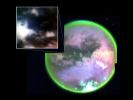
Titan-PIA06983_modest.jpgTitan (false colors) + the Huygens' probe landing site61 visiteCaption NASA originale:"This image taken by Cassini's visual and infrared mapping spectrometer clearly shows surface features on Titan. It is a composite of false-color images taken at three infrared wavelengths: 2 microns (blue); 2.7 microns (red); and 5 microns (green). A methane cloud can be seen at the south pole (top of image). This picture was obtained as Cassini flew by Titan at altitudes ranging from 100.000 to 140.000 Km (88.000 to 63.000 miles), less than two hours before the spacecraft's closest approach. The inset picture shows the landing site of Cassini's piggybacked Huygens probe".
(10 voti)
|
|

VG-Desdemona-V2.jpgDesdemona - Voyager 272 visitenessun commento
(10 voti)
|
|

VF-Cressida, Ophoelia, Portia.jpgCressida, Ophoelia and Portia - Voyager 277 visiteUn piccolissimo commento (forse abbastanza scontato): noi non sappiamo chi, fisicamente, abbia dato i nomi a queste Lune Minori di Urano ma, certamente, si trattava di un appassionato lettore di Sir William Shakespeare.
Non credete?!?...
(10 voti)
|
|

Miranda-V2-PIA01980_modest.jpgMiranda: a funny shaped Moon79 visiteIn questa seconda immagine di Miranda risulta ben visibile una vastissima depressione situata in prossimità del suo Polo Nord la quale potrebbe aver avuto origine a seguito di un impatto con un altro corpo celeste di notevoli dimensioni.
Una luna che ha "sofferto", dunque, e la cui storia risale - molto probabilmente - alle stesse origini del nostro Sistema Solare, quando gli impatti - specie nella sua "periferia" - avvenivano con una frequenza di gran lunga maggiore rispetto a quanto accade ai giorni nostri.
(10 voti)
|
|

Valles_Marineris-MGS.jpgPortion of the Valles Marineris Canyon System (Natural Colors; credits: NASA/MGS/MSSS)92 visitenessun commento
(10 voti)
|
|

Solar Flares.jpgSolar Flares63 visiteCaption NASA originale:"On June, 14th, 1999, SOHO observatory recorded this stunning view of an immense prominence erupting from the Sun's southern latitudes. The false-color image was made in the extreme Ultraviolet light produced by ionized Helium atoms in the solar plasma".
(10 voti)
|
|

Sun & Comet (2).jpgA comet approaching the Sun (from SOHO)66 visiteCaption NASA originale:"SOHO, the space-based SOlar and Heliospheric Observatory, has become by far the reigning champion facility for discovering comets, its total having reached more than 200. As might be expected of a solar observatory, most of the SOHO discovered comets are "sungrazers", such as comets destined to dive within a mere 50.000 Km or so of the solar photosphere.
At that range the intense heat and gravitational forces make it unlikely these primitive chunks of ice and dust will survive".
(10 voti)
|
|

Sun & Comet.jpgA comet approaching the Sun (from SOHO)65 visiteCaption NASA originale:"These 3 frames from SOHO's coronograph were taken two hours apart from each other on April 29, 2000. They show a "sungrazer" (SOHO comet discovery number 111) with a long, bright tail headed toward its fiery encounter.
The Sun itself is hidden behind the coronograph's occulting disk at each frame's upper right".
(10 voti)
|
|
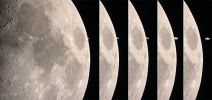
ZV-Moon and Saturn.jpgMoon and Saturn171 visiteCaption NASA originale:"In this sharp sequence of telescopic digital images from the Powell Observatory near Louisburg, Kansas, USA, Saturn is seen reappearing from behind the bright lunar limb over a period of about 2 minutes. The ringed planet emerges above the dark, smooth Lunar Mare Crisium".
(10 voti)
|
|

ZA-Uranus-IP-V2-PIA00346_modest.jpgFarewell Uranus... (1)63 visiteCaption NASA originale:"This image shows a crescent Uranus, a view that Earthlings never witnessed until Voyager 2 flew near and then beyond Uranus on January 24, 1986. The hazy blue-green atmosphere probably extends to a depth of around 5.400 miles, where it rests above what is believed to be an icy or liquid mixture (an 'ocean') of water, ammonia, methane and other volatiles, which in turn surrounds a rocky core, perhaps a little smaller than Earth".
(10 voti)
|
|

M-021-1.jpgM 21 - Open Star Cluster74 visite"L'Infinito e l'Eternità esprimono due delle qualità di Dio. Non possono essere comprese nè discusse: devono essere solo accettate per quello che sono"
P.C. Floegers - "In the Paradox"
(10 voti)
|
|

M-041-1.jpgM 41 - Open Star Cluster80 visite"...Ho analizzato per anni ed in profondità le maggiori forme di comunicazione audio-visuale in uso su questo Pianeta e mi sono convinto che ormai non ha quasi più importanza il valore intrinseco dell'informazione che viene fornita. Ciò che conta, a ben vedere, è il "formato" in cui la si pone. Se poi essa non si presta a "fare spettacolo", viene subito accantonata ed eliminata.
L'Umanità non ha bisogno di essere "informata": ha solo bisogno di essere "intrattenuta"..."
P.C. Floegers - "Conversations"
(10 voti)
|
|
| 25332 immagini su 2111 pagina(e) |
 |
|
|
|
|
130 | |
|
|
|
|





