| Piú votate |

Image027-Heat-Shields.jpgThe "Thing" on Sol 328235 visite(note: this is a translation of the Italian comment to images 1 and 2 herebefore) Watch out: the distance is different, the Martian Days (or Sols) are different, BUT the visual angle the 2 pictures were taken from is THE SAME! So what? So, we're now asking ourselves WHAT HAPPENED to the Opportunity's Heat-Shield in that lap of time running between Sol 104 (when this piece of "Space Junk" looked like a big sparkling stone, partly warped and partly squared - see the previous picture) and Sol 328 (when we "found out" that such a piece of metal was, instead, "round and tapered).
Maybe the "Aliens" - better yet: the Martians! - replaced the original "Made in USA" piece of junk with something else?
Perhaps the 'shooting capacities' of the Rover's cameras changed dramatically?
Or - maybe... - the People of NASA, wisely driven by wise minds, simply ERASED - as long as the Rover was getting closer to what we now believe it was a Surface Anomaly - the original artifact and REPLACED it with a "virtual" Heat-Shield?
(10 voti)
|
|

Image026-Heat-Shields.jpgThe "Thing" on Sol 104242 visitePer chiudere questa repellente farsa, ci sembra giusto citare il commento fatto dal Dr Feltri, Autore di questa eccezionale ricostruzione:"...Vien da ridere a pensare che (i Tecnici NASA del Centro Controllo Missione) si sono fotografati per un mese l'Heat-Shield che avevano nel magazzino sul retro...".
Lunar Explorer Italia si ASSOCIA a quanto detto dal Dr Feltri e si permette una piccolissima aggiunta (a nome del Presidente e di tutti i Soci): a noi viene da ridere per un pò, poi ci viene la nausea a furia di vedere come la NASA e l'Amministrazione Scientifica (??) USA ci stiano prendendo in giro!!! O forse il fatto di raccontare (e di "far vedere"!) tutte queste frottole fa parte del "New Deal" del Signor George W. Bush?!?...
C'è di che riflettere e, soprattutto, c'è di che preoccuparsi... Ma cosa hanno trovato su Marte di così "terribile" che bisogna tener nascosto a tutti i costi? "Alien 5"?!?...
(10 voti)
|
|
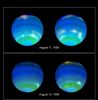
AA-Neptune-HST-PIA01542.jpgThe weather on Neptune - HST57 visite Caption NASA originale:"Using powerful ground and space-based telescopes, scientists have obtained a moving look at some of the wildest, weirdest weather in the Solar System. Combining simultaneous observations of Neptune made by HST and NASA's Infrared Telescope Facility on Mauna Kea, a team of scientists led by Lawrence A. Sromovsky (University of Wisconsin-Madison) has captured the most insightful images to date of a planet whose blustery weather - monster storms and equatorial winds of 900MPH! - bewilders scientists. Blending a series of HST images, Sromovsky's team constructed a time-lapse rotation movie of Neptune, permitting scientists to watch the ebb and flow of the distant planet's weather. And while the observations are helping scientists tease out clues to the planet's stormy weather, they also are deepening some of Neptune's mysteries. The weather on Neptune, is an enygma: the mechanism that drives its near-supersonic winds and giant storms has yet to be discerned! On Earth, weather is driven by energy from the sun as it heats the atmosphere and oceans. On Neptune, the sun is 900 times dimmer and scientists have yet to understand how Neptune's weather-generating machinery can be so efficient".
(10 voti)
|
|
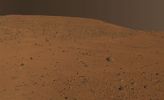
SOL318-325-Husband_Hill-PIA07334_br2-02.jpgColumbia Hills: "Husband Hill's Region" - full 360° panorama (3 - Approximate True Colors; credits: NASA/JPL-Caltech)63 visiteLa prima valutazione negativa su questo frame - e che si può fare anche "ad occhio" guardando la sua versione "BIG" - riguarda il "profilo" del Panorama il quale, come si vede con strabiliante chiarezza, è stato - letteralmente - "ritagliato" (e male).
Nella versione che Vi offriamo sul nostro Sito l'impressione che ricaverete dello "skyline" (impressione che viene esaltata anche operando solo un minimo di ingrandimento) è che esso sia spaventosamente "smeared": cioè opaco, piallato, annebbiato, di poverissima definizione etc.
Il "taglio netto" operato dagli Amici della NASA è visibile anche in versione "modest", ma i "colpi di forbice" (!), nella versione "BIG" del frame, sono evidenti in più di una circostanza...
Domanda: ma perchè è stata fatta questa ridicola mutilazione dell'orizzonte?
(10 voti)
|
|
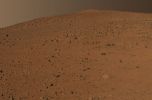
SOL318-325-Husband_Hill-PIA07334_br2-01.jpgColumbia Hills: "Husband Hill's Region" - full 360° panorama (2 - Approximate True Colors; credits: NASA/JPL-Caltech)63 visiteDobbiamo innanzitutto precisare che le nostre valutazioni sono state fatte sul frame "PIA07334-BIG" il quale, almeno in teoria, doveva essere un frame di Elevatissima Qualità ed Altissima Definizione.
Purtroppo quel file - che potete comunque trovare sul Sito NASA "Mars Exploration Rover Mission" - non abbiamo potuto (stanti le sue enormi dimensioni) riportarlo integralmente qui, sul nostro Sito "Lunar Explorer Italia".
Ciò che Vi offriamo è la versione "modest" del frame PIA07334.
Poco male: per verificare le nostre opinioni non dovete fare altro che andare a dare un'occhiata al frame "BIG".
In ogni caso ci teniamo a precisare che i "vizi" del frame PIA07334-modest sono - di fatto - gli STESSI (sebbene in forma più evidente) che potete riscontrare nella sua versione "BIG".
E questa è già una prima stranezza...
(10 voti)
|
|

Comets-Machholz___Meteor.jpgComet Machholz and a "corkscrew" meteor61 visiteCaption NASA originale:"Meteor trains (train--->trajectory) that twist noticeably are rare but have been noted before. The underlying reason for unusual meteors trains is that many meteors are markedly non-spherical in shape and non-uniform in composition. Meteors, usually sand sized grains that originate in comets, will disintegrate as they enter the Earth's atmosphere. Non-uniform meteors may evaporate more on one side than another. This may cause a rotating meteor to wobble slightly in its path, and also to spray fast moving debris in a nearly spiral path. The fast moving meteor debris ionizes molecules in the Earth's atmosphere that subsequently glow when they reacquire elections. Surely no meteor is perfectly uniform and spherical, so that a slight swagger that is below perceptibility is likely typical. Meteors may well have seeded Earth with the prebiotic molecules that allowed for the development of life".
(10 voti)
|
|
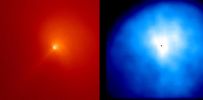
Comets-Comet_Hyakutake-PIA01288_modest.jpgThe "Hyakutake" Comet62 visiteOriginal caption:"These are 2 images of the inner coma of Comet Hyakutake made on April 3 and 4, 1996, using the NASA HST-WFPC2. The 1st one, shown in red, was taken through a narrow-band red filter that shows only sunlight scattered by dust particles in the inner coma of the comet. The 2nd one, shown in blue, was taken with an ultraviolet "Woods" filter image that shows the distribution of scattered ultraviolet radiation from H atoms in the inner coma (the "coma" is the head - or dusty-gas atmosphere - of a comet). The square field of view is 14.000 Km on a side and the Sun is toward the upper right corner of the image. H atoms represent the most abundant gas in the whole coma of the comet. They are produced when solar ultraviolet light breaks up molecules of water, the major constituent of the nucleus of the comet. The inner yellow region near the center of the red dust image is dominated by the contribution from the dust which shows sunward directed spiral jets to the upper right".
(10 voti)
|
|

Craters-Unnamed_Crater_in_Chrise_Planitia-PIA07304.jpgUnnamed Crater in Chrise Planitia (Original NASA/MGS/MSSS b/w Frame)141 visiteCaption NASA originale:"This MGS-MOC image shows an impact crater in Chryse Planitia, not too far from the Viking 1 Lander site, that seems to resemble a bug-eyed head. The 2 odd depressions at the north end of the crater (the "eyes") may have formed by wind or water erosion. This Region has been modified by both processes, with water action occurring in the distant past via floods that poured across western Chryse Planitia from Maja Valles, and wind action common occurrence in more recent history. This crater is located near 22.5°N, 47.9°W". Che dire? Forse gli Alieni (diremmo che in questo caso potrebbe trattarsi dei "Grigi"...) non solo posseggono "tecnologia e senso artistico" ma anche un cospicuo "senso dell'umorismo": solo così, infatti, potremmo spiegare un simile "autoritratto"!
Scherzi a parte, in questo MGS frame è ripresa un'opera della Natura davvero incredibile e che, sicuramente, qualcuno interpreterà alla stregua della "Sfinge di Cydonia".
Naturale o Artificiale? That is the question...
(10 voti)
|
|

SNR-Kepler-PIA06909.jpgKepler's Supernova Remnant75 visite"...Tua res agitur, paries cum proximus ardet..."
(Orazio)
"...Cura (sempre) i tuoi beni, (ma fallo) in particolar modo quando (vedi che) quelli di coloro che ti sono vicini vengono distrutti..."
(10 voti)
|
|

Blobs-PIA07221_modest.jpgGiant Galactic Blobs112 visite"...Non vi è alcun dubbio: coloro che riescono a non pensare al reale significato della propria Esistenza e coloro che non sono capaci di porsi domande sul senso ed il valore della propria e dell'altrui Vita, devono - per forza - essere già morti.
Nessuna Creatura vivente, infatti, può - semplicemente - ignorare il fatto di esistere, di essere parte di una Specie, di possedere un Valore ed una Dignità - al pari di qualsiasi altro Essere - e di avere a propria disposizione un tempo limitato..."
P.C. Floegers - "Conversations"
(10 voti)
|
|

Japetus-PIA07003_modest.jpgJapetus' surface composition (organic material?!?)69 visiteCaption NASA originale:"The polar water ice is relatively dark at this wavelength, so the ice cap is not seen. The next frame shows carbon dioxide on the surface. The carbon dioxide peaks at mid latitudes and shows less strength at the pole and along the equator (the dark band curving near the left edge of the image). The third frame shows the strength of water absorption on Japetus. The brightest regions are due to water ice near the pole. The grayer areas indicate water bound to minerals on the surface. The color composite shows water as blue, carbon dioxide as green, and non-ice minerals as red".
(10 voti)
|
|

APOLLO 15 AS 15 82-11101.jpgAS 15-82-11101 - "Slickensides" rocks (1)981 visiteCross-Sun "before" from the north of the "slickensides" rock. A "slickensides" is a smooth surface created when two rock faces slide across each other.
Noi, dopo aver preso atto di quanto detto in questa caption originale, ci domandiamo "che cosa" possa spingere due rocce a sfregarsi l'una contro l'altra sino a diventare lisce.
Se lo "sfregamento" avviene sulla Luna, poi, la domanda diventa ancora più interessante...
(10 voti)
|
|
| 25332 immagini su 2111 pagina(e) |
 |
|
|
|
|
128 | |
|
|
|
|





