| Piú votate |

004-Mars_Nomenclature.jpgMars Global Map: Main Albedo Features and Nomenclature131 visitenessun commento
(10 voti)
|
|

M-042-3.jpgBarnard's Loop around Orion - "Orion's Belt Nebula"97 visite"Death cancels everything, but Truth; and strips a man of everything, but Genius and Vertue".
William Hazlitt
(10 voti)
|
|

Comets-Halley-30155.jpgThe Halley Comet, from Giotto63 visiteCaption ESA originale:"A composite image of the nucleus of comet Halley. This image is composed of 68 images of varying resolution. The data at the brightest point on the nucleus is at the highest resolution (50 m).
The Sun comes from 30° above the horizontal to the left and is 17° behind the image plane (observation phase angle of 107°). The night side of the nucleus can be seen silhouetted against a background of bright dust in the far-field. Jets can be seen originating from 2 regions on the nucleus. Structure can be seen within the jets. A bright area is seen within the night side of the nucleus. We believe this to be a hill or mountain approximately 500 mt high. Other surface details can be seen in the illuminated region".
(10 voti)
|
|

NGC-6751_-_HST.jpgNGC 6751 - Planetary Nebula in Aquila105 visite"Fortuna opes auferre, non animum potest"
(Seneca)
"Il Destino può portare via le ricchezze tangibili, non l'anima"
(10 voti)
|
|

Image030-93019302-3d1-2-red.jpgBlue Flares and the Invisible Crater: the "Third Frame" (3D)197 visitePurtroppo, però, mi sono bloccato subito per 2 motivi fondamentali: il primo è evidente in questo montaggio 3D della terza foto in cui si nota che il bagliore azzurro è (sembra essere) sulla verticale di un versante scosceso invisibile da questa angolazione e di cui non possediamo immagine alcuna - sebbene l’astronauta visibile al centro dell'immagine pare che stia fotografando a tutto spiano! Il secondo motivo - più generale - si riferisce al fatto che, a mio avviso, quasi tutte le foto delle missioni Apollo sono state pesantemente manipolate o sono (addirittura) false, con alcune eccezioni riguardanti dettagli insignificanti o immagini molto ravvicinate di campioni geologici (frames classificati sotto la denominazione "samples").
Come sempre, poi, la fantasia censoria degli "Scienziati" di Pasadena si è scatenata nelle visioni panoramiche, dove la linea dell’orizzonte (teoricamente) visibile viene artificiosamente abbassata così da NON far vedere qualunque cosa che sia più alta di 20 cm...
(10 voti)
|
|

Mathilde-PIA02479.jpgMathilde74 visiteCaption NASA originale:"Two different views of asteroid 253 Mathilde were obtained by the NEAR spacecraft on June 27, 1997. The image at left was obtained as the spacecraft approached Mathilde with its camera pointed near the direction of the Sun; only a few of the prominent ridges on Mathilde are illuminated. The visible area at left is 29 Km (approx. 18 miles) high and the phase angle (the angle from Sun-Mathilde spacecraft) is 136°. As the spacecraft receded from Mathilde, it observed the asteroid (about 60 Km - or 38 miles across) almost fully lit by the Sun at a phase angle of 43° (right image). Mathilde's irregular shape results from a long history of severe collisions with smaller asteroids. The largest visible crater is about 30 Km (19 miles) in diameter".
(10 voti)
|
|

Mathilde-PIA02494.jpgMathilde and Eros: C-Type and S-Type61 visiteCaption NASA originale:"In this montage, Mathilde (at left) and Eros (at right) are shown at the same scale, as they were imaged by NEAR Shoemaker from about 1.800 Km on June 27, 1997, and February 12, 2000, respectively. Mathilde is 56 Km across and Eros is 33 Km long and 13 Km wide. However, Mathilde's brightness is greatly exaggerated for viewing purposes - it's actually 6 times darker than Eros, with about the same reflectivity as soot! In a scheme that reflects how asteroids have historically been a topic for astronomy, not geology, they are classified into groups based on their colors as observed through telescopes. The 2 major classes of asteroids are called S-Types and C-Types. S-Types, whose colors are consistent with "stony" or rocky compositions, prevail among asteroids that orbit closer to the Sun than the mid-point of the asteroid belt. Eros and the 2 asteroids encountered briefly by the Galileo spacecraft on its way to Jupiter - Gaspra and Ida - are all S-Types. C-Types like Mathilde have a dark gray color consistent with a "carbonaceous" composition, rich in carbon compounds and other dark materials. They prevail in the outer part of the asteroid belt".
(10 voti)
|
|

Miranda-PIA00140.jpgMiranda, from approx. 31.000 Km76 visiteCaption NASA originale:"This Voyager 2 image of Miranda was taken Jan 24, 1986, from a distance of about 31.000 Km (19.000 miles), shortly before the spacecraft's closest approach to the Uranian moon. The HR of 600 meters (2.000 feet) reveals a bewildering variety of fractures, grooves and craters, as well as features of different albedos (reflectancea). This clear-filter, narrow-angle view encompasses areas of older, heavily cratered terrain with a wide variety of forms. The grooves and troughs reach depths of a few Km (or miles) and expose materials of different albedos. The great variety of directions of fractures and troughs, and the different densities of impact craters on them, signify a long, complex geologic evolution of this satellite".
(10 voti)
|
|

OPP-SOL004-1F128540990EDN0205P1001R0M1.jpgEagle Crater on Sol 4103 visiteSperiamo di fare cosa gradita comunicandoVi l'indirizzo http dove potrete leggere le istruzioni per "decodificare" l'ID number dei frames di Spirit ed Opportunity:
"http://marsrovers.jpl.nasa.gov/gallery/edr_filename_key.html"
(10 voti)
|
|

ZZ-Sun Halo.jpgA Sun "Halo" in Tennessee81 visiteDal "NASA - Picture of the Day" del 9 Marzo 2005:"Sometimes it looks like the Sun is being viewed through a large lens. In the above case there are actually millions of lenses: ice crystals. As water freezes in the upper atmosphere, small, flat, six-sided, ice crystals might be formed. As these crystals flutter down, much time is spent with their faces flat, parallel to the ground. An observer may pass through the same plane as many of the falling ice crystals near sunrise or sunset. During this alignment, each crystal can act like a miniature lens, refracting sunlight into our view. Dramatically visible behind neighborhood houses and trees and above the cloud deck is the 22° halo created by sunlight reflecting off of atmospheric ice crystals".
L'alone è spiegato in modo preciso ed accurato, ma esso non è l'unico fenomeno visibile in questa foto: alla Vostra Sx si vedono - e bene! - 2 scie chimiche. E quelle come le spieghiamo? Vapori e cristalli?!?
(10 voti)
|
|
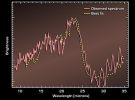
Graph-PIA07395.jpgLooking back...118 visiteThis graph, or spectrum, shows the light from a dusty, distant galaxy (invisible to optical telescopes) that is located 11 BLY away. NASA's SST was able to capture the light from it by using heat-seeking infrared eyes. Spectra are created when a spectrograph spreads light out into its basic parts, like a prism turning sunlight into a rainbow. The spectra contain the signatures of molecules that contribute to an object's light. In this case, the galaxy's spectrum reveals the fingerprint for silicate dust (large dip at right), a planetary building block like sand, only smaller. This particular fingerprint is important because it helps to determine how far away the galaxy lies as well as how much the galaxy's light had stretched ("redshifted") during its journey to SST's eyes. Because the universe is expanding, a galaxy's light will shift toward reddish wavelengths as it moves away from us. This galaxy has a redshift of 1,95, meaning that its light travelled for 11 BY before 'hitting" SST's eyes. The presence of the silicate fingerprint is also significant because it implies that galaxies were ripe for planetary formation 11 billion years ago - back to a time when the universe was 3 billion years old. The universe is currently believed to be 13.5 billion years old. This is the furthest back in time that silicate dust has been detected around a galaxy.
(10 voti)
|
|

Image028-Heat-Shields.jpgOnce again, the whole "scene"...220 visiteVirtual? Maybe what we saw was just a defective (or used for testing) Heat-Shield that was stored in one of Cape Canaveral's warehouses... Anyway, while putting the word "END" to this ridiculous farce, we wish to quote the snide comment of Dr A. Feltri, Author of this outstanding reconstruction of events:"...It makes me laugh when I think that (the Technicians of NASA's Mission Control) took nice pictures - for a month or so - of the old Heat-Shield they kept in their junkyard...".
LUN-EX-IT agrees with what Dr Feltri said and we also wish to make a small addition (on behalf of the President and Members): yes, we do laugh for a while, but then we become nauseated by watching how both NASA and the American Science Adm.n are trying to fool us. ALL OF US!
Unless... Unless this habit of telling (and SHOWING!) a bunch of BBS about Mars is just a very clever part of the "New Deal" created by Mr George W. Bush?!?...
No jokes: we are worried.
What did they find on Mars? "ALIEN 5", maybe?!?...
(10 voti)
|
|
| 25332 immagini su 2111 pagina(e) |
 |
|
|
|
|
127 | |
|
|
|
|





