| Piú votate |

Tempel1-ZZ-ZI.jpgA few seconds before the "Space-Fireworks"60 visiteDa "NASA - Picture of the Day" del 15 Settembre 2005:"Approaching the nucleus of comet Tempel 1 at 10 Km/sec., the Deep Impact probe's targeting camera recorded a truly dramatic series of images. Successive pictures improve in resolution and have been composited here at a scale of 5 mt per pixel - including images taken within a few meters of the surface moments before the July 4th impact. Analyzing the resulting cloud of debris, researchers are directly exploring the makeup of a comet, a primordial chunk of Solar System material. Described as a recipe for primordial soup, the list of Tempel 1's ingredients - tiny grains of silicates, iron compounds, complex hydrocarbons and clay and carbonates thought to require liquid water to form - might be more appropriate for a cosmic souffle, as the nucleus is apparently porous and fluffy.
Seen here, Tempel 1's nucleus is about 5 Km long, with the impact site between the two large craters near the bottom".
(10 voti)
|
|

NGC-0520-1.jpgNGC 520 alias Arp 157 - Colliding Galaxies62 visite"...Sic luceat Lux..."
(anonimo)
"...Così splenda la Luce..."
(10 voti)
|
|
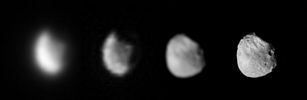
SOL594-phobos_stack_and_sim-A585R1_br.jpgPhobos from Spirit and Mars Express68 visiteTaking advantage of extra solar energy collected during the day, Spirit settled in for an evening of stargazing, photographing Deimos and Phobos. The first 2 images in this sequence show gradual enhancements in the surface detail of Mars' largest moon, Phobos, made possible through a combination technique known as stacking. In stacking scientists use a mathematical process known as Laplacian sharpening to reinforce features that appear consistently in repetitive images and minimize features that show up only intermittently. In this view of Phobos, the large crater named Stickney is just out of sight on the Moon's upper right limb.
Spirit acquired the first 2 images with the PanCam on the night of Sol 585 (Aug. 26, 2005). The far right image of Phobos, for comparison, was taken by the HR Stereo Camera on Mars Express. The third image in this sequence was derived from the far right image by making it blurrier for comparison with the panoramic camera images to the left. More information about the Mars Express image is available at http://www.esa.int/SPECIALS/Mars_Express/SEM21TVJD1E_1.html
(10 voti)
|
|
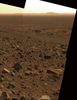
SOL519-Husband5-PIA04180.jpgLooking at Husband's Summit - Sol 519 (Natural Colors; credits: NASA/JPL-Caltech)76 visiteEd ecco, così come accennavamo in sede di commento al sub-frame precedente, l'accecante biancore che, unito alla nebbiolina Marziana, copre, in parte, i rilievi più lontani di Gusev Crater e conferisce a questa visione un quid di vagamente 'familiare'.
Una bella immagine, ripetiamo, decisamente (ed almeno in accordo ai nostri mezzi ed alle nostre competenze ed esperienze) più realistica di quelle - svariate - ricostruzioni in pseudo-colori-quasi-veri che hanno caratterizzato le produzioni NASA degli ultimi mesi.
(10 voti)
|
|
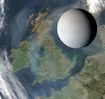
Enceladus-PIA07724.jpgEnceladus, Great Britain and Northern France124 visiteSaturn's moon Enceladus is only 505 Km (approx. 314 miles) across, small enough to fit within the length of the United Kingdom, as illustrated here. The intriguing icy moon also could fit comfortably within Arizona or Colorado.
(10 voti)
|
|

RingsStructure-2-PIA03550.jpgThe "Rings' Structure"59 visiteSaturn's Rings make up an enormous, complex structure. From edge-to-edge, the Ring System would not even fit in the distance between Earth and the Moon. The 7 main rings are labeled in the order in which they were discovered. From the planet outward, they are D, C, B, A, F, G and E. The D-Ring is very faint and closest to Saturn. The main Rings are A, B and C. The outermost Ring, easily seen with Earth-based telescopes, is the A-Ring. The Cassini Division is the largest gap in the Rings and separates the B from the A-Ring. Just outside the A-Ring is the narrow F-Ring, shepherded by tiny moons Pandora and Prometheus. Beyond that are 2 much fainter Rings named G and E. Saturn's diffuse E-Ring is the largest planetary ring in our Solar System, extending from Mimas' orbit to Titan's orbit, about 1 MKM.
The particles in Saturn's rings are composed primarily of water ice and range in size from microns to tens of meters. The rings show a tremendous amount of structure on all scales; some of this structure is related to gravitational interactions with Saturn's many moons, but much of it remains unexplained. One moonlet, Pan, actually orbits inside the A ring in a 330-kilometer-wide (200-mile) gap called the Encke Gap. The main rings (A, B and C) are less than 100 meters (300 feet) thick in most places, compared to their radial extent of 62,120 kilometers (38,600 miles). The main rings are much younger than the age of the solar system, perhaps only a few hundred million years old. They may have formed from the breakup of one of Saturn's moons or from a comet or meteor that was torn apart by Saturn's gravity.
(10 voti)
|
|

Pandora-PIA07570.jpgPandora, from 1,3 MKM58 visiteWhile close to Saturn in its orbit, Cassini stared directly at the Planet to find Saturn's moon Pandora in the field of view. The F-Ring shepherd moon is gliding towards the right in this scene. The F-Ring is thinly visible just above the main rings. Pandora is 84 Km (about 52 miles) across.
Near the lower left, some variation in the height of Saturn's cloud tops can be detected. This effect is often visible near the terminator (such as the day and night boundary), where the Sun is at a very low angle above Saturn's horizon.
The image was taken in visible light with the Cassini spacecraft narrow-angle camera on July 16, 2005, at a distance of approx. 1,3 MKM (about 800.000 miles) from Saturn.
The image scale is about 8 Km (about 5 miles) per pixel on Saturn and about 6 Km (about 4 miles) per pixel on Pandora.
(10 voti)
|
|

NGC-4625-PIA03540.jpgNGC 4625 and 4618 - Interacting Galaxies63 visite"...Quando avrò perso la capacità di sorprendermi, avrò anche perso la capacità di imparare..."
P.C. Floegers - "Conversations"
(10 voti)
|
|

ZZ-ZZ-ZZ-Venus, Mercury and Saturn.jpgVenus, Mercury and Saturn from Cerro Paranal (Chile)81 visiteDa "NASA - Picture of the Day" del 17 Agosto 2005:"Very bright planets and very large telescopes are part of this sunset view of Paranal Observatory. The observatory's four, massive 8,2 meter telescope units are situated on top of the 2.600 meter high mountain, Cerro Paranal, in the dry Atacama Desert in northern Chile. The individual unit telescopes can be used separately or in combination and are named Antu, Kueyen, Melipal and Yepun. Together they are fittingly known as the European Southern Observatory's Very Large Telescope. Of course, the very bright planets are Venus (near center), joined by Mercury (below) and Saturn (left) in late June's western evening skies".
(10 voti)
|
|

Saturn-PIA07563.jpgSaturn or Van Gogh?58 visiteSaturn's turbulent atmosphere is reminiscent of a Van Gogh painting in this view. However, unlike the famous impressionist painter, Cassini records the world precisely as it appears to the spacecraft's cameras.
The feathery band that cuts across from the upper left corner to the right side of this scene has a chevron, or arrow, shape near the right. The center of the chevron is located at the latitude (about 28° South) of an eastward-flowing zonal jet in the atmosphere. Counter-flowing eastward and westward jets are the dominant dynamic features seen in the giant planet atmospheres. A chevron-shaped feature with the tip pointed East means that this is a local maximum in the eastward wind and a region of horizontal wind shear where clouds to the North and South of the jet are being swept back by the slower currents on the sides of the jet.
The image was taken in visible light with the Cassini spacecraft narrow-angle camera on July 6, 2005, at a distance of approx. 2,5 MKM from Saturn using a filter sensitive to wavelengths of infrared light centered at 727 nanometers. The image scale is 14 kilometers (9 miles) per pixel.
(10 voti)
|
|

M-042-8.jpgM 42 - extra detail mgnf68 visite"...Optat ephippia bos, piger optat arare caballus;
Quam scit uterque coli, libens, censebo, exerceat artem..."
(Orazio)
"...Il bue vorrebbe avere una sella (mentre) il cavallo pigro vorrebbe arare, ma la realtà è che ognuno dovrebbe svolgere il lavoro che meglio conosce..."
(10 voti)
|
|
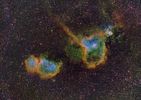
IC-1805-1.jpgIC 180573 visite"...Quos vult perdere, Iupiter dementat prius..."
(ignoto)
"...Dio rende per prima cosa folli coloro dei quali si vuol disfare..."
Nota: sentenza usata per indicare coloro che, testardi sino alla follia, perseguono la propria rovina disprezzando od ignorando i consigli che vengono loro dati.
(10 voti)
|
|
| 25332 immagini su 2111 pagina(e) |
 |
|
|
|
|
124 | |
|
|
|
|





