| Piú votate |

Itokawa-05.jpgOrbiting around Itokawa (2)69 visiteHayabusa is a technology demonstration spacecraft focusing on key technologies that are required for future large-scale sample and return missions, yet is also making new scientific observations and discoveries. The technology demonstration component of the mission consists of 5 goals:
1) ion engine propulsion in interplanetary cruise;
2) ion engine propulsion in combination with an Earth gravity assist;
3) autonomous guidance and navigation using optical measurements;
4) collection of surface samples in an ultra-low gravity environment and
5) the direct recovery of these samples on the ground after its return from interplanetary flight.
To date the Hayabusa project has accomplished these demonstrations up through
the third goal.
(10 voti)
|
|

Itokawa~0.jpgClosing on Itokawa61 visiteItokawa: un asteroide che sembra contraddire tutto quanto viene dato per acquisito nel campo delle forme esteriori e dei rilievi superficiali dei corpi (teoricamente) esposti a pesantissimi azioni di impatto sin dagli albori della loro esistenza. Pensate a 433-Eros, oppure a Ceres, o Dactyl o a qualsiasi altro corpo similare che abbiamo avuto occasione di vedere da distanza ravvicinata. Forse il solo asteroide AnneFrank non sembra presentare una particolare craterizzazione (ma le immagini, di cattiva qualità, non possono essere considerate definitorie) e quindi si viene a porre nel novero delle rarità. Tuttavia, quello che vediamo adesso, è ben più che un'eccezione e molto di più di un'Anomalìa: Itokawa NON ha alcun cratere superficiale visibile e le sue forme, spigolose ed a tratti aguzze, costituiscono una novità assoluta per i Ricercatori e gli Studiosi di Scienze Planetarie.
Original caption:"Where are the craters on asteroid Itokawa? No one knows. The Japanese robot probe Hayabusa recently approached the Earth-crossing asteroid and is returning pictures showing a surface unlike any other Solar System body yet photographed -- a surface possibly devoid of craters. One possibility for the lack of common circular indentations is that asteroid Itokawa is a rubble pile -- a bunch of rocks and ice chunks only loosely held together by a small amount of gravity. If so, craters might be filled in whenever the asteroid gets jiggled by a passing planet -- Earth in this case. Alternatively, surface particles may become electrically charged by the Sun, levitate in the microgravity field, and move to fill in craters. Over the weekend, Hayabusa lowered itself to the surface of the strange asteroid in an effort to study the unusual body and collect surface samples that could be returned to Earth in 2007".
(10 voti)
|
|

Pandora-PIA07632.jpgBeautiful Pandora (false colors)92 visiteCassini's best close-up view of Saturn's F-Ring shepherd moon, Pandora, shows that this small ring-moon is coated in fine dust-sized icy material.
Craters formed on this object by impacts appear to be covered by debris, a process that probably happens rapidly in a geologic sense. The grooves and small ridges on Pandora suggest that fractures affect the overlying smooth material. The crisp craters on another Saturn moon, Hyperion, provide a contrasting example of craters on a small object.
Cassini acquired infrared, green and ultraviolet images on Sept. 5, 2005, which were combined to create this false-color view. The image was taken with the Cassini spacecraft narrow-angle camera at a distance of approx. 52.000 Km from Pandora and at a phase angle of 54°. Resolution in the original image was about 300 mt per pixel".
Nota: un'immagine stupenda e spettacolare e poi, per i più attenti, come non notare l'incredibile somiglianza (troppo grande per essere casuale...) di questa luna con Phobos?
(10 voti)
|
|
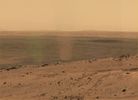
SOL621-6-Everest_L257atc-A622R1.jpgFragments of a "strange" Panorama - Sol 621112 visite...non fosse, allora verrebbe meno quel "quid unicum" che molte Religioni attribuiscono all'uomo e, di conseguenza, verrebbe meno anche una delle fondamenta su cui molte Religioni si reggono. Ma noi sappiamo pure che in molti sanno che la presunta "Unicità dell'uomo" è una paurosa e pretenziosa assurdità che trova la sua origine nella nostra incapacità di accettare - se non addirittura di capire - che nell'Universo non c'è nulla di veramente unico (in un senso "morale" del termine) e che, al tempo stesso, tutto è unico (nel senso di "irripetibile").
Che dite? Può essere che il cover up nasca pure - ed almeno in parte - dalla necessità di mantenere l'Umanità (relativamente) "tranquilla", nella sua pretesa di "cosmica unicità"?
Si tratta, ovviamente, di un tema molto spinoso e molto problematico sul quale ci piacerebbe avere qualche Vostra impressione, se volete...
(10 voti)
|
|

Kuiper_s Belt.jpgRelationship of the Kuiper's Belt to the Oort's Cloud84 visiteThis illustration shows that the Kuiper Belt is shaped like a disk (see inset diagram) and resides within the shell-like structure of the Oort Cloud. Located on the outskirts of the Solar System, the Kuiper Belt is a "junkyard" of countless icy bodies left over from the Solar System's formation. The Oort Cloud is a vast shell of billions of comets.
The inset diagram compares Pluto's orbit with a Kuiper Belt binary object called 1998 WW31. The Kuiper Belt [the fuzzy disk] extends from inside Pluto's orbit to the edge of the Solar System.
(10 voti)
|
|

ZU-2005-19-b-large_web.jpgPluto's System: the best images so far (2)59 visiteSemplifichiamo: la nostra speculazione dice che i due nuovi corpi (che chiameremo P1 e P2) NON orbitano attorno a Plutone in un rapporto riconducibile al modello classico "Satellite:Parent Planet", bensì costituiscono un Sistema Binario Indipendente il quale si trova in - semplice - equilibrio gravitazionale rispetto ad un altro Sistema Indipendente.
Le prove di una simile (azzardata, ma affascinante) costruzione, le potremmo trovare solo studiando in maniera ultra-dettagliata i movimenti di P1 e P2 rispetto a Plutone e Caronte. Movimenti che, se la nostra speculazione fosse corretta, configurerebbero percorsi orbitali - dal nostro punto di vista - "completamente anomali" e riassumibili in questo schema logico:
Plutone è Parent Planet di Caronte e SOLO di Caronte il quale gli orbita attorno assecondando un'orbita circolare; P1 e P2, invece, si muovono armonicamente l'uno rispetto all'altro e, nel farlo, "orbitano" (in senso ampio) attorno al Sistema Plutone-Caronte (che diventa "Parent System").
(10 voti)
|
|

ZE-Pluto-fict-map.jpgFictional Map of Pluto93 visiteLa superficie di Plutone - così ben dettagliata - è frutto dell'immaginazione dell'Artista; altrettanto, invece, non si può dire del colore del paesaggio il quale - a quanto ci è stato detto - è coerente con quanto pensano gli Scienziati che hanno osservato e fotografato Plutone usando le spettacolari ottiche dell'HST, nonchè le tecniche di ripresa maggiormente efficaci ed all'avanguardia. Le stesse tecniche, guarda caso, che ci permettono di dire che la superficie della lontanissima Sedna è rossiccia, ma che non risultano adeguate a chiarire il mistero dei "colori" del vicino - in tutti i sensi - Marte.
Curioso, non credete?!?
(10 voti)
|
|

SOL643-2P183484842EFFAI38P2734L1M1.jpgA "streak" in the Martian Sky - Sol 64394 visiteUna "striscia" di luce decisamente lunga illumina il cielo notturno di Marte: sono appena passate le 22 MLT quando questo interessante fenomeno viene ripreso dalla Left PanCam di Spirit. Voi penserete che si tratta di uno dei 'soliti' raggi cosmici, magari un pò più intenso del solito, ma la realtà, a nostro parere, è che questa traccia appartiene ad un oggetto volante in movimento. Le strisce lasciate dai raggi cosmici - almeno sino ad ora - sono molto più brevi e meno intense (verificate Voi stessi: abbiamo svariati esempi di questo tipo di anomalìa nei nostri archivi).
In questo caso specifico, invece, la scia che appare nel cielo di Marte è identica a quella che caratterizza i Satelliti Iridium i quali, mentre ruotano su loro stessi, sembrano variare di luminosità ed emettere una sorta di flash (causato dai raggi del Sole che si riflettono sui loro pannelli). Se riuscite a "cogliere il momento" del flash ed a fotografarli, sulla foto che avrete ottenuto ci sarà una traccia IDENTICA a questa. Provate...
(10 voti)
|
|
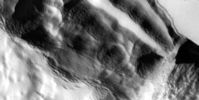
Io-PIA02597.jpgTelegonus Mensa in HR60 visiteA cliff slumps outward in these HR view that NASA's Galileo spacecraft captured of the edge of a mountain named Telegonus Mensa on Jupiter's moon Io. When Galileo flew near the South Pole of Io in October 2001, scientist's targeted this cliff to study the process of erosion. Water and wind cause most erosion on Earth, but Io has neither surface water nor atmosphere. The cliff is slumping due to gravity (?). The picture has a resolution of about 10 mt (33 feet) per picture element. Galileo's camera took it from a distance of about 1000 Km (about 620 miles). North is to the top and the Sun illuminates the surface from the upper right.
(10 voti)
|
|

Io-PIA01070.jpgAs Time Goes By...On Io! (1)62 visiteDetail of changes on Jupiter's moon Io in the Region around Volund as seen by the Voyager 1 spacecraft in April 1979 (left frame) and NASA's Galileo spacecraft in September 1996 (right frame). North is to the top of both frames which are approx. 600 by 600 Km. Note the new linear feature, which may be a volcanic fissure, trending east from the southern end of Volund. Dark diffuse material lies to the west and a ring of bright material which may be SO2- rich plume deposits appears to be centered near the middle of the new linear feature.
(10 voti)
|
|

Io-GalaiPatera-PIA00324.jpgGalai Patera60 visiteIo's volcanic plains are shown in this Voyager 1 image, which spans an area about 1030 km (640 miles) from left to right. North is about the 1:30 position. Numerous volcanic calderas and lava flows are visible here. The brown teardrop-shaped feature at left center is Galai Patera, a 100-km-long (62 mi) lava-flooded caldera (collapsed vent) of a volcano. The composition of Io's volcanic plains and lava flows has not been determined. The prevalent yellow, brown, and orange material may consist dominantly of sulfur with surface frosts of sulfur dioxide or of silicates (such as basalt) encrusted with sulfur and sulfur dioxide condensates. The whitish patches probably are freshly deposited SO2 frost.
(10 voti)
|
|

Io-LokiPatera-PIA00320.jpgLoki patera: an everlasting eruption...61 visiteA huge area of Io's volcanic plains is shown in this Voyager 1 image mosaic. Numerous volcanic calderas and lava flows are visible here. Loki Patera, an active lava lake, is the large shield-shaped black feature. Heat emitted from Loki can be seen through telescopes all the way from Earth. These telescopic observations tell us that Loki has been active continuously (or at least every time astronomers have looked) since the Voyager 1 flyby in March 1979. The composition of Io's volcanic plains and lava flows has not been determined, but they could consist dominantly of Sulphur (S) with surface frosts of S dioxide or of silicates (such as basalts) encrusted with S and S dioxide condensates. The bright whitish patches probably consist of freshly deposited SO2 frost. The black spots, including Loki, are probably hot sulfur lava, which may remain molten by intrusions of molten silicate magma, coming up from deeper within Io. The ultimate source of heat that keeps Io active is tidal frictional heating due to the continual flexure of Io by the gravity of Jupiter and Europa, another of Jupiter's satellites.
(10 voti)
|
|
| 25332 immagini su 2111 pagina(e) |
 |
|
|
|
|
122 | |
|
|
|
|





