| Piú votate - The Clementine Files |

023-The Moon from Clem-SchroendingerBasin.jpg045 - Schroedinger Basin (detail mgnf)66 visiteDetail from the UV-VIS Clementine Camera of the floor of the basin Schrodinger, showing the coverage (inset strip) of the HR camera for comparison. The Dark Halo Crater (center at 76° South Lat. and 139° East Long.; 5 Km across) is a volcanic vent that erupted ash during the period of mare volcanism on the Moon, more than 3,5 BY ago.
(5 voti)
|
|

029-The Moon from Clem-OrientaleBasin.jpg070 - The "Orientale" basin71 visiteMosaic of more than 2000 Clementine (750-nanometers) images, showing the Orientale Basin of the Moon at full resolution of about 250 mt per pixel. The Orientale Basin is about 930 Km in diameter and is only partly filled by dark, mare lava.
The relative paucity of mare basalt fill, coupled with the young age and topographic freshness of the basin, makes this feature the archetypal lunar multiring basin.
(5 voti)
|
|

ZZ-Southside-Clem.jpg011 - The Southern Side of the Moon64 visitenessun commento
(4 voti)
|
|

ChantCrater-UVVIS.jpg170 - Chant Crater67 visitenessun commento
(4 voti)
|
|

ZZ-Farside-Clem.jpg008 - Far-Side Map78 visitenessun commento
(4 voti)
|
|

Antoniadi-UVVis.jpg160 - Antoniadi Crater74 visitenessun commento
(4 voti)
|
|

Copernicus-UVVis.jpg050 - Copernicus64 visitenessun commento
(4 voti)
|
|

LNF60405.gif173 - Chant Crater62 visitenessun commento
(4 voti)
|
|

kepler-multispectral.jpg153 - Kepler Crater (multispectral image)73 visitenessun commento
(4 voti)
|
|

Copernicus Crater.JPG053 - Copernicus Crater (mosaic)72 visiteMosaic of the lunar crater Copernicus produced using images obtained by the Clementine UV/VIS camera. This 95-km crater, believed to be approximately 800 million years old, is located near the center of the lunar nearside and exhibits prominent rays extending in all directions. The right section of the image is a color composite mosaic of the eastern half of Copernicus. This color mosaic was prepared using images obtained through filters of three different colors chosen to allow small lunar color differences to be mapped in a geologic context. In this image, the color assignments are: red (750/415 nm), green ( 750/950 nm), and blue (415/750 nm). The left section of the image is a mosaic of the same area prepared using frames obtained through a single filter (750 nm). This mosaic is displayed as a mirror image to the color composite to allow easy comparison of geologic features and their color.
Extensive large- and small-scale heterogeneity of materials excavated by this large crater is readily evident from the color composite mosaic. Bright blue tones typically suggest fresh material similar to Apollo 16 rocks and breccias, mottled red-orange tones indicate material similar to Apollo 16 soils, vivid red is associated with deposits of impact melt (seen most prominently in the northwestern part of the crater floor), and green-yellow tones along the southern wall imply a higher abundance of iron-bearing materials.
Impact craters can be used as windows into the interior and this multispectral image of Copernicus provides dramatic new information about how materials are excavated, melted, mixed, and deposited in a major impact event. The extensive heterogeneity around the wall of the crater indicates materials are not intimately mixed in spite of the huge energy involved during crater formation. Similarly, impact melt (target rock melted during the impact event) is not distributed uniformly, but can be seen to be concentrated in large sections of the floor and in small areas along ledges of the walls.
(4 voti)
|
|

Plato Crater.JPG091 - Plato Crater72 visitePlato crater imaged by the UV/VIS camera at 1 micron, from an altitude of about 485 Km.
Plato is situated at 51° North Lat. and 9° West Long.; North is up. The strip width of this mosaic is about 90 Km.
The smallest craters visible are roughly 600 meters across.
(4 voti)
|
|
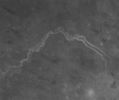
033-The Moon from Clem-Aristarchus-3.jpg041 - Aristarchus and Vallis Schroteri72 visiteThe plateau of the Aristarchus Crater has experienced intense volcanic activity, both effusive and explosive.
It includes the densest concentration of Lunar "sinuous rilles" ("snake-like" valleys) including the largest known, Vallis Schroteri, which is about 160 km long, up to 11 km wide and 1 km deep.
The rilles in this area begin at cobra-head craters, which are the apparent vents for a dark mantling deposit covering the plateau and nearby areas to the North and East.
(4 voti)
|
|
| 81 immagini su 7 pagina(e) |
 |
|
|
5 | |
|





