| Piú votate - The Clementine Files |

NorthPoleoftheMoon.JPG114 - North Polar Region (in natural colors)64 visitenessun commento
(6 voti)
|
|

Erathostenes.jpg221 - Wallace and Erathostenes "A" and "B"66 visitenessun commento
(6 voti)
|
|

LNA60408.gif172 - Chant Crater63 visitenessun commento
(6 voti)
|
|

LUB20245.gif187 - Rydberg Crater and surroundings63 visitenessun commento
(6 voti)
|
|

OrientaleBasin&SC~0.JPG027 - Earthshine and Solar Corona over the Orientale Basin74 visiteThis fantastic view of the Moon was acquired by the Attitude Determination Camera (Startracker) on board Clementine.
The Moon is illuminated only by Earthshine - that is, sunlight reflected from the Earth to the Moon.
The Sun is actually behind the Moon, though the outer portion of the Sun, the Solar Corona, is visible over the limb.
The ringed basin disappearing into the darkness is the Orientale Basin.
deep shadows cast by its steep walls give a dramatic emphasis to its classic multi-ring morphology.
(6 voti)
|
|

NorthPoleoftheMoon.JPG114 - North Polar Region61 visiteThis shows a 630-Km long mosaic of the Northern Polar Region along the 180° West Longitude line from 69° to 90° North Latitude.
Imaged by the UV/VIS camera.
(6 voti)
|
|

Moon-Clem.JPG015 - The Moon (visible and near-infrared)62 visiteOne of the major scientific goals of the Clementine mission is to map the Moon in 11 different wavelengths in the visible and near-infrared parts of the spectrum. The filter colors of the Clementine cameras were carefully chosen to differentiate types of lunar surface material. In our first look at the global color, each Clementine image made by the UV/VIS camera has been reduced to its average value, producing a picture of the Moon at low resolution (about 50 kilometers per pixel). These pictures show the albedo (brightness) and color of the Moon from three aspects: the Earth-centered view (near side) with a 0 degree central longitude, and two far side views with 120 degrees East and 120 degrees West central longitudes. These images have been made by assigning colors to the relative reflectance values obtained through various filters, resulting in a map showing the compositional variation of the Moon.
Major compositional provinces in the highlands are evident. The large dark red-gray region on the far side is the South Pole-Aitken basin, an ancient impact feature that apparently contains rocks of distinct composition. A newly discovered compositional anomaly on the east limb of the Moon (pink area near center of 120 degrees East image) may be related to ancient flows of lava. The color picture shows that very high titanium lavas (deep blue and cyan colors) appear to be largely confined to the Oceanus Procellarum, Mare Imbrium, and Mare Tranquillitatis areas (near side). These views of the Moon in three colors only hint at the scientific richness contained within the Clementine global data, which will be investigated for years to come.
(6 voti)
|
|

Eartshine.JPG024 - Earthshine73 visiteThe Clementine Startracker acquired this image of the Moon glowing from the reflected light of the Earth.
(6 voti)
|
|

051-The Moon from Clem-Aristarchus.jpg043 - Aristarchus Plateau (natural colors)79 visiteA mosaic of more than 250 images showing the complex and diverse Aristarchus Region of the Moon in approximately natural colors (blue = 415 nanometers, green = 750 nanometers, red = 950 nanometers). The plateau is an uplifted block of complex, highland terrain, partly flooded by later mare basalt lavas. Dark, pyroclastic glasses partly cover the uplifted terrain. The crater Aristarchus (47 Km in diameter) has formed in the South-East corner of the plateau, excavating both highlands and mare rocks.
(6 voti)
|
|
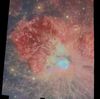
021-The Moon from Clem-Aristachus-PIA00090.jpg042 - Aristarchus Crater (false colors)67 visiteThe Aristarchus region is one of the most diverse and interesting areas on the Moon. About 500 Clementine images acquired through three spectral filters (415, 750, and 1000 nm) were processed and combined into a multispectral mosaic of this region. Shown here is a color-ratio composite, in which the 750/415 ratio controls the red-channel brightness, it inverse (415/750) controls the blue, and the 750/1000 ratio controls the green. Color ratios serve to cancel out the dominant brightness variations and topographic shading, thus isolating the color differences related to composition or mineralogy. The Aristarchus plateau is a rectangular, elevated crustal block about 200 km across, surrounded by the vast mare lava plains of Oceanus Procellarum. Clementine altimetry shows that the plateau is a tilted slab sloping down to the northwest, that rises more than 2 km above Oceanus Procellarum on its southeastern margin. The plateau was probably uplifted, tilted, and fractured by the Imbrium basin impact, which also deposited hummocky ejecta on the plateau surface. The plateau has experienced intense volcanic activity, both effusive and explosive. It includes the densest concentration of lunar sinuous rilles, including the largest known, Vallis Schroteri, which is about 160 km long, up to 11 km wide, and 1 km deep. The rilles in this area begin at 'cobra-head' craters, which are the apparent vents for low-viscosity lavas that formed vents for 'dark mantling' deposit covering the plateau and nearby areas to the north and east. This dark mantling deposit probably consists primarily of iron-rich glass spheres (pyroclastics or cinders), and has a deep red color on this image. Rather than forming cinder cones as on Earth, the lower gravity and vacuum of the Moon allows the pyroclastics to travel much greater heights and distances, thus depositing an extensive regional blanket. The Aristarchus impact occurred relatively recently in geologic time, after the Copernicus impact but before the Tycho impact. The 42 km diameter crater and its ejecta are especially interesting because of its location on the uplifted southeastern corner of the Aristarchus plateau. As a result, the crater ejecta reveal two different stratigraphic sequences: that of the plateau to the northwest, and that of the portion of Oceanus Procellarum to the southwest. This asymmetry is apparent in the colors of the ejecta as seen in this image, which is reddish to the southeast, dominated by excavated mare lava, and bluish to the northwest, caused by the excavation of highland materials in the plateau. The extent of the continuous ejecta blanket also appears asymmetric: it extends about twice as far to the north and east than in other directions, approximately following the plateau margins. These ejecta lobes could be caused by an oblique impact from the southeast, or it may reflect the presence of the plateau during ejecta emplacement. Two dark blue spots in the center of Aristarchus represent tan especially interesting discovery. The infrared spectral properties measured by Clementine are consistent with a composition of almost pure anorthosite, the primitive rock type produced by the lunar magma ocean. This is the first discovery of a major exposure of anorthosite in this region of the Moon, well within the boundary of the hypothetical Procellarum basin. Don Wilhelms (Geologic History of the Moon, USGS Professional Paper, 1984) proposed that the giant Procellarum basin entirely removed the upper anorthositic crust from the north-central nearside of the Moon.
(6 voti)
|
|

017-The Moon from Clem-NearSide-PIA00302.jpg003 - The Near-Side of the Moon82 visiteAbout 50.000 Clem images were processed to produce the 4 orthographic views of the Moon. Images PIA00302, PIA00303, PIA00304 and PIA00305 show albedo variations (normalized brightness or reflectivity) of the surface at a wavelength of 750 nm (just longward of visible red). The Lunar Near-Side is a contrast between dark and light albedo surfaces that has been fancied as the "Man in the Moon". Lunar terrain types are still designated by their 17th century name and that is:
1. Maria (dark albedo features also known as basins) and
2. Terra (brighter albedo features also known as uplands or highlands).
The Maria constitutes about 16% while the Terra 84% of the Lunar Surface. The nearside is composed of about 30 percent maria. Extensive bright ray systems surround craters Copernicus (upper left center) and Tycho (near bottom).
Studies have shown that two major processes, impact and basaltic volcanism have shaped the major physical features of the Lunar Surface.
(6 voti)
|
|

015-The Moon from Clem-FarSide-PIA00304.jpg002 - The Far-Side of the Moon91 visiteClementine Project Information
--------------------------------------------------------------------------------
Clementine was a joint project between the Strategic Defense Initiative Organization and NASA. The objective of the mission was to test sensors and spacecraft components under extended exposure to the space environment and to make scientific observations of the Moon and the near-Earth asteroid 1620 Geographos. The observations included imaging at various wavelengths including ultraviolet and infrared, laser ranging altimetry, and charged particle measurements. These observations were originally for the purposes of assessing the surface mineralogy of the Moon and Geographos, obtaining lunar altimetry from 60N to 60S latitude, and determining the size, shape, rotational characteristics, surface properties, and cratering statistics of Geographos.
Clementine was launched on 25 January 1994 at 16:34 UTC (12:34 PM EDT) from Vandenberg AFB aboard a Titan IIG rocket. After two Earth flybys, lunar insertion was achieved on February 21. Lunar mapping took place over approximately two months, in two parts. The first part consisted of a 5 hour elliptical polar orbit with a perilune of about 400 km at 28 degrees S latitude. After one month of mapping the orbit was rotated to a perilune of 29 degrees N latitude, where it remained for one more month. This allowed global imaging as well as altimetry coverage from 60 degrees S to 60 degrees N.
After leaving lunar orbit, a malfunction in one of the on-board computers on May 7 at 14:39 UTC (9:39 AM EST) caused a thruster to fire until it had used up all of its fuel, leaving the spacecraft spinning at about 80 RPM with no spin control. This made the planned continuation of the mission, a flyby of the near-Earth asteroid Geographos, impossible. The spacecraft remained in geocentric orbit and continued testing the spacecraft components until the end of mission.
More information on the Clementine mission, instruments, and early results can also be found in the Clementine special issue of Science magazine, Vol. 266, No. 5192, December 1994.
(6 voti)
|
|
| 81 immagini su 7 pagina(e) |
 |
3 | |
|
|
|





