| Piú votate - The Clementine Files |

003-The Moon and Venus from Clem.JPG021 - The Moon, Solar Corona and Venus58 visiteThis color-enhanced image of Venus, the solar corona, and the Moon was acquired by the Startracker.
The Terminator between the dark side of the Moon and the Earth-lit side can also be seen.     (11 voti)
|
|

Clem_insignia.jpg001 - Clementine's "Insignia"60 visitenessun commento     (10 voti)
|
|

002-The Moon and Planets from Clem.JPG020 - The Moon and a few planets60 visiteThe Startracker imaged this spectacular shot of the sunrise, planets, and Moon. This color-enhanced image shows, from right to left, the Moon lit by the Earth, the terminator - or boundary between light and dark - into the dark side with the solar corona just rising over the limb, and the bright planets Saturn, Mars, and Mercury. Several dimmer stars can also be seen. The Startracker algorithm achieved a star match, realizing that the Sun and planets were not in the correct position to be stars, and ignored them.     (9 voti)
|
|

018-The Moon from Clem-WestLimb-PIA00305.jpg004 - The western limb of the Moon: Mare Orientale and Oceanus Procellarum55 visiteThe so-called Mare Orientale (ringed feature just below image center) is just visible from Earth on the extreme western edge of the Near-Side of the Moon.
Oceanus Procellarum (large dark albedo area in upper right of image) is a familiar Near-Side feature as seen from Earth.     (9 voti)
|
|

Tycho-UVVis-2.gif203 - Tycho Crater56 visitenessun commento     (8 voti)
|
|

Tycho-2.jpg202 - Tycho Crater55 visitenessun commento     (8 voti)
|
|

Moon_Full-STB.jpg026 - Earthshine55 visitenessun commento     (8 voti)
|
|

Tycho-UVVis.jpg200 - Tycho Crater54 visitenessun commento     (8 voti)
|
|

000-The Moon from Clem.JPG014 - Light-up the Moon!61 visiteMosaic of the near side of the Moon lit by Earthshine, as imaged by a Startracker camera on March 15, 1994.
The Southern Hemisphere is up.
The bright crater toward the top of the image is Tycho.     (8 voti)
|
|
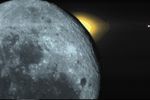
009-The Moon from Clem-Corona.JPG022 - Solar Corona58 visiteThe Earth-lit Moon, The Sun's corona, and - to the far right - Venus, are visible in this color-enhanced Startracker image. The Mare Humorum is the dark circular mare at the center of the lunar disk.     (8 voti)
|
|

019-The Moon from Clem-EastLimb-PIA00303.jpg005 - The eastern limb of the Moon: Mare Smythii, Mare Marginis, Mare Crisium and Mare Fecunditatis55 visiteThe dark albedo features Mare Smythii (image center) and Mare Marginis (above Smythii) are just visible from Earth on the extreme eastern edge of the Lunar Near-Side. Mare Crisium (West of Marginis) and Mare Fecunditatis (SouthWest of Crisium) are familiar Near-Side features as seen from Earth.
Maria Regions are believed to be large basins formed by impacts from cosmic projectiles later filled by basaltic lava flows from volcanic eruptions. Basaltic lava flows on the basin floors give maria their dark albedo appearance.     (8 voti)
|
|

000-Clementine.gif000 - Clementine59 visiteDescription
Clementine was a joint project between the Ballistic Missile Defense Organization (BMDO, nee the Strategic Defense Initiative Organization, or SDIO) and NASA. The objective of the mission was to test sensors and spacecraft components under extended exposure to the space environment and to make scientific observations of the Moon and the near-Earth asteroid 1620 Geographos. The Geographos observations were not made due to a malfunction in the spacecraft. The lunar observations made included imaging at various wavelengths in the visible as well as in ultraviolet and infrared, laser ranging altimetry, gravimetry, and charged particle measurements. These observations were for the purposes of obtaining multi-spectral imaging the entire lunar surface, assessing the surface mineralogy of the Moon and obtaining altimetry from 60N to 60S latitude and gravity data for the near side. There were also plans to image and determine the size, shape, rotational characteristics, surface properties, and cratering statistics of Geographos. Clementine carried 7 distinct experiments on-board: a UV/Visible Camera, a Near Infrared Camera, a Long Wavelength Infrared Camera, a High Resolution Camera, two Star Tracker Cameras, a Laser Altimeter, and a Charged Particle Telescope. The S-band transmitter was used for communications, tracking, and the gravimetry experiment.
Spacecraft and Subsystems
The spacecraft was an octagonal prism 1.88 meters high and 1.14 m across with two solar panels protruding on opposite sides parallel to the axis of the prism. A high-gain fixed dish antenna was at one end of the prism, and the 489 N thruster at the other end. The sensor openings were all located together on one of the eight panels, 90 degrees from the solar panels, and protected in flight by a single sensor cover. The spacecraft propulsion system consisted of a nonpropellant hydrazine system for attitude control and a bipropellant nitrogen tetraoxide and monomethyl hydrazine system for the maneuvers in space. The bipropellant system had a total capability of about 1900 m/s with about 550 m/s required for lunar insertion and 540 m/s for lunar departure. Attitude control was achieved with 12 small attitude control jets, two star tracker cameras, and two inertial measurement units. The spacecraft was three-axis stabilized in lunar orbit via reaction wheels with a precision of 0.05 Deg. in control and 0.03 Deg. in knowledge. Power was provided by gimbaled, single axis, GaAs/Ge solar panels which charged a 15 amp-hour, 47-w hr/Kg Nihau (Ni-H) common pressure vessel battery. Spacecraft data processing was performed using a MIL-STD-1750A computer (1.7 million instructions per second) for savemode, attitude control, and housekeeping operations, a RISC 32-bit processor (18 million ips) for image processing and autonomous operations, and an image compression system provided by the French Space Agency CNES. A data handling unit sequenced the cameras, operated the image compression system, and directed the data flow. Data was stored in a 2 Gbit dynamic solid state data recorder.
Mission Profile
The mission had two phases. After two Earth flybys, lunar insertion was achieved approximately one month after launch. Lunar mapping took place over approximately two months, in two parts. The first part consisted of a five hour elliptical polar orbit with a periapsis of about 400 Km at 30 degrees south latitude and an apoapsis of 8300 Km. Each orbit consisted of an 80 minute lunar mapping phase near periapsis and 139 minutes of downlink at apoapsis. After one month of mapping the orbit was rotated to a periapsis at 30 degrees north latitude, where it remained for one more month. This allowed global imaging and altimetry coverage from 60 degrees south to 60 degrees north, over a total of 300 orbits. After a lunar/Earth transfer and two more Earth flybys, the spacecraft was to head for Geographos, arriving three months later for a flyby, with a nominal approach closer than 100 Km. Unfortunately, on May 7, 1994, after the first Earth transfer orbit, a malfunction aboard the craft caused one of the attitude control thrusters to fire for 11 minutes, using up its fuel supply and causing Clementine to spin at 80 rpm. Under these conditions, the asteroid flyby could not yield useful results, so the spacecraft was put into a geocentric orbit passing through the Van Allen radiation belts to test the various components on board. The mission ended in June 1994 when the power level onboard dropped to a point where the telemetry from the spacecraft was no longer intelligible.
     (8 voti)
|
|
| 81 immagini su 7 pagina(e) |
1 |
 |
 |
 |
 |
|