| Piú votate - Original Nasa Apollo Frames: from Apollo 4 to Apollo 17 |

APOLLO_07_AS_07-07-1835.jpgAS 07-07-1835 - A "very" bizarre image-artifact, from Apollo 7 (2)86 visitenessun commentoMareKromium
(1 voti)
|
|

as15-96-13096.jpgAS 15-96-13096 - Mare Crisium, Mare Marginis and Mare Smythii58 visiteImage Collection: 70mm Hasselblad
Mission: 15
Magazine: 96
Magazine Letter: Q
Latitude: approx. 24,0° North
Longitude: approx. 79,0° East
Film Type: SO-368
Film Width: 70 mm
Film Color: color
Feature(s): MARE CRISIUM, MARE MARGINIS and MARE SMYTHIIMareKromium
(1 voti)
|
|

as15-96-13097.jpgAS 15-96-13097 - Mare Marginis, Mare Smythii and Neper Crater (Processing by NASA - L&PI)55 visiteImage Collection: 70mm Hasselblad
Mission: 15
Magazine: 96
Magazine Letter: Q
Latitude: approx. 11,0° North
Longitude: approx. 89,0° East
Film Type: SO-368
Film Width: 70 mm
Film Color: color
Feature(s): MARE MARGINIS, MARE SMYTHII and NEPER CRATERMareKromium
(1 voti)
|
|

as15-96-13094.JPGAS 15-96-13094 - Mare Marginis and Mare Smythii55 visiteImage Collection: 70mm Hasselblad
Mission: 15
Magazine: 96
Magazine Letter: Q
Latitude: approx. 15,0° North
Longitude: approx. 90,0° East
Film Type: SO-368
Film Width: 70 mm
Film Color: color
Feature(s): MARE MARGINIS, MARE SMYTHII and NEPER CRATERMareKromium
(1 voti)
|
|

as10-29-4175.JPGAS 10-29-4175 - Reflections in the window58 visiteImage Collection: 70mm Hasselblad
Mission: 10
Magazine: 29
Magazine Letter: P
Latitude: 1,0° South
Longitude: 161,7° East
Film Type: 3400
Film Width: 70 mm
Film Color: black & white
Feature(s): CRATER VENING MEINESZMareKromium
(1 voti)
|
|

as08-14-2393.JPGAS 08-14-2393 - Earthrise55 visiteImage Collection: 70mm Hasselblad
Mission: 8
Magazine: 14
Magazine Letter: B
Latitude: 13,0° South
Longitude: approx. 105,0° East
Lens Focal Length: 80 mm
Film Type: SO-368
Film Width: 70 mm
Film Color: color
Feature(s): HUMBOLDT, NORTHEAST OFMareKromium
(1 voti)
|
|

as08-14-2400.JPGAS 08-14-2401 - The Dark Side of the Moon (4 - natural colors; credits: Lunexit)57 visiteImage Collection: 70mm Hasselblad
Mission: 8
Magazine: 14
Magazine Letter: B
Latitude: approx. 3,0° South
Longitude: approx. 155,5° West
Lens Focal Length: 250 mm
Description: NEAR TERMINATOR; FARSIDE
Film Type: SO-368
Film Width: 70 mm
Film Color: color
MareKromium
(1 voti)
|
|

as08-14-2399.JPGAS 08-14-2399 - The Dark Side of the Moon (3 - natural colors; credits: Lunexit)60 visiteImage Collection: 70mm Hasselblad
Mission: 8
Magazine: 14
Magazine Letter: B
Latitude: approx. 3,0° South
Longitude: approx: 155,0° West
Lens Focal Length: 250 mm
Description: NEAR TERMINATOR; FARSIDE
Film Type: SO-368
Film Width: 70 mm
Film Color: colorMareKromium
(1 voti)
|
|

as08-13-2267.jpgAS 08-13-2267 - Beautiful Vision (2 - MULTISPECTRUM; credits: Lunexit)57 visiteLatitude: approx. 13,5° South
Longitude: approx: 78,5° EastMareKromium
(1 voti)
|
|

as16-107-17473.JPGAS 16-107-17473 - The "Sample Container"55 visiteThis picture is showing the Rover in the background, while the SCB that John Young brought to hold individual sample bags is in the foreground. Charlie is at the back of the Rover. Note the footprints that John made as he made his way up to the Station 4 Crater.
MareKromium
(1 voti)
|
|
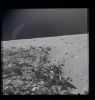
as16-107-17483.JPGAS 16-107-17483 - Station 4 Crater (ejecta crater)57 visiteStation 4 crater. Note that there is very little debris on the Western (right) side of the Crater. As John Young recognized in the field, this crater was almost certainly formed by a large piece of highly-shocked ejecta from South Ray Crater which plowed into the side of Stone Mountain at relatively low velocity and came apart.
Hence, this is a Secondary Crater.
Notes (from "Glossary of Geology", 2nd Edition, American Geological Inst., Falls Church (VA) - 1980)
Ejecta — The material thrown out of an impact crater by the shock pressures generated during the impact event. Ejecta generally covers the surface around an impact crater to a distance of at least one crater diameter, with individual streamers of material extending well beyond this distance ("rays"). The ejecta blanket of a crater becomes less visible with increasing age of the crater.
Secondary craters — Craters produced by the impact of debris thrown out by a large impact event. Many secondary craters occur in clusters or lines where groups of ejecta blocks impacted almost simultaneously.MareKromium
(1 voti)
|
|
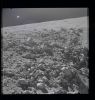
as16-107-17477.JPGAS 16-107-17477 - Station 4 Crater (ejecta crater)56 visitenessun commentoMareKromium
(1 voti)
|
|
| 1322 immagini su 111 pagina(e) |
 |
|
|
|
|
105 | |
|
|
|
|





