| Piú votate - The Lunar Surface in HR |

APOLLO 15 AS 15-0757.jpgAS 15-0757 - Tsiolkovsky64 visiteTsiolkovsky is one of the most prominent features on the Far-Side of the Moon. It is a 1 90-Km- wide impact crater with a large, complex central peak that is offset from the apparent center of the crater. Differences in tone and texture between the central peak, the lava-flooded floor, the terraced walls and the ejecta blanket are dramatically displayed in this oblique view. The ejecta blanket is dominated by a coarse pattern of ridges radiating outward from the crater; superposed on this pattern are many small level pools of smooth material that are much lighter than the otherwise similar smooth dark mare in the floor of Tsiolkovsky. The pools probably originated differently. They may consist of rock that was melted by the heat and pressure generated during the impact event and that flowed into depressions before it hardened.
Cratering experiments on Earth have shown that central peaks consist of bedrock that has been displaced upward by a distance equal to about 1/10th the diameter of the resulting crater. If samples could be obtained from the central peak at Tsiolkovsky, they might be rocks that were 20 km below the Moon's surface before Tsiolkovsky was created.
(3 voti)
|
|
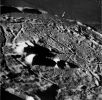
APOLLO 16 AS 16-120-19295~0.jpgAS 16-120-19295 - Gassendi56 visiteThis view into the shallow crater Gassendi shows another strongly fractured crater floor. Gassendi is about 110 Km wide. Dark mare lavas in the distance embay the rim and a little of the interior of Gassendi. They may have entered the crater through the narrow gap partly in shadow below the arrow. Most craters that have fractured floors are near areas of mare flooding. This suggests that the fracturing is a consequence of volcanic activity. An area next to the central peaks of Gassendi was the runnerup choice for a landing site for Apollo 17.
(3 voti)
|
|
APOLLO_14_AS_14-66-9300_(HR).jpgAS 14-66-9300 (HR) - Looking for the Blue Flare... (12)53 visiteCaption NASA:"Rightward of 9299, showing the western tip of Ed's shadow".MareKromium
(2 voti)
|
|

APOLLO 16 AS 16-4531.jpgAS 16-4531 - Teophilus' "Peak"55 visiteA detailed view of part of the central peak complex of Theophilus. Central peaks are typical of most young, large impact craters on the Moon-and also of many manmade craters on Earth. From experimental data using controlled explosions, central peaks are known to consist of bedrock originally lying below the crater floor that, during the explosion, was uplifted, faulted, and folded by shock wave action. The irregular light-toned mountainous mass projecting above the floor of Theophilus is split into at least three enormous blocks separated by V-shaped structural valleys. Four or five circular craters without a prominent raised rim are located near or at the bases of the steep slopes. If these craters are endogenic vents rather than impact craters, their presence further suggests structural control along major fault planes. The planar walls of the northwest-trending valley contrast with other sloping surfaces of the central peak complex. They are steeper and, except for a few outcrops of protruding bedrock, are marked by linear grooves not unlike slickensides on many fault planes on Earth. Rock chutes do not seem to be a likely explanation for the grooves because there are no talus deposits or blocks at their lower ends. The debris cover is thin enough along the southern valley wall (top of picture) to show that the southern mountain block consists of layered rocks-at least five thick, light-toned layers alternate with thin, dark layers.
(2 voti)
|
|

APOLLO 17 AS 17-151-23260.jpgAS 17-151-23260 - Copernicus Crater61 visiteThe large Crater Copernicus has served as a type example of Lunar Impact Craters since the classic analysis was made by E. M. Shoemaker in 1962. Bright rays of ejecta radiate outward from Copernicus across a large part of the Moon's Near-Side. Material from one of the rays may have been sampled at the Apollo 12 Landing Site, 370 Km South of the center of the crater. This photograph shows how the Crater appeared from the Apollo 17 spacecraft looking Southward over the Montes Carpatus (Carpathian Mountains).
Notice that the rim deposits immediately adjacent to the Crater have a very crisp, blocky appearance in contrast to the softer appearance of the rest of the ejecta blanket. This crisp zone is also found on many other craters and suggests the ejecta here was swept clean by some erosion process late in the cratering event. The terraced slumps on the Crater wall appear like giant stair steps leading to the floor, 3 to 4 Km below the rim. The 1-Km-high central peaks were made famous in 1966 by a "Picture of the century" view looking into the crater from the south by Lunar Orbiter 2. Now Apollo has given us scores of even more spectacular photographs.
(2 voti)
|
|

APOLLO 16 AS 16-5006 (1).jpgAS 16-5006 - Details of King Crater (1)56 visiteHere is an enlarged vertical view of more flow lobes inside King Crater. Fine lineations radial to King are prominent in the ejecta blanket behind (South-East of) the lobate fronts. The term "deceleration lobe" has been applied because the lobes occur only where the ejecta slowed down and came to rest on slopes that face toward King. They resemble terrestrial rock avalanche deposits that came to rest after climbing a small slope. Some lobes overlap each other outward like shingles.
The sketch (2) shows what would probably be seen in a cutaway view. The arrow shows the direction of movement of the ejecta over the old landscape.
(2 voti)
|
|
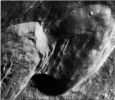
APOLLO 17 AS 17-2773.jpgAS 17-2773 - Overlapping Craters54 visiteThis pair of overlapping medium-sized craters illustrates some of the criteria used to determine relative ages: material ejected from the larger polygonal crater on the left partially fills the smaller crater on the right; thus, the crater on the left is younger. Furthermore, the wall of the large crater is complete, whereas the West wall of the smaller crater is absent, obviously having been destroyed by the larger crater.
Even if the 2 craters did not overlap, the sharp rim, terraced walls and prominent central peak of the larger crater clearly identify it as the younger of the two. The frames used in the stereogram were selected to show exaggerated relief, a technique very helpful to photointerpreters in determining shapes and relative elevations of surface features.
These 2 craters are located in the rugged terrain of the Far-Side highlands, approx. 250 Km north of Tsiolkovsky.
(2 voti)
|
|

APOLLO 17 AS 17-2444.jpgAS 17-2444 - Mare Imbrium & Copernicus Crater54 visiteThis oblique view across southern Mare Imbrium looks toward Copernicus, the large crater near the horizon. The distance from the lower edge of the picture to the center of Copernicus is 400 km. The mountains at the edge of Mare Imbrium are the Montes Carpatus, and the large crater near the center of the picture is Pytheas, almost 19 km in diameter. Copernicus is one of the youngest of the Moon's large craters. It is visible from Earth, even without the aid of a telescope because of its bright ejecta blanket and its extensive bright rays. The many chains and clusters of small irregular craters and the many bright streaks or rays extending across Mare Imbrium are caused by the secondary impact of debris ejected from Copernicus. The viewing angle accentuates the radial pattern of the secondary impact features. The Sun angle is sufficiently low to show their relief, but high enough to show the contrast between the bright streaks and the normal dark mare surface. As in figure 124, herringbone ridges point toward the primary crater, and the flaring sides of the secondary craters point away from it. The arrow midway between Copernicus and the left edge of the photograph points to a less common pattern of secondary craters; these are concentric to Copernicus.
(2 voti)
|
|

APOLLO 17 AS 17-1672.jpgAS 17-1672 - "D" like "Depression"...54 visiteThe steep-walled but shallow D-shaped depression near the center of the photograph is apparently a unique feature. It is located in a patch of mare on the foothills of the Montes Haemus, west of Mare Serenitatis. Measured along its straight side, the depression is about 3 Km wide. It is situated atop a very gentle circular dome that appears to be somewhat smoother than the surrounding mare surface. As is more clearly shown in AS 15-9960, the many bulbous structures on the floor give it a blisterlike appearance.
The depression is believed to be volcanic, probably a caldera (...).
(2 voti)
|
|

APOLLO 15 AS 15-9299.jpgAS 15-9299 - Le Monnier Crater56 visiteOn January 16, 1973, the Soviet unmanned roving vehicle Lunokhod 2 was landed by Luna 21 in or near this area in the South-Eastern part of the crater Le Monnier. This crater is a large (61 Km) pre-Imbrian crater cut into terra at the Eastern edge of Mare Serenitatis before Serenitatis was flooded by mare laves. Part of Le Monnier's Southern wall fills the lower part of the picture. A conspicuous chain of elongate depressions has formed in the lava-filled floor of the crater. The chain trends 22 Km northward and its pattern is quite surely controlled by an underlying fracture system. Regionally, the inferred fracture system is concentric to the grossly circular Serenitatis Basin and in this area trends Northward. No comparably young structural features having the same trend cut the terrae surrounding Le Monnier. However, older structures having this trend occur in the southern and northern walls and rims of Le Monnier. The aligned depressions on the mare are mostly 300 to 400 mt wide and 30 to 60 mt deep. The three deepest stretches are 1 to 2 km long and about 50 to 65 m deep. These depressions probably were the locus of fissure eruptions of mare basalt. Withdrawal of the last lava back into the fissure may have created subsurface voids into which collapse took place, causing the depressions and accounting for the absence of raised rims on the depressions.
(2 voti)
|
|
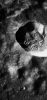
APOLLO 17 AS 17-2265.jpgAS 17-2265 - Proclus Crater54 visiteThis oblique view looks South over the 26-Km-diameter crater Proclus in the highlands at the Western edge of Mare Crisium. Proclus is a young rayed crater that is distinctive because of the marked asymmetry of its ray system-a characteristic visible even in Earth-based telescopic views. The excluded zone is along the South-West edge (top of photograph) but is visible in this moderate Sun photo only as a slight albedo change. Laboratory experiments suggest that a low trajectory angle might account for the asymmetry. A number of large blocks can be seen at the edge of the crater rim. The exceptionally large block (arrow) is about 200 mt wide and, judging from the length of the shadow it casts, nearly as high. As in several other craters shown in this chapter, a darker layer is present in the upper part of the crater wall.
(2 voti)
|
|

APOLLO 17 AS 17-3081.jpgAS 17-3081 - Pytheas Crater (HR)55 visiteThe Apollo 17 Panoramic Camera provided this high-resolution, enlarged view of the South Wall of Pytheas. Pytheas is about the same size as Bessel, but is located in South-Central Mare Imbrium, almost 1100 km West of Bessel.
The outcrops in the walls of the two craters are remarkably similar.
These and the many other craters in mare areas that contain outcrops of dark horizontally layered rock demonstrate the moonwide uniformity of conditions in the upper part of the mare basins.
(2 voti)
|
|
| 86 immagini su 8 pagina(e) |
 |
|
|
|
6 | |
|





