| Piú votate - The Lunar Surface in HR |

APOLLO 16 AS 16-120-19266.jpgAS 16-120-19266 - The "Playa" of King Crater56 visiteThe Apollo 16 Astronauts captured this spectacular view of the large dark "pool" on the North flank of the crater King as they approached from the East.
The pool (also known as a "lake", "pond" or "playa") is in an old crater swamped by King ejecta. The maximum width of the pool is about 21 Km. The peculiar dark material that forms the large pool and also coats adjacent hills was first discovered on Apollo 10 and was later seen again from Apollo 14.
The most exciting part of the discovery had to wait until the mapping and Panoramic Cameras of Apollo 16 showed that this material contains some of the freshest and most spectacular flow structures on the Moon.
These structures, some of which are seen in the following figures, show that the material behaved like lava.
The material is very similar in appearance to that filling parts of the floor of King.
(3 voti)
|
|
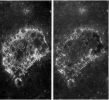
APOLLO 15 AS 15-9960.jpgAS 15-9960 - The "D" in "Detail"...56 visiteThe enlarged view provided by this stereogram shows that there are at least 3 different types of material within the floor of the D-shaped depression (see AS 17-1672). A brighter annulus parallels the wall, and darker material fills the inner floor.
Within both areas numerous bulbous and slightly raised comical structures are easily distinguishable.
There are craters on the summits of many of the structures, suggesting that each one is probably an extrusive dome with a summit crater.
Many similar features on Earth are caused by the subterranean drainage of lavas following extrusion and release of pressure following the upward movement of a central plug.
(3 voti)
|
|

APOLLO 16 AS 16-5410.jpgAS 16-5410 - Number "8"54 visiteThis 18-km-long ''figure 8" pair of noncircular craters near the crater Guericke probably was not formed by hypervelocity impacts of bodies from space. It could be a secondary impact feature formed by projectiles from the Imbrium Basin, 700 Km to the North. The terrace at the base of the crater walls could be debris from the walls or a "bathtub ring" left by a formerly higher stand of the mare fill. Alternatively, the crater pair and the terrace could have been formed by volcanic eruptions.
The superposed bright crater is younger than and unrelated to either the "figure 8" pair or the mare.
(3 voti)
|
|

APOLLO 15 AS 15-9874.jpgAS 15-9874 - Dawes Crater55 visiteThis is a near vertical view of the crater Dawes, 18 Km in diameter. Morphologically it is typical of many lunar craters in the 15- to 20-Km size range. It lacks terraced walls and distinct central peaks but has an extremely rough floor. Small terracelike structures on the crater floor (upper left, lower right) occur where the wall is bowed outward and probably represent slump deposits where portions of the crater wall have collapsed into the crater. Local stratigraphy is revealed in the walls of the crater, and material of different albedo is seen streaming down into the crater from various levels. The dark layer clearly visible in the upper part of the crater wall represents the thin mare deposits in this part of Northern Mare Tranquillitatis. The lighter gray material below it is a combination of underlying submare material and talus from units higher on the crater wall. The highest unit (white and gray) probably represents the ejecta blanket and may consist primarily of lighter lunar crustal material excavated from beneath the mare.
(3 voti)
|
|

APOLLO 15 AS 15-9866.jpgAS 15-9866 - Jansen "B" Crater55 visiteHigh Sun views such as this often show fascinating dark and bright patterns that would be overwhelmed by highlights or shadows if the Sun were lower in the sky. This view of the 17-Km-wide crater Jansen "B" shows numerous bright avalanche deposits on the steep crater walls, apparently originating at outcrop ledges near the top of the wall. Most avalanches stop in a moat at the base of the wall, but a few in the foreground extend out onto the irregular, inward- sloping floor.
The floor is a jumble of slump blocks.
Avalanching appears to be a major means of erosion on steep lunar slopes.
(3 voti)
|
|
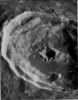
APOLLO 17 AS 17-3072.jpgAS 17-3062 - Timocharis Crater55 visiteThis oblique view of the crater Timocharis in Southe-Eastern Mare Imbrium illustrates how the original diameter of a crater is enlarged by slumping of its walls. Its present diameter is about 35 Km. The sparsity of small superposed craters on the walls of Timocharis - in contrast to their density on its floor and rim - is caused by the erosive effect of downslope movement of material on the steep walls. Timocharis, like many other young impact craters of similar size, possesses a well-defined central peak complex. Such structures are believed to result from elastic rebound of the bedrock immediately after the impacting event. However, the central peak of Timocharis apparently has been substantially modified by a large superimposed crater.
(3 voti)
|
|

APOLLO 16 AS 16-1973.jpgAS 16-1973 - The "Davy Crater Chain"59 visiteThe Davy Crater Chain (arrow) is one of the most spectacular chains of craters on the Moon. It extends for about 50 Km across the floor of the large, very old crater Davy "Y" and onto its eastern rim. The chain may be related in origin to the pair of irregular craters Davy "G" and Davy "GA", 75 Km from the furthest end of the chain.
Two origins have been proposed: some lunar geologists believe it is a chain of secondary impact craters and others believe it is a line of volcanic craters. The simple geometry of the Davy Chain, the symmetry and uniform spacing of its individual craters and its alinement with Davy "G", strongly support, in my opinion, a volcanic origin. Also arguing against a secondary impact origin is the fact that the Davy Chain is a lone feature. There are no other similar chains with this trend in the area. Secondary crater chains tend to occur in large numbers within the belt of secondary craters surrounding a large primary crater.
On Earth some rocks from deep within the crust have been brought to the surface through volcanic orifices, thus providing a means of studying material that would otherwise be inaccessible. For this reason the Davy area was once seriously considered as a landing site. However, when the originally planned number of Apollo missions was reduced, the Davy area was one of those eliminated.
(3 voti)
|
|

APOLLO 16 AS 16-4530.jpgAS 16-4530 - Seconday impact craters, faults and rifles56 visiteLinear features of external and internal origin are contrasted in this area of Southernmost Mare Tranquillitatis.
The North-trending line of overlapping, very irregular craters along the East edge of the picture is clearly a chain of secondary impact craters. Its trend is radial to Theophilus, a large crater of early Copernican age that lies about 105 Km south of this area. The flaring shapes of some of the craters and their state of preservation also suggest that Theophilus is the primary crater. The narrow, straight rifle or graben that extends westward across the picture is clearly of internal origin. It formed when tensional forces ruptured the crust, causing the floor of the rifle to subside along faults.
Straight rifles are commonly the sites of volcanic cones or of blankets of volcanic ejecta; however, there are no signs of volcanism here that can be related to this rifle.
(3 voti)
|
|

APOLLO 16 AS 16-4511.jpgAS 16-4511 - Crater "Rays"56 visiteThis picture shows the striking bilateral symmetry of the rays of a small (2-Km diameter) crater in the floor of the large crater Daguerre in Mare Nectaris. Continuous areas and narrow filaments of light-gray ejecta extend from the crater across the dark mare surface through 270°, but are entirely absent in the southern 90° sector. Within the crater, dark material occurs on the southern crater wall while the remaining walls are bright. (The reader may wonder about the material whose reflectivity cannot be observed because it lies in shadow on the East wall of this crater. Until the area is observed under high Sun conditions, we are forced to make the simplifying assumption that it is bright because most of the materials visible elsewhere in the walls are bright).
This crater probably resulted from the impact of a projectile traveling from South to North along an oblique trajectory.
Its pattern of ejecta distribution is similar to that of small craters produced by the impact of missiles along oblique trajectories at the White Sands Missile Range, N. Mex. Some observers postulate that the dark material is a talus deposit of mare material that has fallen into the crater.
(3 voti)
|
|

APOLLO 16-4136-B.jpgAS 16-4136 - Cratered Region near Mandel'shtam (2)55 visiteThis enlarged view of part of frame AS 16-4136 shows some of the smooth flows that originate near the crest of the crater rim at the left side of photograph. Arrows point to the lower ends of two flows.
The origin of the flow material is controversial.
It was probably molten material generated by shock-wave compression of lunar rocks and ejected at relatively low velocities during the late stages of the formation of the impact crater; or it may have resulted from the flow of rock debris mixed with a fluidizing agent such as gas or water; or it may have been volcanically generated lava.
(3 voti)
|
|

APOLLO 16-4136-A.jpgAS 16-4136 - Cratered Region near Mandel'shtam (1)56 visiteThis view looks southward near Mandel'shtam on the Lunar Far-Side. Most young lunar craters wider than about 40 Km have flows on their rims that resemble lava flows or mud flows on Earth. The unnamed crater near the top is about 14 Km wide and was recognized by H. J. Moore (1972) as being the smallest crater known to have such flows. Flows in the middle of the picture surged downhill off the high rim of the crater making lobes and tongues and leaving behind drained channels with levees.
In the area to the right of the crater, enlarged in the next frame, are some thin lobate flows that apparently rode over small hills, as if these flows were propelled outward from the crater with sufficient velocity to climb the hills. Ejecta deposits farther than about 1 Km from the rim are radially lineated and are smoother than the ground immediately surrounding the crater. The crisp, blocky zone around the crater is typical of many fresh craters.
(3 voti)
|
|

APOLLO 15 AS 15-9591.jpgAS 15-9591 - Tsiolkovsky54 visiteModerate enlargement of part of a panoramic camera frame provides greater detail of the central peak complex of Tsiolkovsky. A relatively large population of superposed craters has been preserved on level areas of the peaks (near the left-center of the photograph). In contrast, very few craters are present on steep slopes-most have been destroyed by the downslope movement of erosional debris. An intermediate population of craters on the dark mare shows that the mare surface is younger than the level areas of the peak complex but older than the freshly exposed steep slopes of the peaks. The youngest part of the mare surface is the dark, smooth area adjacent to the small angular rifle in the upper left corner. Here small craters have been almost completely filled by the flow and are barely discernible. The rifle may have served as the vent for the young lavas.
(3 voti)
|
|
| 86 immagini su 8 pagina(e) |
 |
|
|
5 | |
|
|





