| Piú votate - The Lunar Surface in HR |

APOLLO 15 AS 15-9328.jpgAS 15-9328 - Bessel Crater55 visiteOutcrops of layered rock are strikingly evident in the upper part of the far wall of the crater Bessel (17- Km diameter) in South-Central Mare Serenitatis. The outcrop is most evident where it forms shadows; however, the dark debris that streams downslope from the layered rock is visible even on parts of the crater wall where the Sun has washed out all details of relief. The outcrop is at a uniform distance below the crater rim, indicating that the strata are horizontal. Thus, Bessel furnishes convincing evidence that mare surfaces are underlain by dark layered rock. The dark rock is now known to be basalt that accumulated as successive flows or layers of lava.
Bessel is youthful enough that boulders are abundant on its rim and floor.
An anomalously high number of boulders is visible in and around the 750-m diameter crater (arrow) on the floor.
(4 voti)
|
|

APOLLO 16 AS 16-4653.jpgAS 16-4653 - Secondary Craters' Clusters54 visiteThese 3 clusters of secondary craters (see arrows) are on the East flank of the larger crater Ptolemaeus near the center of the Moon's Near-Side. Each cluster has a ridged and hummocky appearance. The primary crater has not been identified in this case, but the configuration of the clusters tells us that it must be to the South of Ptolemaeus. Note that the South-facing side of each cluster is more sharply defined than the North-facing side.
This is a consequence of the oblique trajectory of impacting fragments that causes the ejecta of the secondary craters to be propelled away (down range) from the primary crater. Observations of manmade impact craters have shown that the individual fragments within a cluster of secondary debris strike the surface nearly simultaneously.
In the process, ejecta from one secondary collides and interferes with ejecta from adjacent craters, producing a ridged and hummocky surface.
(4 voti)
|
|

APOLLO 16 AS 16-4502.jpgAS 16-4502 - The beautiful Isidorus "D"56 visiteThis oblique view of the crater Isidorus "D" was taken with the PanCam on Apollo 16. Isidorus "D" is about 15 Km in diameter and is located in the highlands between Mare Tranquillitatis and Mare Nectaris.
Evidence of avalanching (Howard, 1973) and of other types of downslope movement of material are clearly visible on the inner walls of the crater. The streaks resembling shooting stars on the left wall appear to be avalanche scars. The avalanches probably were spearheaded by large blocks followed by fine-grained material. On the near wall (arrow) a larger landslide terminates in a straight line against the relatively flat crater floor. In the shadowed part of the crater wall many short irregular benches or narrow terraces mark the tops of masses of slumped material. The brightness of the avalanche scars is an indication of their freshness; in general, freshly exposed lunar materials are brighter than undisturbed materials nearby.
(4 voti)
|
|

APOLLO 16 AS 16-4559.jpgAS 16-4559 - Kant "P" Crater and its "inner" crater57 visiteKant "P" is a medium-sized crater located in the central highlands on the Moon's Near-Side. About 5,5 Km in diameter, its overall shape is not in the least unusual. However, the younger, small pear-shaped crater on Kant "P"'s North wall is an excellent example of the controlling effect that topographic relief plays on the shape of an impact crater. Because the small crater was formed on a steeply sloping surface, its ejecta was deposited chiefly downslope and formed a broad rim. The original rim and wall on the upslope side have been obliterated by slumping.
The slumping has left a landslide scar and has caused talus and scree to be deposited in the lower part of the crater.
(4 voti)
|
|

APOLLO 15 AS 15-9596.jpgAS 15-9596 - Tsiolkovsky55 visiteDrastic enlargement of a panoramic camera frame provides a wealth of detail within the small area outlined in AS 15-9591. Note the many large blocks on the slope. The largest block is about 125 mt wide. Most blocks apparently originated at the discontinuous ledge near the top of the slope. Note also the fillets on the upslope side of many of the blocks. They probably consist of fine-grained debris that was trapped behind the blocks as it moved downslope. The arrows identify what appear to be two craters in the process of being destroyed by erosion. Otherwise, craters are absent on the steeply dipping slope, although numerous craters are present on the gentler slopes above.
(4 voti)
|
|
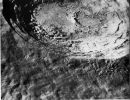
APOLLO 15-0326.jpgAPOLLO 15-0326 - Aristarchus61 visiteAristarchus is a large crater on the edge of a plateau within Northern Oceanus Procellarum. In this scene the crater is viewed obliquely from the North. One of the brightest and youngest craters of its size on the Near-Side of the Moon, Aristarchus is believed to be younger even than Copernicus. The general appearance of Aristarchus and of parts of the plateau around it led Alfred Worden, the Apollo 15 CMP, to describe this part of the Moon as "... probably the most volcanic area that I've seen anywhere on the surface". For many years before the Apollo Missions, Earth-based viewers had reported telescopic sightings of TLP's centered on Aristarchus. These brief, subtle changes in color or in sharpness of appearance have been suggested as evidence for volcanic activity or the venting of gases from the lunar interior. The sightings are controversial, but Aristarchus remains a center of interest.
About 39 Km in diameter, Aristarchus is on the borderline between medium-sized and large- sized craters. We have included it among the large craters because its welldeveloped concentric terraces are characteristic of most large craters that have not been too severely degraded. Its terraced walls, as well as its arcuate range of central peaks, are particularly well shown in this view. The walls and parts of the crater floor are extremely rough and cracked, a characteristic feature of other young impact craters of this size range, such as Tycho and Copernicus. The rough deposits in the floor are probably made up largely of shockmelted material formed at the time of the impact. The inner, rougher portions of the rim show a series of channels, lobate flows, and smooth puddlelike deposits that may represent shock-melted material deposited on the crater rim. The outer, smoother portions show the rhomboidal pattern characteristic of crater ejecta blankets.
(4 voti)
|
|

Moon-Lunar_Unnamed_Crater-f56dcf43b7768c6f7ecee39e14ad2696_XL.jpgUnnamed Crater176 visiteQui non si fa Politica, ma qualcosa occorre scriverla. Dato che l'India é arrivata sulla Luna e vorrebbe arrivare su Marte (come Cina ed USA), io mi chiedo, oggi.... - quote -
"Come sarebbe stato nascere in India? C’è chi la domanda se l’è posta davvero. E ha anche deciso di toccare con mano, di vedere come si vive in questo grande Paese.
È possibile dare una prima risposta: nascere in India significa, fin da piccoli, imparare a dover fare i conti con la povertà.
La povertà…
Si parla di povertà estrema quando una parte, più o meno consistente, di popolazione vive con meno di 1,90 dollari al giorno. Secondo i dati della Banca mondiale, nel 2015 l’India aveva una popolazione pari a un miliardo e trecento milioni di persone.
La percentuale di popolazione che vive con meno di 1,90 dollari al giorno è di circa il 21%. Fatto il calcolo, sono più di 270 milioni di persone.
…la fame…
Ci sono tre dati, la cui fonte è il Programma alimentare mondiale, che descrivono perfettamente la situazione:
• In India vive un quarto delle persone denutrite di tutto il mondo.
• Nove donne incinte su dieci soffrono di malnutrizione e anemia.
• Più della metà dei bambini sotto i cinque anni è malnutrita o soffre di nanismo.
Qui comincia un circolo vizioso. Chi non mangia abbastanza, non ha forze sufficienti per lavorare e guadagnare. Senza lavorare e guadagnare, non si ha la possibilità di comprare cibo. Un circolo vizioso fatto di fame e povertà. Un circolo difficile da spezzare.
…e gli altri problemi dell’India
Perché non ci sono “solo” la fame e la povertà. Il tasso di mortalità materna è tra i più alti del mondo: ogni anno, circa 120.000 donne non superano il parto o la gravidanza. La metà delle donne è analfabeta e i loro diritti fondamentali vengono negati sistematicamente. Anche il tasso di abbandono scolastico è molto alto e questo significa che i bambini sono costretti a lavorare".
Ed i Governanti di questo ricchissimo Inferno, anziché far qualcosa, vanno a guardare da vicino la Luna? L'India l'ho vista e vissuta, poco o tanto non conta. Ma son stato lì e non mi sono fermato ai telegiornali, quando ne parlano (e cioé quasi mai, salvo che per le "tensioni" politiche e militari con i "Vicini").
Non ho parole. Anzi si. Specie dopo aver visto, ieri, a Milano (Italia, la "Capitale del Nord", dicono, e NON Nuova Delhi, Calcutta, o qualche altra "Città della Gioia"....), un pò (un BEL pò!) di miseria e di degrado.
Che nausea.
Che vergogna.
Povera India.
E poveri noi......MareKromium
(3 voti)
|
|

APOLLO_15_-_AS15-84-11319_HR.jpgAS 15-84-11319 - Mount Hadley56 visitenessun commentoMareKromium
(3 voti)
|
|

APOLLO_15_-_AS15-84-11314_HR.jpgAS 15-84-11314 - Mount Hadley58 visitenessun commentoMareKromium
(3 voti)
|
|

APOLLO_15_-_AS15-84-11313_HR.jpgAS 15-84-11313 - Mount Hadley66 visitenessun commentoMareKromium
(3 voti)
|
|
APOLLO_14_AS_14-66-9294_(HR).jpgAS 14-66-9294 (HR) - Looking for the Blue Flare... (6)54 visiteCaption NASA:"Al has move to the 12 o'clock position, due West of the ladder, to take a third pan. Down-Sun".MareKromium
(3 voti)
|
|

APOLLO 16 AS 16-5006 (2).jpgAS 16-5006 - Sketch of the details of King Crater (2)54 visitenessun commento
(3 voti)
|
|
| 86 immagini su 8 pagina(e) |
 |
|
4 | |
|
|
|





