| Piú votate - The Soviet "Moon Programme" |

Zond-08-59-detail.jpgLunar Surface from ZOND-8157 visitenessun commento
(10 voti)
|
|

Zond-07-09.jpgSetting Earth, from ZOND-7 (2)205 visiteZond-7 photographed the Earth on August 9, 1969, and performed two photo sessions at the Moon on August 11, 1969. It shot 35 pictures with the SKD camera and 300 mm objective, on 5,6 × 5,6 cm frames of color and panchromatic film.
Come definire i risultati fotografici di Zond-7? Giudicate Voi stessi: sono, a nostro parere, delle immagini splendide e di una qualità così alta da far impallidire i miseri e scialbi fotogrammi ottenuti dalla Sonda ESA SMART-1 la quale, dopo tante chiacchiere e promesse di scoperta e divulgazione (promesse, ad oggi, NON mantenute), sembra già essere piombata - con merito - nel dimenticatoio...
(8 voti)
|
|

Zond-07-01.jpgSetting Earth, from ZOND-7 (1)102 visiteZond-7 was launched towards the Moon from a mother spacecraft (69-067B) on a mission focused on further studies of the Moon and Circum-Lunar Space; to obtain color photography of both Earth and Moon from varying distances, and to flight test the spacecraft systems.
Earth photos were obtained on August 9, 1969.
On August 11, 1969, the spacecraft flew past the Moon at a distance of 1984,6 Km and conducted two picture taking sessions.
Zond-7 reentered the Earth's atmosphere on August 14, 1969, and achieved a soft landing in a preset region, south of Kustanai.
(8 voti)
|
|

Zond-08-X02.jpgMagnificent "Gibbous Moon", from ZOND-8 (1)105 visiteDue frames che vanno a concludere la modesta raccolta di frames Zond-8 disponibili. Solo un commento: la qualità delle immagini - considerato il periodo storico di riferimento ed i mezzi e le tecnologie disponibili - era ed è altissima. Di gran lunga superiore, come già accennammo in passato, a quella dei frames SMART-1 (e che l'ESA non ce ne voglia...) e, per quanto è nelle nostre mani, Clementine (e che la NASA non ce ne voglia).
Deduzioni?
O la tecnologia, nel tempo, è peggiorata oppure è migliorata a tal punto che quello che si riesce a vedere, oggi, è così sconvolgente da incutere timore. Un timore che "suggerisce" di lasciare tutte le scoperte nell'ombra e nel silenzio.
Fantasia o realtà? Decidete Voi...
(7 voti)
|
|

Zond-08-09.jpgLunar Limb and setting Earth, from ZOND-8 (2)112 visitenessun commento
(7 voti)
|
|

Zond-07-11.jpgSetting Earth, from ZOND-7 (3)103 visitenessun commento
(7 voti)
|
|

Zond-08-38.jpgThe "Terminator", from ZOND-882 visitenessun commento
(6 voti)
|
|

Zond-08-01.jpgEarthrise, from ZOND-8124 visiteZond-8 was launched from an Earth orbiting platform, Tyazheliy Sputnik (70-088B), towards the Moon, on October, 20, 1970. The announced objectives were the investigations of the Moon and Circum-Lunar Space and the testing of onboard systems and units. The spacecraft obtained photographs of the Earth on October 21, from a distance of 64.480 Km. The spacecraft transmitted flight images of the Earth for 3 days. Zond-8 flew past the Moon on October 24, 1970, at a distance of 1110,4 Km and obtained both b/w and color photographs of the Lunar Surface. Scientific measurements were also obtained during the flight.
Zond-8 reentered the Earth's atmosphere and splashed down in the Indian Ocean on October 27, 1970.
(6 voti)
|
|

Luna17-Horz02.jpgTracks on the Moon282 visiteAs with many Soviet space images, generation loss prevents us from seeing the original quality. Most Lunokhod images are derived from scanning printed images or second-generation film copies.
Each stage of photography, printing and scanning introduces noise, nonlinear brighness mapping, and (worst of all) clamping to white or black.
As a matter of fact, all these images only hint at the appearance of the original video signal.
Nota: oltre le tecnicalità sulla fotografia, guardate attentamente il "nido" e le "tracce" lasciate dal Rover Lunokhod-1. Eravamo nel 1970, in piena Era Apollo, lontanissimi dai giorni di Spirit ed Opportunity eppure...eppure la tecnologia di Spirit ed Opportunity c'era già: davanti a noi, in queste immagini, e sulla Luna.
Le considerazioni - inevitabili - che seguono, già le conoscete...
(6 voti)
|
|

Luna17_Lander.jpgLuna 17 Lander from atop (small)80 visiteAn amazing spacecraft gently settled to the lunar surface on 17 November 1970. It carried the first successful robotic lunar rover -- Lunokhod 1. For the next ten months the rover was driven by operators in the Soviet Union, with the total distance traveled exceeding 10 km. For comparison, in six years of operation the Mars Exploration Rover Opportunity has traveled about 12 km.
After landing, the rover drove down a ramp onto the lunar surface and tested its eight wheels. The rover was driven by solar power during the day; at night it parked and relied on thermal energy from a polonium-210 radioisotope heater to survive the cold (-150°C).
The intrepid rover sent back valuable data concerning the composition of the regolith (soil), close up views of the local topography, and important engineering measurements of the regolith.
Note: Soviet Robotic Lander Luna 17 still sitting on Mare Imbrium where it delivered the Lunokhod 1 Rover in November 1970. MareKromium
(5 voti)
|
|

Lunokhod_2_Rover.jpgLook at that! The Lunokhod 2 Rover, from LRO127 visiteLunokhod 2 Rover, note its tracks tracing its route southward. The enlargement is specially stretched to show the form of the Rover, the brighest area may be the open clamshell lid, ~400 meters wide.MareKromium
(5 voti)
|
|
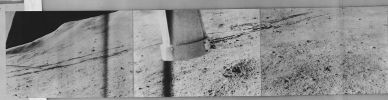
Luna21-Photomosaic-002a.jpgRover Tracks and the distant Inner Rim of LeMonnier Crater64 visitenessun commentoMareKromium
(5 voti)
|
|
| 84 immagini su 7 pagina(e) |
1 |
 |
|
|
|
|





