| Piú votate - Asteroids and Comets |

Itokawa-10.jpgSurface details (3)59 visite(B) Taking advantage of the observations made with the onboard instruments, sufficiently detailed information about the sampling sites has been obtained, and the relation between the potential samples and the spectroscopic data has been correctly correlated. As a technology demonstration mission, Hayabusa has already finished the preliminary steps towards the primary sample and return goal. These samples will provide important scientific clues concerning the puzzlingly inconsistent correlations between S-type asteroids and ordinary chondrites, and lead to an improved understanding of the space weathering effect, which may clarify our understanding of the early Solar System and Earth.
(C) Combinations of the Itokawa images along with spacecraft navigation information has enabled shape and gravity models to be numerically defined. The Science Team has started to study and identify the special mechanisms that can move boulders and regolith in the ultra-low gravity environment associated with small objects.
(8 voti)
|
|

Itokawa-07.jpgOrbiting around Itokawa (4)56 visiteThe deep-space exploration technologies that the Top World's Space Agencies are pursuing consist of 3 major elements:
1) high efficiency electric propulsion for cruise;
2) rendez-vous with target destinations and
3) round-trip flights back to the Earth.
As of this time Hayabusa has accomplished the first and second of these elements, leading the way for the Space Exploration Agencies of the World.
Furthermore, robotic sample collection and return from an extra terrestrial object has not been executed before, and is not currently planned, except for Hayabusa, which will attempt to gather a bulk sample from Itokawa.
Hayabusa’s success clearly shows that Japan’s deep space exploration technology has reached the level of the World’s most developed Space Agencies, and that Japan is now in a Leadership Position in some select engineering fields.
Thus Hayabusa opens a New Era in the exploration of the Solar System.
(8 voti)
|
|

Asteroids_from_HST-01.jpgAsteroids, from HST (2)58 visite"Many asteroids remain undiscovered. In fact, 1 was discovered in 1998 as the long blue streak in the above archival image taken by the Hubble Space Telescope. In 2002 June, the small 100-mt asteroid 2002 MN was discovered only after it whizzed by the Earth, passing well within the orbit of the Moon. 2002 MN passed closer than any asteroid since 1994 XM1 but not as close as 2004 MN4 will pass in 2029. A collision with a large asteroid would not affect Earth's orbit so much as raise dust that would affect Earth's climate. One likely result is a global extinction of many species of life, possibly dwarfing the ongoing extinction occurring now".
Dopo aver letto questi commenti la nostra memoria ritorna allo tsunami del Dicembre 2004 ed al paventato spostamento dell'asse terrestre: l'ipotesi più plausibile per spiegare l'accaduto sembra essere proprio quella che la NASA stessa ci suggerisce commentando questi frames HST: un asteroide di circa 100 metri potrebbe aver impattato l'Oceano Indiano.
C'è da riflettere.
(8 voti)
|
|
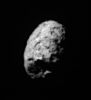
Comets-Wild_2-00.jpgApproaching Wild 2 (1)59 visiteCaption NASA originale:"This image was taken during the close approach phase of Stardust's Jan 2, 2004 flyby of comet Wild 2. It is a distant side view of the roughly spherical comet nucleus. One hemisphere is in sunlight and the other is in shadow analogous to a view of the quarter moon. Several large depressed regions can be seen. Comet Wild 2 is about 5 Km (3,1 miles) in diameter".
(8 voti)
|
|

Comets-Wild_2-03.jpgSome surface features of Wild 258 visiteCaption NASA originale:"These images taken by NASA's Stardust spacecraft highlight the diverse features that make up the surface of comet Wild 2. The three pictures on the left side show a variety of small pinnacles and mesas seen on the limb of the comet. The picture on the right shows the location of a 2-Km (1,2-mile) series of aligned scarps, or cliffs, that are best seen in the stereo images".
(8 voti)
|
|

Comets-Comet_Churyumov-Gerasimenko-cometCG01_rosetta_2048-MF-EB-LXTT-IPF.jpgA view of Comet Churyumov-Gerasimenko224 visiteUn "piccolo" Tributo dato dalla prestigiosa rubrica quotidiana NASA "Astronomy Picture Of The Day" ai nostri Amici e Partner, Marco Faccin ed Elisabetta Bonora. Guardate su http :// apod. nasa. gov/ apod/ astropix.html di lunedì, 15 Settenbre 2014. Complimenti, di Cuore! E, sia detto per Onestà Intellettuale, qui, Lunexit, non c'entra nulla. Il nostro è solo un Omaggio a due OTTIMI Partners. Ma Lunexit, su questo Lavoro, non ha credito alcuno.MareKromium
(7 voti)
|
|

Comets-Comet_Hyakutake.jpgComet Hyakutake58 visiteDa "NASA - Picture of the Day" del giorno 16 Dicembre 2009:"In 1996, an unexpectedly bright comet passed by planet Earth. Discovered less than two months before, Comet C/1996 B2 Hyakutake came within only 1/10th of the Earth-Sun distance from the Earth in late March. At that time, Comet Hyakutake, dubbed the Great Comet of 1996, became the brightest comet to grace the skies of Earth in 20 years. During its previous visit, Comet Hyakutake may well have been seen by the stone age Magdalenian culture, who 17.000 years ago were possibly among the first humans to live in tents as well as caves.
Pictured above near closest approach as it appeared on 1996 March 26, the long Ion and Dust Tails of Comet Hyakutake are visible flowing off to the left in front of a distant star field that includes both the Big and Little Dippers.
On the far left, the blue Ion Tail appears to have recently undergone a magnetic disconnection event. On the far right, the Comet's green-tinted Coma obscures a dense nucleus of melting dirty ice estimated to be about 5 Km across. A few months later, Comet Hyakutake began its long trek back to the outer Solar System.
Because of being gravitationally deflected by massive planets, Comet Hyakutake is not expected back for about 100.000 years...".MareKromium
(7 voti)
|
|

Asteroids-Asteroid_1994-CC-PIA12134.gifTriple Asteroid 1994-CC in motion (GIF-Movie; credits: NASA/JPL/GSSR)56 visiteCaption NASA:"Radar imaging at NASA's Goldstone Solar System Radar on June 12 and 14, 2009, revealed that near-Earth Asteroid 1994-CC is a Triple System.
Asteroid 1994 CC encountered Earth within 2,52 MKM (such as 1,56 MMs) on June 10. Prior to the flyby, very little was known about this celestial body. 1994 CC is only the second Triple System known in the near-Earth population. A team led by Marina Brozovic and Lance Benner, both scientists at NASA's Jet Propulsion Laboratory in Pasadena, Calif., made the discovery.
1994-CC consists of a central object about 700 meters (2300 feet) in diameter that has two smaller moons revolving around it. Preliminary analysis suggests that the two small satellites are at least 50 meters (164 feet) in diameter.
Radar observations at Arecibo Observatory in Puerto Rico, led by the center's director Mike Nolan, also detected all 3 objects, and the combined observations from Goldstone and Arecibo will be utilized by JPL scientists and their colleagues to study 1994-CC's orbital and physical properties.
The next comparable Earth flyby for Asteroid 1994-CC will occur in the year 2074 when the space rock trio flies past Earth at a distance of about 2,5 MKM (such as approx. 1,6 million miles). Of the hundreds of near-Earth asteroids observed by radar, only about 1% are Triple Systems".MareKromium
(7 voti)
|
|

Asteroids-Asteroid_1994-CC-PIA12134.jpgTriple Asteroid 1994-CC56 visitenessun commentoMareKromium
(7 voti)
|
|

Comets-Comet_Lulin_05.jpgComet Lulin and distant Galaxies57 visiteCaption NASA, da "NASA - Picture of the Day" del giorno 7 Marzo 2009:"Now fading in our night sky, Comet Lulin has provided some lovely cosmic vistas. Moving rapidly against the background of stars, Lulin briefly posed with the likes of Saturn and Regulus (Alpha Leo).
But here it is seen against a field of distant galaxies. To reveal the faint background galaxies and trace the Comet's fading tail, the remarkable picture is a blended composite of telescopic exposures aligned with the both the stars and the speedy comet. The largest galaxies seen left of the comet's head or coma are cataloged as NGC 3016, NGC 3019, NGC 3020 and NGC 3024 and lie at a distance of 100 MLY or so.
When the exposures were made, on February 28, the Lulin was about 3,6 Light-Minutes from Earth".MareKromium
(7 voti)
|
|

Comets-Comet_Lulin04-Lodriguss.jpgLulin and Saturn near Opposition59 visiteDa "NASA - Picture of the Day" del giorno 27 Febbraio 2009:"Tracking through the constellation Leo on February 23rd, bright planet Saturn and Comet Lulin were both near Opposition -- such as opposite to the Sun in Planet Earth's Sky.
They also passed within only 2° of each other creating a dramatic celestial photo-op. Comet Lulin was near its closest approach to planet Earth at the time, at a distance of some 61 MKM, but was orbiting in the opposite direction.
As a result it swept remarkably rapidly across the background of stars. This telephoto image captures both bright Saturn and greenish Lulin in the same field in a scene not too different from binocular views.
Don't recognize ringed Saturn? The rings are presently tilted nearly edge-on to our view and the brighter Planet is overexposed to record details of the fainter comet. At the upper right, Saturn is marked by multiple diffraction spikes created by the aperture blades in the telephoto lens".
MareKromium
(7 voti)
|
|

EnckeCometTailRipoff_movie_short.gifComet Encke encounters a CME58 visiteCaption NASA:"Swinging inside the orbit of Mercury, on April 20th, 2007, periodic comet Encke encountered a blast from the Sun in the form of a Coronal Mass Ejection (CME). When CMEs, enormous clouds of energetic particles ejected from the Sun, slam into Earth's magnetosphere, they often trigger auroral displays.
But in this case, the collison carried the tail of the comet away.
The tail was likely ripped off by interacting magnetic fields rather than the mechanical pressure of the collision.
This a GIF-movie showing the remarkable event as recorded by the Heliospheric Imager onboard the STEREO A spacecraft. In the movie, the time between frames is about 45 minutes, while the frames span about 14x20 MKM at the distance of the comet. Of course, similar collisions have happened before as the ancient comet loops through its 3,3 year solar orbit. So don't worry, Encke's tail will grow back!".MareKromium
(7 voti)
|
|
| 282 immagini su 24 pagina(e) |
 |
|
|
|
|
7 | |
|
|
|
|





