| |

| Piú votate - Asteroids and Comets |
Asteroid_DD-45-d.gifAsteroid 2009 DD-45 (GIF-Movie)149 visitenessun commentoMareKromium
(9 voti)
|
|
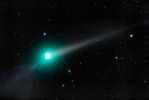
Comets-Comet_Lulin03-Richins.jpgThe Two Tails of Comet Lulin56 visiteCaption NASA:"Go outside tonight and see Comet Lulin. From a dark location, you should need only a good star map and admirable perseverance -- although wide-field binoculars might help. Yesterday, Comet Lulin passed its closest to Earth, so that the comet will remain near its brightest over the next few days. The comet is currently almost 180° around from the Sun and so visible nearly all night long, but will appear to move on the sky about 10 full moons a night. Pictured above, Comet Lulin was captured in spectacular form two nights ago from New Mexico, USA.
The central coma of the comet is appearing quite green, a color likely indicating glowing cyanogen and molecular carbon gasses. Bright stars and a distant spiral galaxy are clearly visible in the image background. The yellow dust tail, reflecting sunlight, is visible sprawling to the coma's left trailing behind the comet, while the textured bluish-glowing ion tail is visible to the coma's right, pointing away from the Sun. Over the past few weeks, from the current vantage point of Earth, these two tails appeared to point in opposite directions. Comet Lulin is expected to slowly fade over the next few weeks".MareKromium
(9 voti)
|
|
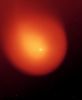
Comets-Comet_Holmes-UZ_PIA11228-1.jpgComet 17-P Holmes now in the Outer Solar System (IR)57 visiteNASA's Spitzer Space Telescope captured the picture of comet Holmes in March 2008, 5 months after the comet suddenly erupted and brightened a millionfold overnight. The contrast of the picture has been enhanced (see the next frame) to show the anatomy of the comet.
Every 6 years, comet 17P/Holmes speeds away from Jupiter and heads inward toward the Sun, traveling the same route typically without incident. However, twice in the last 116 years, in November 1892 and October 2007, comet Holmes mysteriously exploded as it approached the Asteroid Belt. Astronomers still do not know the cause of these eruptions.
Nota Lunexit: la "causa" di queste repentine eruzioni della Cometa 17-P Holmes le quali avvengono - guarda caso - durante il transito della medesima attraverso la Fascia degli Asteroidi potrebbe essere RAGIONEVOLMENTE rinvenuta nella verificazione di impatti con corpi erranti di piccole/piccolissime dimensioni (l'occorrere di impatti con uno o più oggetti di dimensioni medie o medio/grandi porterebbe inevitabilmente alla frammentazione/distruzione completa del nucleo di 17-P Holmes ed alla sua relativa e definitiva sparizione). Che gli "outbursts" possano essere (anche) l'ovvia conseguenza di un impatto ad altissima velocità è stato recentemente dimostrato dall'esperimento (come ricorderete contestatissimo) effettuato dalla NASA sulla Cometa Tempel-1, la quale fu centrata da un'ogiva metallica e, all'atto dello "scontro spaziale", aumentò la sua luminosità in maniera agevolmente percepibile anche da Terra.MareKromium
(9 voti)
|
|
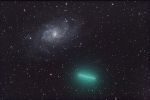
Comets-Comet_Tuttle_and_M33.jpgComet 8-P/Tuttle and M-3358 visiteCaption NASA:"This gorgeous galaxy and comet portrait was recorded on December 30th, 2007, in the skies over Hoogeveen (NL). The combined series of 60-by-60" exposures finds the lovely green coma of Comet 8P/Tuttle near its predicted conjunction with the Triangulum Galaxy.
Aligning each exposure with the stars shows the comet as a streak, slowly moving against the background stars and galaxy. An alternative composition with exposures centered on the comet, shows the background stars and galaxy as streaks.
The alluring celestial scene would also have been a rewarding one for the influential 18th Century comet hunter Charles Messier. While Messier scanned French skies for comets, he carefully cataloged positions of things which were fuzzy and comet-like in appearance but did not move against the background stars and so were definitely not comets. The Triangulum Galaxy, also known as M-33, is the 33rd object in his famous not-a-comet catalog.
The modern understanding holds that the Triangulum Galaxy is a large spiral galaxy some 3 MLY distant. Comet 8P/Tuttle, just bright enough to be visible to the unaided eye in dark, Northern Skies, is about 40 MKM (such as 2 LM - Light Minutes) away".MareKromium
(9 voti)
|
|
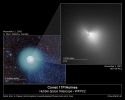
Comets-Comet_Holmes-UZ-1.jpgComet 17-P-Holmes, from Earth and from HST56 visiteNASA's HST has probed the bright core of Comet 17P/Holmes, which, to the delight of sky watchers, mysteriously brightened by nearly a millionfold in a 24-hour period beginning Oct. 23, 2007.
Astronomers used Hubble's powerful resolution to study Comet Holmes' core for clues about how the comet brightened. The orbiting observatory's Wide Field Planetary Camera 2 (WFPC2) monitored the comet for several days, snapping images on Oct. 29, Oct. 31, and Nov. 4. Hubble's crisp "eye" can see objects as small as 33 miles (54 Km) across, providing the sharpest view yet of the source of the spectacular brightening.
The Hubble image at right, taken Nov. 4, shows the heart of the comet. The central portion of the image has been specially processed to highlight variations in the dust distribution near the nucleus. About twice as much dust lies along the east-west direction (the horizontal direction) as along the north-south direction (the vertical direction), giving the comet a "bow tie" appearance.
The composite color image at left, taken Nov. 1 by an amateur astronomer, shows the complex structure of the entire coma, consisting of concentric shells of dust and a faint tail emanating from the comet's right side.
The nucleus-the small solid body that is the ultimate source of all the comet's activity- is still swaddled in bright dust, even 12 days after the spectacular outburst. "Most of what Hubble sees is sunlight scattered from microscopic particles," explained Hal Weaver of The Johns Hopkins University Applied Physics Laboratory in Laurel, Md., who led the Hubble investigation. "But we may finally be starting to detect the emergence of the nucleus itself in this final Hubble image."
Hubble first observed Comet 17P/Holmes on June 15, 1999, when there was virtually no dusty shroud around the nucleus. Although Hubble cannot resolve the nucleus, astronomers inferred its size by measuring its brightness. Astronomers deduced that the nucleus' diameter was approximately 2.1 miles (3.4 kilometers), about the length of New York City's Central Park. They hope to use the new Hubble images to determine the size of the comet's nucleus to see how much of it was blasted away during the outburst.
Hubble's two earlier snapshots of Comet Holmes also showed some interesting features. On Oct. 29, the telescope spied three "spurs" of dust emanating from the nucleus, while the Hubble images taken on Oct. 31 revealed an outburst of dust just west of the nucleus.
The Hubble images, however, do not show any large fragments near the nucleus of Comet Holmes, unlike the case of Comet 73P/Schwassmann-Wachmann 3 (SW3). In the spring of 2006 Hubble observations revealed a multitude of "mini-comets" ejected by SW3 after the comet increased dramatically in brightness.
Ground-based images of Comet Holmes show a large, spherically symmetrical cloud of dust that is offset from the nucleus, suggesting that a large fragment broke off and subsequently disintegrated into tiny dust particles after moving away from the main nucleus.
Unfortunately, the huge amount of dust near the comet's nucleus and the comet's relatively large distance from Earth (149 million miles, or 1.6 astronomical units, for Holmes versus 9 million, or 0.1 astronomical unit for SW3), make detecting fragments near Holmes nearly impossible right now, unless the fragments are nearly as large as the nucleus itself.
The Hubble Comet Holmes observing team comprises H. Weaver and C. Lisse (The Johns Hopkins University Applied Physics Laboratory); P. Lamy (Laboratoire d'Astrophysique de Marseille, France); I. Toth (Konkoly Observatory, Hungary); M. Mutchler (Space Telescope Science Institute); W. Reach (California Institute of Technology); and J. Vaubaillon (California Institute of Technology).
MareKromium
(9 voti)
|
|

Comets-Comet_Holmes-UZ.jpgComet 17-P-Holmes, from Italy64 visiteRecent development from 17-P-Holmes: this picture is a deep image from L'Aquila, Italy on November 8, 2007.
It shows the ion tail disconnecting from the comet (just like it happened to the Encke Comet).
MareKromium
(9 voti)
|
|

Comets-Comet_Holmes-TView.jpgTelescopic View of the Comet Holmes57 visiteCaption NASA, da "NASA - Picture of the Day" del 29 Ottobre 2007:"What's happened to Comet Holmes? A normally docile comet discovered over 100 years ago, Comet 17P/Holmes suddenly became nearly one million times brighter last week, possibly over just a few hours. In astronomical terms, the comet brightened from magnitude 17, only visible through a good telescope, to magnitude 3, becoming visible with the unaided eye. Comet Holmes had already passed its closest to the Sun in 2007 May outside the orbit of Mars and was heading back out near Jupiter's orbit when the outburst occurred. The comet's sudden brightening is likely due to some sort of sunlight-reflecting outgassing event, possibly related to ice melting over a gas-filled cavern, or possibly even a partial breakup of the comet's nucleus. Pictured above through a small telescope, Comet Holmes appeared as a fuzzy yellow spot, significantly larger in angular size than Earth-atmosphere blurred distant stars. Although Comet Holmes' orbit will place it in northern hemisphere skies for the next two years, whether it will best be viewed through a telescope or sunglasses remains unknown".MareKromium
(9 voti)
|
|

Comets-Comet_Holmes.jpgComet 17-P-Holmes56 visiteCaption NASA, da "NASA - Picture of the Day" del 26 Ottobre 2007:"Comet 17 P-Holmes stunned comet watchers across planet Earth earlier this week.
On October 24th, 2007, it increased in brightness over half a million times in a matter of hours. The outburst transformed it from an obscure and faint comet quietly orbiting the Sun with a period of about 7 years to a naked-eye comet rivaling the brighter stars in the constellation of Perseus. Recorded on that date, this view from Teheran, Iran, highlights the comet's (enhanced and circled) dramatic new visibility in urban skies.
The inset (left) is a telescopic image from a backyard in Buffalo, New York showing the comet's greatly expanded coma, but apparent lack of a tail. Holmes' outburst could be due to a sudden exposure of fresh cometary ice or even the breakup of the comet nucleus. The comet may well remain bright in the coming days".MareKromium
(9 voti)
|
|

McNaught-08.jpgComet McNaught (9)57 visiteCaption NASA originale:"Comet McNaught, the Great Comet of 2007, has grown a long and filamentary tail. The spectacular tail spreads across the sky and is visible to Southern Hemisphere observers just after sunset. The head of the comet remains quite bright and easily visible to even city observers without any optical aide. The amazing tail is visible on long exposures and even to the unaided eye from a dark location. Reports even have the tail visible just above the horizon after sunset for many Northern observers as well. Comet McNaught, estimated at magnitude - 2 (minus two), was caught by the comet's discoverer in the above image just after sunset last Friday from Siding Spring Observatory in Australia.
Comet McNaught, the brightest comet in decades, is now fading as it moves further into Southern Skies and away from the Sun and Earth".MareKromium
(9 voti)
|
|

Comets-Comet_Machholtz.jpgComet Machholtz, from SST57 visitenessun commentoMareKromium
(9 voti)
|
|

Comets-Comet_SWAN-0.jpgComet SWAN87 visiteDa "NASA - Picture of the Day", del 19 Ottobre 2006:" This cosmic portrait recorded October 9th features the lovely blue-green coma of Comet SWAN posing with spiral galaxy NGC 5005 in the northern constellation Canes Venatici. At the time the comet (center) was in the close foreground, a mere 9 LM (Light-Minutes) from planet Earth, with the galaxy a more substantial 60 million LY (Light-Years) distant. Not actually related to a bird, Comet SWAN (C/2006 M4) was so named as it was first spotted in image data from the SWAN (Solar Wind ANisotropies) camera aboard the Sun-staring SOHO spacecraft. Having rounded the Sun, this comet is headed for interstellar space, but first it will make its closest approach to Earth on October 24. With binoculars, northern hemisphere observers can now spot the comet above the northwestern horizon, near the handle of the Big Dipper in the early evening sky".
(9 voti)
|
|

Itokawa-09.jpgSurface details (2)57 visiteA) Morphological and geological discoveries about Itokawa: the a-priori theoretical assumption that small near-Earth asteroids should have geologically homogeneous features was completely overturned by the observation of a wide variety of surface features and types at Itokawa. The surface is covered with huge boulders and, for the first time, naked surfaces not covered with regolith have been exposed. Previously visited asteroidswere covered with thick regolith, thus Itokawa’s surface is like nothing that has seen before, which is quite fortunate for the Hayabusa Mission. The opportunity to observe the true asteroid surface, which isusually concealed from view, advancesour understanding of spectroscopic observations of asteroids taken from Earth, and allows us to expand our knowledge of near Earth asteroids.
(9 voti)
|
|
| 282 immagini su 24 pagina(e) |
|
|
4 | |
|
|
|
|
|
|
|
|
|





