| Piú votate - Asteroids and Comets |

Comets-Comet_Holmes-UV.gifComet 17-P-Holmes57 visiteCaption NASA, da "NASA - Picture of the Day" del 30 Ottobre 2007:"Go outside tonight and see Comet Holmes.
No binoculars or telescopes are needed -- just curiosity and a sky map.
Last week, Comet 17P/Holmes underwent an unusual outburst that vaulted it unexpectedly from obscurity into one of the brightest comets in recent years.
Sky enthusiasts from the Northern Hemisphere have been following the comet's progress closely. Pictured above Quebec, Canada, the coma of Comet Holmes has been noticeably expanding over the past few days. In the above picture, an image of Jupiter has been placed artificially nearby to allow for a comparison of angular sizes.
Jupiter has been scaled to the size it would appear at the current location of Comet Holmes. How Comet Holmes will further evolve is unknown, with one possibility being that the expanding gas cloud that started from its recent outburst will slowly disperse and fade".MareKromium
(10 voti)
|
|

Itokawa-06.jpgOrbiting around Itokawa (3)58 visiteSpecifically, at the time of arrival at Itokawa, Hayabusa had driven its proprietary new ion engines for 26.000 hours, including their operation during an Earth flyby.
It has also perfectly completed a period of hybrid optical navigation followed by
precise guidance and navigation of the spacecraft during its station keeping period around Itokawa.
These engineering achievements are the primary mission of Hayabusa and their successful completion is a great achievement.
(10 voti)
|
|

Itokawa-05.jpgOrbiting around Itokawa (2)65 visiteHayabusa is a technology demonstration spacecraft focusing on key technologies that are required for future large-scale sample and return missions, yet is also making new scientific observations and discoveries. The technology demonstration component of the mission consists of 5 goals:
1) ion engine propulsion in interplanetary cruise;
2) ion engine propulsion in combination with an Earth gravity assist;
3) autonomous guidance and navigation using optical measurements;
4) collection of surface samples in an ultra-low gravity environment and
5) the direct recovery of these samples on the ground after its return from interplanetary flight.
To date the Hayabusa project has accomplished these demonstrations up through
the third goal.
(10 voti)
|
|

Itokawa~0.jpgClosing on Itokawa58 visiteItokawa: un asteroide che sembra contraddire tutto quanto viene dato per acquisito nel campo delle forme esteriori e dei rilievi superficiali dei corpi (teoricamente) esposti a pesantissimi azioni di impatto sin dagli albori della loro esistenza. Pensate a 433-Eros, oppure a Ceres, o Dactyl o a qualsiasi altro corpo similare che abbiamo avuto occasione di vedere da distanza ravvicinata. Forse il solo asteroide AnneFrank non sembra presentare una particolare craterizzazione (ma le immagini, di cattiva qualità, non possono essere considerate definitorie) e quindi si viene a porre nel novero delle rarità. Tuttavia, quello che vediamo adesso, è ben più che un'eccezione e molto di più di un'Anomalìa: Itokawa NON ha alcun cratere superficiale visibile e le sue forme, spigolose ed a tratti aguzze, costituiscono una novità assoluta per i Ricercatori e gli Studiosi di Scienze Planetarie.
Original caption:"Where are the craters on asteroid Itokawa? No one knows. The Japanese robot probe Hayabusa recently approached the Earth-crossing asteroid and is returning pictures showing a surface unlike any other Solar System body yet photographed -- a surface possibly devoid of craters. One possibility for the lack of common circular indentations is that asteroid Itokawa is a rubble pile -- a bunch of rocks and ice chunks only loosely held together by a small amount of gravity. If so, craters might be filled in whenever the asteroid gets jiggled by a passing planet -- Earth in this case. Alternatively, surface particles may become electrically charged by the Sun, levitate in the microgravity field, and move to fill in craters. Over the weekend, Hayabusa lowered itself to the surface of the strange asteroid in an effort to study the unusual body and collect surface samples that could be returned to Earth in 2007".
(10 voti)
|
|

Tempel1-ZZ-ZI.jpgA few seconds before the "Space-Fireworks"56 visiteDa "NASA - Picture of the Day" del 15 Settembre 2005:"Approaching the nucleus of comet Tempel 1 at 10 Km/sec., the Deep Impact probe's targeting camera recorded a truly dramatic series of images. Successive pictures improve in resolution and have been composited here at a scale of 5 mt per pixel - including images taken within a few meters of the surface moments before the July 4th impact. Analyzing the resulting cloud of debris, researchers are directly exploring the makeup of a comet, a primordial chunk of Solar System material. Described as a recipe for primordial soup, the list of Tempel 1's ingredients - tiny grains of silicates, iron compounds, complex hydrocarbons and clay and carbonates thought to require liquid water to form - might be more appropriate for a cosmic souffle, as the nucleus is apparently porous and fluffy.
Seen here, Tempel 1's nucleus is about 5 Km long, with the impact site between the two large craters near the bottom".
(10 voti)
|
|

Tempel1-U-HST.jpgDeep-impact from HST55 visiteCaption NASA originale:"These 2 pictures of comet Tempel-1 were taken by NASA's HST. They show the comet before and after it ran over NASA's Deep Impact probe".
(10 voti)
|
|

Comets-Halley-30155.jpgThe Halley Comet, from Giotto58 visiteCaption ESA originale:"A composite image of the nucleus of comet Halley. This image is composed of 68 images of varying resolution. The data at the brightest point on the nucleus is at the highest resolution (50 m).
The Sun comes from 30° above the horizontal to the left and is 17° behind the image plane (observation phase angle of 107°). The night side of the nucleus can be seen silhouetted against a background of bright dust in the far-field. Jets can be seen originating from 2 regions on the nucleus. Structure can be seen within the jets. A bright area is seen within the night side of the nucleus. We believe this to be a hill or mountain approximately 500 mt high. Other surface details can be seen in the illuminated region".
(10 voti)
|
|

Mathilde-PIA02479.jpgMathilde71 visiteCaption NASA originale:"Two different views of asteroid 253 Mathilde were obtained by the NEAR spacecraft on June 27, 1997. The image at left was obtained as the spacecraft approached Mathilde with its camera pointed near the direction of the Sun; only a few of the prominent ridges on Mathilde are illuminated. The visible area at left is 29 Km (approx. 18 miles) high and the phase angle (the angle from Sun-Mathilde spacecraft) is 136°. As the spacecraft receded from Mathilde, it observed the asteroid (about 60 Km - or 38 miles across) almost fully lit by the Sun at a phase angle of 43° (right image). Mathilde's irregular shape results from a long history of severe collisions with smaller asteroids. The largest visible crater is about 30 Km (19 miles) in diameter".
(10 voti)
|
|

Mathilde-PIA02494.jpgMathilde and Eros: C-Type and S-Type59 visiteCaption NASA originale:"In this montage, Mathilde (at left) and Eros (at right) are shown at the same scale, as they were imaged by NEAR Shoemaker from about 1.800 Km on June 27, 1997, and February 12, 2000, respectively. Mathilde is 56 Km across and Eros is 33 Km long and 13 Km wide. However, Mathilde's brightness is greatly exaggerated for viewing purposes - it's actually 6 times darker than Eros, with about the same reflectivity as soot! In a scheme that reflects how asteroids have historically been a topic for astronomy, not geology, they are classified into groups based on their colors as observed through telescopes. The 2 major classes of asteroids are called S-Types and C-Types. S-Types, whose colors are consistent with "stony" or rocky compositions, prevail among asteroids that orbit closer to the Sun than the mid-point of the asteroid belt. Eros and the 2 asteroids encountered briefly by the Galileo spacecraft on its way to Jupiter - Gaspra and Ida - are all S-Types. C-Types like Mathilde have a dark gray color consistent with a "carbonaceous" composition, rich in carbon compounds and other dark materials. They prevail in the outer part of the asteroid belt".
(10 voti)
|
|

Comets-Machholz___Meteor.jpgComet Machholz and a "corkscrew" meteor56 visiteCaption NASA originale:"Meteor trains (train--->trajectory) that twist noticeably are rare but have been noted before. The underlying reason for unusual meteors trains is that many meteors are markedly non-spherical in shape and non-uniform in composition. Meteors, usually sand sized grains that originate in comets, will disintegrate as they enter the Earth's atmosphere. Non-uniform meteors may evaporate more on one side than another. This may cause a rotating meteor to wobble slightly in its path, and also to spray fast moving debris in a nearly spiral path. The fast moving meteor debris ionizes molecules in the Earth's atmosphere that subsequently glow when they reacquire elections. Surely no meteor is perfectly uniform and spherical, so that a slight swagger that is below perceptibility is likely typical. Meteors may well have seeded Earth with the prebiotic molecules that allowed for the development of life".
(10 voti)
|
|
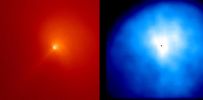
Comets-Comet_Hyakutake-PIA01288_modest.jpgThe "Hyakutake" Comet58 visiteOriginal caption:"These are 2 images of the inner coma of Comet Hyakutake made on April 3 and 4, 1996, using the NASA HST-WFPC2. The 1st one, shown in red, was taken through a narrow-band red filter that shows only sunlight scattered by dust particles in the inner coma of the comet. The 2nd one, shown in blue, was taken with an ultraviolet "Woods" filter image that shows the distribution of scattered ultraviolet radiation from H atoms in the inner coma (the "coma" is the head - or dusty-gas atmosphere - of a comet). The square field of view is 14.000 Km on a side and the Sun is toward the upper right corner of the image. H atoms represent the most abundant gas in the whole coma of the comet. They are produced when solar ultraviolet light breaks up molecules of water, the major constituent of the nucleus of the comet. The inner yellow region near the center of the red dust image is dominated by the contribution from the dust which shows sunward directed spiral jets to the upper right".
(10 voti)
|
|

Comets-Comet_Hartley_2-MF-LXTT3.jpgComet "Hartley 2" (possible Natural Colors; credits for the additional process. and color.: Dr Marco Faccin - Lunexit Team)119 visitenessun commentoMareKromium
(9 voti)
|
|
| 282 immagini su 24 pagina(e) |
 |
3 | |
|
|
|
|
|
|
|
|





