| Piú votate - Asteroids and Comets |

Asteroids-Annefrank_Asteroid-PIA02885_modest.jpgAsteroid Annefrank from Stardust66 visiteAsteroid Annefrank is seen as irregularly shaped, cratered body in an image taken by NASA's Stardust spacecraft during a Nov. 2 flyby of the asteroid.
Stardust flew within about 3.300 Km (about 2.050 miles) of the asteroid as a rehearsal for the spacecraft's encounter with its primary target, comet Wild 2, in January 2004. The camera's resolution was sufficient to show that Annefrank is about 8 Km (5 miles) in length, twice the predicted size from Earth-based observations. The surface reflects about 0,1 to 0,2% of sunlight, slightly less than anticipated. A few craters that are hundreds of meters across can be seen. The straight edge in the right side of the image may be an artifact of processing.
(15 voti)
|
|
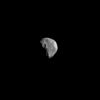
DACTYL-PIA00297.jpgAsteroid Dactyl59 visiteThis image is the most detailed picture of the recently discovered natural satellite of asteroid 243 Ida taken by the Galileo Solid-State Imaging camera during its encounter with the asteroid on August 28, 1993. Shuttered through the camera's broadband clear filter as part of a 30-frame mosaic designed to image the asteroid itself, this frame fortuitously captured the previously unknown moon at a range of about 3,900 kilometers (2,400 miles), just over 4 minutes before the spacecraft's closest approach to Ida. Each picture element spans about 39 meters (125 feet) on the surface of the moon. More than a dozen craters larger than 80 meters (250 feet) in diameter are clearly evident, indicating that the moon has suffered numerous collisions from smaller Solar System debris during its history. The larger crater on the terminator is about 300 meters (1,000 feet) across.
(7 voti)
|
|

Tempel 1-PIA07879.jpgComet "Tempel 1"57 visiteCaption NASA originale:"Sixty-nine days before it gets up-close-and-personal with a comet, NASA's Deep Impact spacecraft successfully photographed its quarry, comet Tempel 1, at a distance of 39,7 MMs. The image, taken on April 25, 2005, is the first of many comet portraits Deep Impact will take leading up to its historic comet encounter on July 4, 2005".
(6 voti)
|
|

Comets-Comet_Ikeya_Zhang_2.jpgComet Ikeya-Zhang (from Colorado)63 visiteThis lovely early evening view of the comet in Rocky Mountain skies looks northwest over ridges and low clouds. The time exposure was recorded on March 31st from an 8.000 foot elevation near Yampa, Colorado, USA. Sporting a sweeping yellowish dust tail and blue ion tail eight to ten degrees long, Ikeya-Zhang is nestled near the horizon in the northern constellation of Andromeda. To the comet's left is the bright star Mirach or Beta Andromedae while the stretched celestial fuzzball to the comet's right is M 31 or the Andromeda galaxy, the nearest bright spiral galaxy to our own Milky Way. As the days pass, Comet Ikeya-Zhang's apparent motion through the sky is towards the right in this image. Tonight, comet-watchers blessed with clear skies should find Ikeya-Zhang posing perfectly for binoculars and cameras just above M 31, less than two degrees from the center of the bright galaxy.
(16 voti)
|
|

Haumea2.jpgHaumea and other "Dwarf" Companions56 visiteCaption NASA:"One of the strangest objects in the Outer Solar System was classified as a Dwarf Planet last week (September 2008) and given the name Haumea.
This designation makes Haumea the 5th designated Dwarf Planet after Pluto, Ceres, Eris, and Makemake. Haumea's smooth but oblong shape make it extremely unusual. Along one direction, Haumea is significantly longer than Pluto, while in another direction Haumea has an extent very similar to Pluto, while in the third direction is much smaller.
Haumea's orbit sometimes brings it closer to the Sun than Pluto, but usually Haumea is further away.
Illustrated above, an artist visualizes Haumea as a nearly featureless ellipsoid. Quite possibly, however, Haumea has interesting craters and surface features that currently remain unknown. Originally discovered in 2003 and given the temporary designation of 2003 EL61, Haumea was recently renamed by the IAU for a Hawaiian goddess. Haumea has two small moons discovered in 2005, recently renamed Hi'iaka and Namaka after the daughters of the Goddess".MareKromium
(5 voti)
|
|

Tempel1-q.jpg13 MKM from Comet Tempel 157 visiteDa "NASA - Picture of the Day" del 29 Giugno 2005:"The Deep Impact spacecraft continues to close on Comet Tempel 1, a comet roughly the size of Manhattan. Early on July 3 (EDT), the Deep Impact spacecraft will separate in to 2 individual robotic spaceships, one called Flyby and the other called Impactor. During the next 24 hours, both Flyby and Impactor will fire rockets and undergo complex maneuvers in preparation for Impactor's planned collision with Comet Tempel 1. On July 4 (1:52 am EDT) if everything goes as scheduled, the 370-Kg Impactor will strike Tempel 1's surface at over 14.000 Km p.h.. Impactor will attempt to photograph the oncoming comet right up to the time of collision, while Flyby photographs the result from nearby. The above image was taken on 19 June from about 13 MKM out and used to help identify the central nucleus of the comet inside the diffuse coma. Telescopes around the Earth, including the HST, will also be closely watching the distant silent space bullet".
(5 voti)
|
|

DACTYL-PIA00298.jpgAsteroid Dactyl58 visiteWithin seconds of its closest approach to the asteroid 243 Ida on August 28, 1993, the Galileo spacecraft's Solid State Imaging camera caught this glimpse of Ida's previously unknown moon orbiting the asteroid. One frame of a 15-image set designed to capture a view of Ida at the highest possible resolution landed by chance with its edge right on the little moon. The range from the spacecraft was about 2.400 Km and each picture element spans about 24 meters (80 feet) on the surface of the moon. Only a small sliver of the sunlit crescent is visible at the edge of the frame (which was shifted inward toward the center in this frame). Dactyl is approximately egg-shaped, measuring about 1.2 x 1.4 x 1.6 Km (0.75 x 0.87 x 1 mile). At the time this image was shuttered, Ida was about 90 Km (56 miles) away from the moon, outside this frame to the left and slightly below center. The smoothly curving shape of the dark edge of Ida's moon can be seen on the left. The moon's observed darkside was just barely detectable.
(8 voti)
|
|

Asteroids-Opportunity-041007163946.jpgThe path to immortality: an asteroid named "Opportunity"57 visiteL'immortalità (o quasi), in qualche modo, le Sonde Spirit ed Opportunity sono riuscite a guadagnarsela: il lavoro svolto dai due Rover, infatti, è stato (ed è tuttora) così prezioso e scientificamente significativo che si è pensato - ed è la prima volta in assoluto che accade una cosa simile - di dedicare ai due robot (e NON, quindi, ad un "essere umano"...) due asteroidi scoperti all'inizio degli anni '60, ma definitivamente riconosciuti e codificati - mediante l'assegnazione di un numero seriale ufficiale - solo nel 2002 (in questo caso, però, non si è trattato di inefficienza, bensì di ottemperanza alle rigide regole stabilite dalla IAU - International Astronomical Union - le quali "...require asteroids to be observed during 4 separate cycles around the Earth and Sun before they become eligible for numbering and naming...").
(19 voti)
|
|

Asteroids-Hygiea.jpgAsteroid 10 Hygiea80 visiteGrazie al lavoro della "Two Micron All Sky Survey - 2MASS" siamo in grado di offrirvi le immagini di qualche asteroide del tutto sconosciuto (crediamo) a coloro che non siano - in qualche modo - direttamente "addetti ai lavori" nei Campi dell'Astronomia e/o dell'Astrofisica (Studenti delle due Discipline inclusi).
Si tratta di immagini che non ci dicono molto, dal punto di vista di un eventuale studio delle caratteristiche superficiali di questi oggetti (a dire il vero una cosa sembrano dirla: si tratta di oggetti davvero molto luminosi!), ma che, in ogni caso, rimangono molto suggestive e sono capaci di mostrarci dei "frammenti" di Cielo che contengono, oltre ai cosiddetti "corpi fissi" (cioè stelle e galassie), anche degli oggetti "mutevoli e transitori" (almeno dal punto di vista di chi li osserva).
Gli Asteroidi, appunto.
(18 voti)
|
|

Asteroids-1992-CO.jpgAsteroid 1992 CO58 visitenessun commento
(17 voti)
|
|

Asteroids-Pallas.jpgAsteroid 2 Pallas56 visitenessun commento
(17 voti)
|
|

Asteroids-Spirit-041007163903.jpgThe path to immortality: an asteroid named "Spirit"56 visiteEd ora qualche dato NASA ufficiale relativamente ai due asteroidi: Spirit dovrebbe avere un diametro compreso fra i 4 ed i 9 Km mentre il diametro di Opportunity oscillerebbe fra i 3 ed i 7. Sia Spirit che Opportunity sono fisicamente posizionati ad una distanza intermedia fra Marte e Giove, all'interno di un piccolo Gruppo di asteroidi conosciuto come "Hilda" ed entrambi impiegano poco meno di 8 anni per compiere un'intera orbita attorno al Sole. Nessuno dei due corpi celesti si muove su una traiettoria tale da poterlo condurre ad incrociare l'orbita di altri Pianeti e nè Spirit, nè Opportunity, inoltre (ed in base ai dati in nostro possesso), dovrebbero mai risentire in maniera critica e decisiva dell'immensa influenza gravitazionale di Giove. Ed infine una curiosità: il Gruppo di asteroidi "Hilda" si caratterizza per avere un periodo di "risonanza orbitale", rispetto a Giove, di 3 a 2 (solo un modo difficile per dire che, per ogni 2 orbite complete di Giove attorno al Sole, il Gruppo "Hilda" ne compie 3).
(17 voti)
|
|
| 282 immagini su 24 pagina(e) |
 |
|
|
|
|
|
|
|
|
23 |
|





