| |

| Piú votate - Asteroids and Comets |

EROS-PIA02905-0.jpgEros (the BIG Pseudo-Anomaly)140 visiteThis image of Eros, taken from the NEAR Shoemaker spacecraft on May 1, 2000, is among the first to be returned from "low orbit." Between May and August, the spacecraft orbited at altitudes near 50 Km or less. This will be the prime period of activity for some of the spacecraft's science instruments. The X-ray / gamma-ray spectrometer will build up maps of chemical abundances, while the laser rangefinder measures the shape of Eros to within meters (a few feet). At the same time the magnetometer will watch for indications of Eros' magnetic field and the near-infrared spectrometer will map rock types. The imager will take pictures of the entire surface of Eros that capture features as small as 4 meters (13 feet) across. This particular image, taken from an orbital altitude of 53 Km, shows a scene about 1.8 Km across. Numerous craters and boulders as small as 8 meters (26 feet) across dot the landscape. The large, rectangular boulder at the upper right is about 45 meters across.
(13 voti)
|
|

Comets-Comet_Holmes-UZ-1.gifBigger than the Sun!56 visiteCaption NASA:"The spherical coma of Comet Holmes has swollen to a diameter of over 1,4 MKM, making the tenuous, dusty cloud even bigger than the Sun. Scattering sunlight, all that dust and gas came from the comet's remarkably active nucleus, whose diameter before the late October outburst was estimated to be a mere 3,4 Km.
In this sharp image, recorded on November 14, 2007, with the Canada-France-Hawaii Telescope, stars are easily visible right through the outer coma, while the nucleus is buried inside the condensed, bright region. The bright region of the coma seems offset from the center, consistent with the idea that a large fragment drifted away from the nucleus and disintegrated, producing the comet's spectacular outburst. Of course, more recent images of Holmes also show the bright star Mirfak (Alpha Persei) shining through as the comet sweeps slowly through the constellation Perseus".MareKromium
(12 voti)
|
|

Comets-Comet_Holmes-TW-P17HolmesWeb3_goldman.jpgComet 17-P-Holmes and its Golden Coma58 visiteCaption NASA, da "NASA - Picture of the Day", del 3 Novembre 2007:"Surprising Comet Holmes remains easily visible as a round, fuzzy cloud in the Northern constellation Perseus. Skywatchers with telescopes, binoculars, or those that just decide to look up can enjoy the Solar System's latest prodigy as it glides about 150 MKM from Earth, beyond the orbit of Mars.
Still expanding, Holmes now appears to be about 1/3 the size of the Full Moon, and many observers report a yellowish tint to the dusty coma. A golden color does dominate this telescopic view recorded on November 1, showing variations across the coma's bright central region.
But where's the comet's tail? Like any good comet, Holmes' tail would tend to point away from the Sun. That direction is nearly along our line-of-sight behind the comet, making its tail very difficult to see". MareKromium
(12 voti)
|
|

Comets-Comet_Pojmanski-2.jpgThe "Pojmanski" Comet58 visiteE' passata inosservata, lontana dalla nostra Terra, ed è stata ben lungi dall'essere spettacolare come lo fu, qualche anno fa, la meravigliosa Hale-Bopp.
Certo, la cometina Pojmanski non aveva - forse - i numeri giusti per entrare nell'Albo delle (cosiddette) Grandi Comete, ma certo è che i media (TUTTI!) se ne sono guardati bene dal pubblicizzarla. E la NASA? Leggerete Voi stessi le scarne note prodotte al riguardo nel "NASA - Picture of the Day" del giorno 6 Marzo 2006. Noi, nel nostro piccolo, dato che ci meravigliamo per niente, siamo andati in cerca di fotografie di questa cometa ed abbiamo "scoperto" una straordinaria somiglianza fra C/2006 A1 (la Pojmanski Comet appunto) e la C/2004 Q2 (meglio nota come Machholz Comet). Uguale tipologia - o classe visuale - di appartenenza (nucleo sferico e chioma filiforme) e, soprattutto, uguale colore (ergo uguale - o comunque molto simile - composizione chimica). Deduzione logica: si tratta di "Sister-Comets". Domanda: ci sono altre "sorelle" in arrivo?!?
Have you ever seen a comet? Comets bright enough to be visible to the unaided eye appear only every few years. Right now, however, a new comet has brightened unexpectedly and is visible as a faint streak to the unaided northern observer in the eastern morning sky just before sunrise. Binoculars may help. Comet Pojmanski, officially designated C/2006 A1 and discovered only in January, now sports a turquoise tail several times longer than the full moon. Comet Pojmanski's ion tail is due to gas particles expelled by the comet being pushed away from the Sun by the solar wind, the same wind that ionizes gas in the tail causing its blue tint. Pictured above as it appeared only last week, Comet Pojmanski has now begun to fade as its orbit around the Sun takes it further from the Earth.
(12 voti)
|
|

Asteroids-Asteroid_2002JF56-PIA09230-01.jpgFormer "Unknown Asteroid" is now "Asteroid 2002 JF56"59 visiteThe two "spots" in this image are a composite of two images of asteroid 2002 JF56 taken on June 11 and June 12, 2006, with the Multispectral Visible Imaging Camera (MVIC) component of the New Horizons Ralph imager. In the bottom image, taken when the asteroid was about 3,36 MKM (approx. 2,1 MMs) away from the Spacecraft, 2002 JF56 appears like a dim star. At top, taken at a distance of about 1,34 MKM (such as about 833.000 miles), the object is more than a factor of six brighter.
The best current, estimated diameter of the asteroid is approx. 2,5 Km.
The asteroid observation was a chance for the New Horizons team to test the spacecraft's ability to track a rapidly moving object. On June 13 New Horizons came to within about 102.000 Km of the small asteroid, when the Spacecraft was nearly 368 MKM (about 228 MMs) from the Sun and about 273 MKM (approx 170 MMs) from Earth.MareKromium
(11 voti)
|
|

Comets-Comet_Holmes-UW.jpgComet 17-P-Holmes is getting Bigger!63 visiteCaption NASA, da "NASA - Picture of the Day", del 5 Novembre 2007:"Comet Holmes continues to be an impressive sight to the unaided eye. The comet has diminished in brightness only slightly, and now clearly appears to have a larger angular extent than stars and planets.
Astrophotographers have also noted a distinctly green appearance to the comet's coma over the past week.
Pictured above over Spain in 3 digitally combined exposures, Comet 17P/Holmes now clearly sports a tail. The blue ion tail is created by the solar wind impacting ions in the coma of Comet Holmes and pushing them away from the Sun. Comet Holmes underwent an unexpected and dramatic increase in brightness starting only two weeks ago. The detail visible in Comet Holmes' tail indicates that the explosion of dust and gas that created this dramatic brightness increase is in an ongoing and complex event.
Comet Holmes will move only slightly on the sky over the next month (such as December 2007)".MareKromium
(11 voti)
|
|

Comets-Comet_Pojmanski-4.jpgThe "Pojmanski" Comet (HR)62 visiteComet Pojmanski flew by planet Earth last weekend (March 4/5, 2006) on a surprise trip through the Inner Solar System. (...)
Pojmanski ultimately showed off a long tail, but also presented some lovely green-blue hues as gas molecules in its tenuous coma and tail fluoresced in the sunlight. Astronomers Adam Block and Jay GaBany recorded this colorful HR view on March 3rd, 2006, in the darkness just before twilight. The picture spans about two full moons on the sky. Comet Pojmanski (C/2006 A1) is outward bound and fading now, still visible in binoculars for northern hemisphere observers.
(11 voti)
|
|

Itokawa-03.pngThe Southern Hemisphere of Itokawa58 visiteAfter reaching the sub-solar point, Hayabusa started to travel out of the ecliptic plane to observe the polar regions of Itokawa. This image shows the Southern Hemisphere
of Itokawa. Due to the low altitude and solar elevation angles, we can see detailed topography in the high-latitude regions. There are even some boulders on Muses-Sea, which looked very smooth in previous observations. Imagine one of these boulders flying in space. If it came to the Earth's vicinity, we would observe it as a tiny independent near-Earth asteroid. It has long been conjectured that meteorites are fragments of asteroids delivered to the Earth's surface, but it remains to be proven. The samples of Itokawa collected and returned by Hayabusa could provide the first direct evidence of the link between asteroids and meteorites.
(11 voti)
|
|

Tenth_Planet-03.jpgThe 10th Planet? (3)56 visiteDa "NASA - Picture of the Day", del 1mo Agosto 2005:"Has a tenth planet been discovered? A newly discovered object, designated 2003 UB313 and located more than twice the distance of Pluto, is expected to be at least as large as Pluto and probably larger, given current measurements. 2003 UB313's dimness and highly tilted orbit (44°) prevented it from being discovered sooner. Many astronomers speculate that numerous other icy objects larger than Pluto likely exist in the Kuiper Belt of the far distant Solar System. If so, and if some are found closer in than 2003 UB313, it may be premature to call 2003 UB313 the tenth planet. Illustrated above is an artist's drawing showing what 2003 UB313 might look. The unusually bright star on the right is the Sun. Much of the world eagerly await the decision by the International Astronomical Union on whether 2003 UB313 will be designated a planet or given a name without subscripts".
(11 voti)
|
|
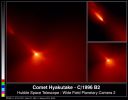
Comets-Comet_Hyakutake-PIA01290_modest.jpgThe "Hyakutake" Comet55 visiteFULL-FIELD VIEW (Left)--->This image is 3340 Km acroos and shows that most of the dust is being produced on the sunward-facing hemisphere of the comet. Also at upper left are 3 small pieces which have broken off the comet and are forming there own tails. Icy regions on the nucleus are activated as they rotate into sunlight, ejecting large amounts of dust in the jets that are faintly visible in this image. Sunlight striking this dust eventually turns it around and "blows" it into the tailward hemisphere. What might be another jet is emanating from the nightside of the nucleus, but this direction might be misleading due to the angle of the jet relative to our line-of-site.
CLOSE-UP OF NUCLEUS (Bottom Right) This expanded view of the near-nucleus region is only 760 Km across. The nucleus is near the center of the frame, but the brightest area is probably the tip of the strongest dust jet rather than the nucleus itself. Presumably, the nucleus surface lies just below this bright jet.
CLOSE-UP OF COMET FRAGMENTS (Top Right) This image shows pieces of the nucleus that apparently broke off and were first detected during ground-based observations on March 24. The Hubble image shows at least three separate objects that are probably made up of coarse-grained dust. Large fragments of the nucleus would not be accelerated into the tail, which appears to be the case in this image.
(11 voti)
|
|

Steins-0.jpg2867 Šteins98 visiteCaption NASA:"Cruising though space, sometimes you'll come across an unusual object. Such was the case on Friday for ESA's Rosetta Spacecraft on it's way to comet Churyumov-Gerasimenko. Robotic Rosetta buzzed right by the main belt asteroid 2867 Šteins, taking many pictures, some of which have been compiled into a short video.
At first glance, Steins looked like a 5-Km wide diamond, but as Rosetta shot by, craters and a more extended shape become evident. In the above sequence of 6 images, a notable chain of craters is evident vertically on the Asteroid's Surface, most probably caused by a chance collision with a stream of meteors. Space scientists will now study the data taken by Rosetta of asteroid Steins in an effort to better understand its composition, origin, and why the asteroid reflects light so well.
As the Earth-bound scientists toil, Rosetta itself will continue to zoom across our Solar System, next swooping again by the Earth in 2009 November, flying by asteroid 21 Lutetia in July 2010, and finally landing on Comet Churyumov-Gerasimenko in November 2014".
Nota Lunexit: un nuovo (ed eclatante) esempio di Asteroide il quale ci mostra, fra le diverse Surface Features che ne caratterizzano le fattezze, un gigantesco cratere (da impatto?!?) il quale - nonostante le usuali spiegazioni degli Scienziati Planetari NASA ed ESA - non potrebbe (nè dovrebbe) esistere.
Altri tre esempi di piccoli asteroidi che presentano un inspiegabile (per dimensioni e fattezze) "Mega-Cratere" sulla loro superficie: Annefrank; Mathilde e Dactyl (senza dimenticare Phobos, come ovvio, anche se Phobos - tecnicamente - non è un asteroide. O almeno: non lo è più...).MareKromium
(10 voti)
|
|

Comets-Comet_Holmes-UZ.gifThe Inner Coma of Comet Holmes57 visiteCaption NASA:"What's happening to Comet Holmes?
The rare comet remains visible to the unaided eyes of northern observers as an unusual small puff ball in the constellation of Perseus. A high resolution set of images of the comet's inner coma, taken last week and shown above, reveals significant detail. Close inspection shows numerous faint streamers that are possibly the result of jets emanating from the comet's nucleus. Comet Holmes has remained surprisingly bright over the past week, with luminosity estimates ranging from between visual magnitudes 2 to 3, making it brighter than most stars visible on a dark sky.
The above image of Comet Holmes was made with a small automated 0,38-meter telescope hirable over the web for a small fee".MareKromium
(10 voti)
|
|
| 282 immagini su 24 pagina(e) |
2 | |
|
|
|
|
|
|
|
|
|
|
|





