| Piú votate - Asteroids and Comets |

Comets-Comet_Hartley_2-EB-LXTT4.jpgComet "Hartley 2" (credits for the additional process. and color.: Elisabetta Bonora - Lunexit Team)69 visitenessun commentoMareKromium
(3 voti)
|
|

Meteor-Wiggle.jpgWiggling Meteor76 visiteDalla Rubrica "NASA - Picture of the Day" del giorno 2 Giugno 2010:"Did this meteor take a twisting path?
No one is sure. Considered opinions are solicited.
Meteors, usually sand sized grains that originate in comets, will typically disintegrate as they enter the Earth's atmosphere. A fast moving meteor ionizes molecules in the Earth's atmosphere that subsequently glow when they reacquire electrons. Meteor paths that twist noticeably have been noted before, and even photographed, but attributing such behavior to the motion of the meteor itself and neither the wind-blown meteor train nor the observer remains somewhat controversial.
The above meteor, imaged two weeks ago streaking over the Teide Observatory in Tenerife, Canary Islands, appears to swagger as much as several minutes of arc, which the experienced astrophotographer did not think could be attributed to drifting of the resulting train or motion of the camera mount.
If truly an indication of a twisted meteor path, an underlying reason could be the pictured meteor was markedly non-spherical in shape, non-uniform in composition, or electrically charged. Non-uniform meteors, for example, may evaporate more on one side than another, causing a rotating meteor to wobble.
Understanding meteors is important partly because meteors are candidates to have seeded Earth with prebiotic molecules that allowed for the development of life". MareKromium
(3 voti)
|
|

KBO-2-Artist_Conception.jpgKuiper's Belt Object occulting a Star57 visiteNASA's Hubble Space Telescope has discovered the smallest object ever seen in Visible Light in the Kuiper Belt, a vast ring of icy debris that is encircling the outer rim of the Solar System, just beyond Neptune.
The needle-in-a-haystack object found by Hubble is only 3200 feet across and a whopping 4,2 Billion Miles away. The smallest Kuiper Belt Object (KBO) seen previously in reflected light is roughly 30 miles across, or 50 times larger.
This is the first observational evidence for a population of comet-sized bodies in the Kuiper Belt that are being ground down through collisions. The Kuiper Belt is therefore collisionally evolving, meaning that the region's icy content has been modified over the past 4,5 BYs.
The object detected by Hubble is so faint — at 35th magnitude — it is 100 times dimmer than what Hubble can see directly.
So then how did the space telescope uncover such a small body?MareKromium
(3 voti)
|
|

KBO-3-Artist_Conception.jpgKuiper's Belt Object occulting a Star57 visiteIn a paper published in the December 17th issue of the journal Nature, Hilke Schlichting of the California Institute of Technology in Pasadena, Calif., and her collaborators are reporting that the telltale signature of the small vagabond was extracted from Hubble's pointing data, not by direct imaging.
Hubble has three optical instruments called Fine Guidance Sensors (FGS). The FGSs provide high-precision navigational information to the space observatory's attitude control systems by looking at select guide stars for pointing. The sensors exploit the wavelike nature of light to make precise measurement of the location of stars.
Schlichting and her co-investigators determined that the FGS instruments are so good that they can see the effects of a small object passing in front of a star. This would cause a brief occultation and diffraction signature in the FGS data as the light from the background guide star was bent around the intervening foreground KBO.
They selected 4,5 years of FGS observations for analysis. Hubble spent a total of 12.000 hours during this period looking along a strip of sky within 20° of the Solar System's Ecliptic Plane, where the majority of KBOs should dwell. The team analyzed the FGS observations of 50.000 guide stars in total.
Scouring the huge database, Schlichting and her team found a single 0,3-second-long occultation event. This was only possible because the FGS instruments sample changes in starlight 40 times a second. The duration of the occultation was short largely because of the Earth's orbital motion around the Sun.
They assumed the KBO was in a circular orbit and inclined 14° to the Ecliptic. The KBO's distance was estimated from the duration of the occultation, and the amount of dimming was used to calculate the size of the object. "I was very thrilled to find this in the data", says Schlichting.
Hubble observations of nearby stars show that a number of them have Kuiper Belt–like disks of icy debris encircling them. These disks are the remnants of planetary formation. The prediction is that over billions of years the debris should collide, grinding the KBO-type objects down to ever smaller pieces that were not part of the original Kuiper Belt population.
The finding is a powerful illustration of the capability of archived Hubble data to produce important new discoveries. In an effort to uncover additional small KBOs, the team plans to analyze the remaining FGS data for nearly the full duration of Hubble operations since its launch in 1990.MareKromium
(3 voti)
|
|

LLQ-Itokawa-ST_2482160259_v-2.jpgRectangular Surface Feature on Itokawa? (context frame)60 visiteIl bravissimo Dr Gianluigi Barca ha provato a calarsi nei panni di coloro che cercano Anomalìe di Superficie su tutti i Corpi Celesti sino ad ora esplorati (almeno fotograficamente...) e, come lui stesso immaginava, non gli è stato difficile traovare un dettaglio più che meritevole di interesse: nella cerchiatura color fucsia, infatti, "impressa" (diremmo addirittura "scolpita") sulla parte illuminata e rivolta verso lo Spazio di un picco di discrete dimensioni - il quale, per altro, proietta una splendida e ben definita ombra su una delle poche aree "lisce" di Itokawa - è ben visibile un rilievo a forma rettangolare (decisamente di colore più chiaro rispetto alla struttura alla quale esso accede) con possibile apertura alla base (una sorta di piccolo "hangar", si potrebbe dire).
E' un "segno" di attività NON naturale? E' una svista? E' una Singolarità o un'Anomalìa?
Andiamo a vedere il detail-mgnf preparatoci dal Dr Barca stesso...MareKromium
(3 voti)
|
|

LLO-Itokawa-ST_25590030-68_v.jpgThe unbelievable surface of 25143-Itokawa (HR2 - possible natural colors; elab. Lunexit)56 visitenessun commentoMareKromium
(3 voti)
|
|

LLN-Itokawa-ST_2506464135_v.pngApproaching Itokawa (1 - natural colors; elab. Lunexit)56 visitenessun commentoMareKromium
(3 voti)
|
|
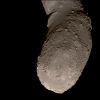
LLN-Itokawa-ST_2506694595_v.pngApproaching Itokawa (3 - natural colors; elab. Lunexit)58 visitenessun commentoMareKromium
(3 voti)
|
|

LLN-Itokawa-ST_2539429953_v.jpgThe unbelievable surface of 25143-Itokawa (HR - possible natural colors; elab. Lunexit)55 visiteIl piccolo Asteroide Itokawa si mostra ancora una volta per ciò che è: un piccolo mondo senza crateri e, apparentemente, senza polveri, la cui superficie - come questa splendida immagine HR ottenuta dalla Sonda JAXA "Hayabusa" - sembra risolversi in una serie di strati "a squame", tutti sensibilmente inclinati rispetto al piano dell'asteroide e, forse, piuttosto affilati (ci ricordano, in versione più grande, i "Razorblades" dei Crateri Endurance e Victoria (Marte).
Un piccolo mondo che, dopo un breve periodo di "fama", è ripiombato nell'oblìo collettivo, dopo che la Sonda JAXA "Hayabusa" ha malfunzionato (in circostanze e per cause ancora abbastanza oscure).
I Giapponesi, come ovvio, hanno preso molto male questo incidente, ma la coltre di silenzio che è caduta sulla Missione - la quale, come saprete, ha mostrato alla Terra il primo (ed unico?) Corpo Celeste PRIVO di crateri (un altro "schiaffo" per uno dei Maggiori Dogmi dell'Astronomia Convenzionale) - ha lasciato tutti molto perplessi.MareKromium
(3 voti)
|
|

Eris.jpgAnother "Dwarf Planet" with satellite: 136199-Eris and Dysnomia56 visiteDa "NASA - Picture of the Day" del 18 Settembre 2006:"Is Pluto the largest Dwarf Planet? No! Currently, the largest known dwarf planet is 136199-Eris, renamed last week from 2003 UB313. Eris is just slightly larger than Pluto, but orbits as far as twice Pluto's distance from the Sun. Eris is shown above in an image taken by a 10-meter Keck Telescope from Hawaii, USA.
Like Pluto, Eris has a moon, which has been officially named by the International Astronomical Union as (136199) Eris I (Dysnomia). Dysnomia is visible above just to the right of Eris. Dwarf Planets Pluto and Eris are Trans-Neptunian Objects that orbit in the Kuiper belt of objects past Neptune. Eris was discovered in 2003, and is likely composed of frozen water-ice and methane. Since Pluto's recent demotion by the IAU from planet to dwarf planet status, Pluto has recently also been given a new numeric designation: 134340-Pluto.
Currently, the only other officially designated Dwarf Planet is 1-Ceres".
(3 voti)
|
|

Comets-Schwassmann_Wachmann_1-09.jpgComet Schwassmann-Wachmann 3: the whole "crumbling" Comet (3)58 visitenessun commento
(3 voti)
|
|

Comets-Schwassmann_Wachmann_1-08.jpgComet Schwassmann-Wachmann 3: the whole "crumbling" Comet (2)57 visitenessun commento
(3 voti)
|
|
| 282 immagini su 24 pagina(e) |
 |
|
|
|
|
19 | |
|
|
|
|





