| Piú votate - Asteroids and Comets |

LLQ-Itokawa-ST_2482160259_v-3.jpgRectangular Surface Feature on Itokawa? (extra-detail mgnf)61 visiteAllora, fermiamoci ai fatti: il "rettangolo" esiste (e si vede bene) ed alla sua base c'è effettivamente qualcosa che non può essere altro che una apertura.
Questo rilievo - che solo un occhio attento al dettaglio poteva individuare - rientra, a nostro parere, nella Classe delle Singolarità Superficiali.
E' un rilievo affascinante, suggestivo, decisamente curioso: certo. Ma quali elementi abbiamo per poter anche solo supporre una sua origine NON naturale?
Nessuno.
L'intero Asteroide Itokawa è un campionario di Singolarità, le quali vanno dalla mancanza di crateri alla presenza, su un buon 75% della sua superficie, di una sorta di "squamatura rocciosa" (si tratta di mini-boulders a forma appuntita ed inclinati - leggermente - rispetto al piano dell'asteroide).
Itokawa (al pari di Phobos, o di 1-Ceres, o di 433-Eros, o al pari delle "unexplainable surface features" di Marte, di Giapeto, di Callisto ed Europa e così via), è una Meraviglia della Natura: è unico, è lontano, è affascinante e, per noi, è largamente inesplicabile.
Parlare di "intervento intelligente" (come sinonimo di "NON naturale") allorchè si analizzano rilievi come questo (o come quelli relativi agli altri Corpi Celesti sopra menzionati), vuol dire - a nostro parere - NEGARE la Capacità Creativa della Natura e, di fatto, significa rifiutarsi di vedere l'Universo per quello che è davvero: una Meravigliosa Opera la quale, per il suo 99,99%, era, è e - probabilmente - rimarrà uno splendido enigma per gli Uomini.
Un enigma che dovrebbe invogliarci a studiare di più e meglio, a capire di più e meglio e ad essere un pochino più umili e consapevoli dei nostri limiti e della attuale nostra incapacità di razionalizzare tutto quello che vediamo e quindi di sussumere l'Ignoto all'interno di Classi di Conoscenza ancora largamente e profondamente imperfette.
Un profondo ringraziamento all'Amico e Collega, Dr Gianluigi Barca, per l'eccezionale "occhio" e per la splendida provocazione che ha lanciato: provocazione che ci ha offerto un eccellente spunto per esprimere un pensiero che, in tanti ormai, avevamo da tempo voglia di tradurre in parole.MareKromium
(4 voti)
|
|

LLO-Itokawa-ST_2563511720_v.jpgThe unbelievable surface of 25143-Itokawa (HR5 - possible natural colors; elab. Lunexit)55 visitenessun commentoMareKromium
(4 voti)
|
|

McNaught-13.jpgMc Naught and its "Iron Tail"58 visiteCaption NASA:"Outstanding in planet Earth's sky early this year, Comet McNaught is captured in this view from the STEREO A spacecraft. McNaught's coma is so bright, it blooms into the long horizontal stripe at the bottom of the field. Brilliant Venus, near the top left corner, also produces a severe horizontal blemish in the digital image. But the sensitive camera does accurately record the striations in McNaught's famous dust tail along a region stretching over 30 MKM toward the top right of the field of view. A separate, fainter, arching tail just to the left of the dust tail was initially thought to be an example of a common ion tail, formed by electrically charged atoms carried away from the comet by the Solar Wind.
However, detailed modeling indicates that tail is actually due to Neutral Iron atoms pushed out by the pressure of sunlight - the first ever detected Neutral Iron tail from a comet. The Iron atoms are thought to originate in dust grains from the comet nucleus that contain the Iron-Sulfur mineral Troilite (FeS)". MareKromium
(4 voti)
|
|
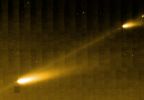
Comets-Schwassmann_Wachmann_1-04.jpgComet Schwassmann-Wachmann 3 from SST54 visiteThis image from NASA's Spitzer Space Telescope (SST) shows three of the many fragments making up Comet 73P/Schwassman-Wachmann 3. The infrared picture also provides the best look yet at the crumbling comet's trail of debris, seen here as a bridge connecting the larger fragments.
The comet circles around our Sun every 5,4 years.
In 1995, it splintered apart into four pieces, labeled "A" through "D", with "C" being the biggest. Since then, the comet has continued to fracture into dozens of additional pieces. This image is centered about midway between fragments "C" and "B"; fragment "G" can be seen in the upper right corner.
The comet's trail is made of dust, pebbles and rocks left in the comet's wake during its numerous journeys around the sun. Such debris can become the stuff of spectacular meteor showers on Earth.
This image was taken on April 1, 2006, by Spitzer's Multi-Band Imaging Photometer using the 24-micron wavelength channel.
(4 voti)
|
|

Tempel1-ZZ-ZL-PIA02132_fig1.jpgThe "Sunny Side" of Comet Tempel-157 visiteCaption originale:"This image composite shows comet Tempel 1 in visible (left) and infrared (right) light. The infrared picture highlights the warm, or sunlit, side of the comet, exactly where NASA's Deep Impact probe hit. These data were acquired about six minutes before impact.
The visible image was taken by the medium-resolution camera on the mission's flyby spacecraft, and the infrared data were acquired by the flyby craft's infrared spectrometer".
(4 voti)
|
|

Shoemaker-Levy 9-2.jpgShoemaker-Levy 9: the W-impact (2)58 visiteThese four images of Jupiter and the luminous night-side impact of fragment W of Comet Shoemaker-Levy 9 are different versions of an average of 8 images taken by the Galileo spacecraft of July 22, 1994.
The frames that were averaged span about 30" near 8:06 UT.
These four "averaged" images show the scene without and with (top and bottom) spatial filtering and contrast enhancement, and without and with (left and right) a latitude/longitude grid. Grid spacing is 30 degrees, with 230° Longitude centered. The terminator is at about 265°. The impact location is about 43° South, as predicted, and at 280° Longitude. The dark spots to the right of the flash are from previous impacts.
(4 voti)
|
|
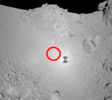
LLL-Itokawa.jpgTarget Marker located on Itokawa (2)57 visiteThe spacecraft shifted to safe-hold mode because of its attitude dispersion during ascent, and Sagamihara Deep Space Control Room is now carrying out the recovery operation to three-axis control mode.
It therefore takes a few more days to obtain detailed data relating the procedure. Instruments onboard are functioning very well so far.
Spacecraft Hayabusa could find, on the surface of Itokawa, the Target Marker dropped on Nov. 20 among the images taken during descent phase on Nov. 26.
On the Target Marker are etched 880.000 names from 149 Countries.
The previous images show the area named "MUSES Sea" and they were taken at 04:58 of Nov. 20, 2005 (left) and at 06:24 of Nov. 26, 2005 (right).
In this frame, the white light spot inside the red circle is the Target Marker with the 880.000 names!
(4 voti)
|
|

LL-Itokawa.jpgTarget Marker located on Itokawa (1)58 visiteOn Nov. 26, spacecraft "Hayabusa" challenged the second trial to execute landing on and sampling from the asteroid Itokawa. Hayabusa team confirmed the whole process to have been implemented and it is sure that the team succeeded in sampling materials on the surface of an asteroid for the first time in World History. Detailed data to be sent from Hayabusa will further verify the sampling.
Hayabusa started its last descent phase from the altitude of 1 km above Itokawa by command from Earth around 10:00 p.m. Nov.25 (JST). It was followed by starting the vertical descent from around 6:00 a.m. Nov.26., and, around 6:25 a.m., Sagamihara Deep Space Control Room sent a command to continue the descent.
Hayabusa challenged landing and sampling operation after a hovering phase. Hayabusa team is now sure, through the analysis of telemetry data, that a series of sequence for sampling was successfully done. Hayabusa then flew up to several kilometers altitude with normal solar paddles power, spacecraft attitude, etc.
(4 voti)
|
|

Tempel1-Y.jpgThe South-Pole of Tempel-1 and the impact area60 visiteDa "NASA - Picture of the Day" del 6 Luglio 2005:"This diverse landscape is the surface of comet Temple-1's nucleus as seen by the Deep Impact probe's Impactor Targeting Sensor. Within minutes of recording the rugged view, the landscape had changed dramatically though, as the impactor smashed into the surface near the two large, half kilometer-sized craters at picture center. Indications are that the probe penetrated well below the surface before vaporizing, sending a relatively narrow plume of debris blasting back into space. Researchers are still speculating on the final size of the crater produced by the July 4th comet crash, but material continues to spew from the impact site and has caused the faint comet to brighten significantly. Determining the crater dimensions and analyzing the debris ejected from the comet's interior will provide premier insights into the formation of comet Tempel 1, a primordial chunk of our own Solar System".
(4 voti)
|
|

Tempel1-X.jpgDeep-impact...16 seconds after collision!56 visiteCaption NASA originale:"This image shows the initial ejecta that resulted when NASA's Deep Impact probe collided with comet Tempel-1 at 10:52 p.m. Pacific time, July 3 (1:52 a.m. Eastern time, July 4) . It was taken by the spacecraft's medium-resolution camera 16 seconds after impact".
(4 voti)
|
|

Eros-PIA02488.jpgCraters' "Trio"57 visiteCaption NASA originale:"The Near Earth Asteroid Rendezvous (NEAR) spacecraft snapped the image on the left (Image of the Day Feb. 13, 2000 B) during its approach to Eros on Feb. 11, 2000, from a range of 2590 Km (approx 1.609 miles). This image shows a heart-shaped depression about 5 Km long. The image mosaic on the right was taken from 204 Km on March 3, 2000 and reveals that the mysterious heart-shaped feature is actually 3 separate craters. The oblique lighting conditions and low resolution of the earlier image created the illusion of a heart shape".
(4 voti)
|
|

Eros-PIA02499.jpgA deep impact on Eros means short daylight hours...58 visiteCaption NASA originale:"For people who live in mountain valleys, daylight can be a short-lived experience. Mountains to the east make the Sun rise later in the morning, while mountains to the west make the Sun set earlier in the evening. The brevity of daytime in a valley is accentuated during the shortened days of winter. The floor of the 5,5-Km (3,4-mile) diameter impact crater that dominates one face of Eros experiences the ultimate in short daylight hours. Three factors conspire to make this true. Firstly, Eros rotates rapidly, once every 5,27 hours. Secondly, the crater's 0,9-Km (0,56-mile) high walls tend to block direct sunlight from the floor, even while the outside of the crater is illuminated. Thirdly, during the current season on Eros, the Sun never makes it high in the sky in this location".
(4 voti)
|
|
| 282 immagini su 24 pagina(e) |
 |
|
|
|
|
16 | |
|
|
|
|





