| |

| Piú votate - Asteroids and Comets |

EROS-PIA02901_modest.jpgCraters on the limb of Eros57 visiteIn this image, taken April 17, 2000, from a height of 101 Km (63 miles), the shadows highlight small-scale surface features. The surface is pockmarked with craters ranging in size up to the 2,8 Km (1,74 mile) diameter crater in the center of the image. The smallest craters which can be resolved are about 20 meters (65 feet) across. In lower right corner of the image, 20-meter boulders can be seen that were not evident in images from higher altitudes.
(5 voti)
|
|

Eros-PIA02495_modest.jpgSide view and front view of a bright crater56 visiteLighting and viewing geometries make a huge difference in the appearance of Eros' surface features. One of the most striking examples is the 2.7 Km diameter crater shown in these two images. The image at left, looking at the crater nearly edge-on, was taken February 16, 2000, from a range of 341 Km. The image at right was taken high over the crater on March 2, 2000, from a range of 226 Km. In the first image the only visible part of the crater's interior is the far, bright wall, which at the time was well-lit. The lighting, in combination with the particular viewing angle, make the crater appear stunningly bright. In the second view, the brighter material occupies only part of the slightly-shaded interior, greatly reducing the overall brightness contrast between the crater and the surrounding terrain.
(5 voti)
|
|

Dart-4.jpgGreat Balls of Fire! - 472 visitenessun commentoMareKromium
(4 voti)
|
|

Asteroids-Polymele.jpg15094-Polymele151 visiteUna luna sconosciuta! Anzi, una mini-luna di un piccolo steroide! La Verità è che non si può dire ancora nulla con certezza, ad oggi.
Certo è che trattasi di un minuscolo Corpo Celeste: un piccolo oggetto roccioso che orbita intorno a un Asteroide (15094-Polymele) vicino a Giove. Le dimensioni? Leggermente superiori a quelle di Manhattan (NY-NY). Se le prossime analisi confermeranno che si tratta effettivamente di una luna, sarebbe uno dei più piccoli satelliti mai individuati nel Sistema Solare.
Il satellite nano è stato scoperto da un gruppo di scienziati che lavorano alla missione Lucy della Nasa: l’obiettivo è inviare una sonda per studiare alcuni degli asteroidi Troiani (Trojans): due grossi gruppi di rocce vaganti nei pressi di Giove. Ma non proprio “attorno”: il campo gravitazionale del Gigante Gassoso, insieme a quello del Sole, controlla un Sistema Complesso di Corpi Celesti, detti appunto "Asteroidi Troiani", che si trovano in corrispondenza di alcuni Punti di Equilibrio (Lagrange Points) di questo rapporto gravitazionale. In quelle regioni la risultante fra l'Attrazione Gravitazionale complessiva esercitata da questi due Corpi Celesti (Giove ed il Sole) e la Forza Centrifuga (Apparente) è pari a 0 (Zero).
La missione esplorativa "Lucy", dedicata per la precisione a quattro di questi Asteroidi (dovrà eseguire sorvoli ravvicinati di 3548-Eurybates, 15094-Polymele, 11351 Leucus e 21900-Horus), ha avuto inizio il 16 ottobre 2021 con il lancio da Cape Canaveral, in Florida. L’arrivo nella "Nuvola Troiana" L4 (Lagrange Point 4) è previsto per la fine del 2027, dopo una breve sosta nella Cintura (Belt) di Asteroidi situata fra Marte e Giove (la cosiddetta “Fascia Principale”). Mentre Lucy, pur con un pannello solare a mezzo servizio, vola verso i suoi obiettivi, gli esperti a Terra studiano l’ambiente in cui arriverà, cercando di identificare dove il suo lavoro potrebbe avere più successo ed essere dunque più utile.
Lo scorso 27 Marzo (2022) il più piccolo dei bersagli di Lucy, 15094 - Polymele, è transitato di fronte a una stella distante, consentendo agli scienziati di misurare le dimensioni dell’Asteroide. L’osservazione ha appunto riservato una sorpresa: un punto più piccolo seguiva la scia di Polymele.
Dopo aver approfondito i dati si è capito che deve trattarsi di un satellite. Avrebbe un diametro di appena 5 Km e ne dovrebbe distare circa 200 dalla piccola roccia "Primaria" (Polymele), a sua volta del diametro di circa 27 Km. Al momento dell’osservazione, Polymele si trovava a 772 MKM dalla Terra.
"Quelle distanze sono più o meno equivalenti a trovare un quarto di dollaro su un marciapiede a Los Angeles mentre si cerca di individuarlo da un grattacielo a Manhattan" ha scritto la Nasa in un comunicato. Nel Sistema solare sono state individuate oltre 200 lune (senza includere quelle degli Asteroidi), un termine che può essere applicato a ogni oggetto solido che orbiti intorno ad un Pianeta, ad un Asteroide, o ad un Pianeta Nano".
Per il momento i Ricercatori possono effettuare solo osservazioni fugaci dell'ipotetico satellite di 15094 - Polymele; quindi, il suo percorso orbitale è molto incerto. Di conseguenza, la roccia spaziale non può ancora essere ufficialmente designata come luna. Ma i ricercatori sono fiduciosi che quando Lucy arriverà da quelle parti, la navicella sarà in grado di raccogliere dati sufficienti per attribuirle il titolo che probabilmente le spetta.MareKromium
(4 voti)
|
|
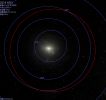
Asteroids-469219-Kamo_oalewa-2.jpgKamo'oalewa91 visiteThe size of Kamo'oalewa has not yet been firmly established, but it is likely that it is approximately 40-to-100 meters (130–330 feet).Based on an assumed standard albedo for stony S-type asteroids of 0.20 and an absolute magnitude of 24.3, it measures 41 meters (135 ft) in diameter. Photometric observations in April 2017 revealed that Kamoʻoalewa is a fast rotator. Lightcurve analysis gave a rotation period of 0.467 ± 0.008 hours (28.02 ± 0.48 minutes) and a brightness variation of 0.80±0.05 magnitude (U=2). In 2021, a comprehensive physical characterization of Kamoʻoalewa was conducted using the Large Binocular Telescope and the Lowell Discovery Telescope, which found that the asteroid is composed of lunar-like silicates and may be an impact fragment from the Moon.
During the 2017 Astrodynamics Specialist Conference held in Stevenson in the U.S. state of Washington, a team composed of graduate research assistants from the University of Colorado Boulder and the São Paulo State University (UNESP) was awarded for presenting a project denominated "Near-Earth Asteroid Characterization and Observation (NEACO) Mission to Asteroid (469219) 2016 HO3", providing the first baselines for the investigation of this celestial object using a spacecraft. Recently, another version of this work was presented adopting different constraints in the dynamics.
The China National Space Administration (CNSA) is planning a robotic mission that would return samples from Kamoʻoalewa. Currently, this mission, via ZhengHe, is planned to launch in 2025.MareKromium
(4 voti)
|
|

Comet_Borisov_-_Still.pngFrom far away: Comet Borisov138 visiteDa un altro Sistema, dallo Spazio Interstellare, da "altrove".... La "Cometa" Borisov attraverserà il nostro Sistema Solare così come una Rondine attraversa il nostro campo visivo in un luminoso giorno di Primavera.
Da dove viene? Dove va?
... Ma che importa, alla fine?!?.....MareKromium
(4 voti)
|
|

Comets-Comet_ISON-Nucleus.jpgComet ISON (Tian Lian 1 - Satellite's View - Controversial: possible fake)84 visiteEd ecco il Nucleo di ISON: come vedete, assomiglia TANTISSIMO a quello di Tempel-1 e Wild-2. Mia opinione? Immagine genuina. Con tutto quanto ne segue e consegue... Il punto è che, a quanto leggo (ma NON sul Sito dell'Agenzia Spaziale Cinese, sul quale non posso capirci nulla), il Satellite Geostazionario Tian-Lian 1 NON ha fotocamere! E se questo è vero (ma non so se è vero), allora è evidente che siamo davanti all'ennesima bufala...MareKromium
(4 voti)
|
|
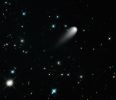
Comets-Comet_ISON-HST-30Apr-V_I-L-800.jpgComet ISON (Hubble Space Telescope's View)148 visiteAdvanced amateur astronomers are already getting good images of Comet ISON, which currently shines at around +12th magnitude in the constellation Cancer. And although NASA’s Deep Impact/EPOXI mission is down for the count, plans are afoot for the Curiosity rover and the Mars Reconnaissance Orbiter to attempt imaging the comet when it makes its closest approach to the Red Planet on October 1st at 0.0724 Astronomical Units (A.U.) or 10,830,000 kilometres distant. If MSL is successful, it would be the first time that a comet has been observed from the surface of another world.
Currently, ISON sits about a magnitude below the projected light curve, (see below) but that isn’t all that unusual for a comet. Already, there’s been increasing talk of “ISON being a dud,” but as Universe Today’s Nancy Atkinson pointed out in a recent post, these assertions are still premature. The big question is what ISON will do leading up to perihelion, and if it will survive its passage 1.1 million kilometres above the surface of the Sun on November 28th to become a fine comet in the dawn skies in the weeks leading up to Christmas.
ISON is already starting to show a short, spikey tail in amateur images. Tsutomu Seki estimated it to be shining at about magnitude +11.1 on September 16th. Keep in mind, a caveat is in order when talking about the magnitudes of comets. Unlike stars, which are essentially a point source, the brightness of a comet is spread out over a large surface area. Thus, a comet may appear visually fainter than the quoted magnitude, much like a diffuse nebula. Although +6th magnitude is usually the limit for naked eye visibility, I’ll bet that most folks won’t pick up ISON with the unaided eye from typical suburban sites until it breaks +4th magnitude or so.
The forward scattering of light also plays a key role in the predicted brightness of a comet. The November issue of Astronomy Magazine has a great article on this phenomenon. It’s interesting to note that ISON stacks up as a “9” on their accumulated point scale, right at the lower threshold of comet “greatness,” versus a 15 for sungrazing Comet C/1965 S1 Ikeya-Seki. Another famous “9” was Comet C/1996 B2 Hyakutake, which passed 0.1018 A.U. or 15.8 million kilometres from Earth on March 25, 1996.
ISON will pass 0.429 A.U. or 64.2 million kilometres from Earth the day after Christmas. Bruce Willis can stay home for this one.
Here is a blow-by-blow breakdown of some key dates to watch for as ISON makes its plunge into the inner solar system:
-September 25th: ISON crosses the border from the astronomical constellation of Cancer into Leo.
-September 27th: ISON passes 2 degrees north of the planet Mars.
-October 1st: The 12% illuminated waning crescent Moon passes 10 degrees south of Mars & ISON.
-Early October: ISON may break +10th magnitude and become visible with binoculars or a small telescope.
-October 4th: New Moon occurs. The Moon then exits the dawn sky, making for two weeks of prime viewing.
-October 10th: ISON enters view of NASA’s STEREO/SECCHI HI-2A CAMERA:
-October 16th: ISON passes just 2 degrees NNE of the bright star Regulus, making a great “guidepost” to pin it down with binoculars.
-October 18th: The Full Moon occurs, after which the Moon enters the morning sky.
-October 26th: A great photo-op for astro-imagers occurs, as ISON passes within three degrees the Leo galaxy trio of M95, M96, & M105.
-October 30th: The 17% illuminated Moon passes 6 degrees south of ISON.
-Early November: Comet ISON may make its naked eye debut for observers based at dark sky sites.
-November 3rd: A hybrid (annular-total) solar eclipse occurs, spanning the Atlantic and Central Africa. It may just be possible for well placed observers to catch sight of ISON in the daytime during totality, depending on how quickly it brightens up. The Moon reaching New phase also means that the next two weeks will be prime view time for ISON at dawn.
-November 5th: ISON crosses the border from the astronomical constellation of Leo into Virgo.
-November 7th: ISON passes less than a degree from the +3.6 magnitude star Zavijava (Beta Virginis).
-November 8th: ISON passes through the equinoctial point in Virgo around 16:00 EDT/20:00 UT, passing into the southern celestial hemisphere and south of the ecliptic.
-November 14th: ISON passes less than a degree from the 10th magnitude galaxy NGC 4697.
-November 17th: The Moon reaches Full, passing into the morning sky.
-November 18th: ISON passes just 0.38 degrees north of the bright star Spica.
-November 22nd: ISON crosses into the astronomical constellation of Libra.
-November 23rd: ISON sits 4.7 degrees SSW of the planet Mercury and 4.9 SSW of Saturn, respectively.
-November 25th: ISON pays a visit to another famous comet, passing just 1.2 degrees south of short period comet 2P/Encke which may shine at +8th magnitude.
-November 27th: ISON enters the field of view of SOHO’s LASCO C3 coronagraph.
-November 28th: ISON reaches perihelion at ~18:00 PM EST/ 23:00 UT.
After that, all bets are off. The days leading up to perihelion will be tense ones, as ISON then rounds the Sun on a date with astronomical destiny. Will it join the ranks of the great comets of the past? Will it stay intact, or shatter in a spectacular fashion? Watch this space for ISON updates… we’ll be back in late November with our post-perihelion guide!
Be sure to also enjoy recently discovered Comet C/2013 R1 Lovejoy later the year.
(source: http://www.universetoday.com/104818/comet-ison-a-viewing-guide-from-now-to-perihelion/#ixzz2fpLTKJwD)
Read more: http://www.universetoday.com/104818/comet-ison-a-viewing-guide-from-now-to-perihelion/#ixzz2fpLG75usMareKromium
(4 voti)
|
|

Lutetia-05-CTX-EDM-PCF-LXTT-IPF.jpgAsteroid 21-Lutetia (CTX Frame and EDM - Absolute Natural Colors; credits for the additional process. and color.: Dr Paolo C. Fienga - Lunexit Team)153 visite21 Lutetia is a relatively large Main-Belt Asteroid, measuring about 100 Km in diameter (approx. 120 km along its Major Axis). It was discovered in the AD 1852 by the French-German Astronomer Hermann Goldschmidt, and is named after Lutetia, such as the Latin name of the city that stood where Paris was later built. The Asteroid 21 Lutetia has an irregular shape and is heavily cratered, with the largest Impact Crater reaching about 45 Km in diameter.
The Surface of this Asteroid is geologically heterogeneous and it is intersected by a system of Grooves and Scarps, which are thought to be the external manifestation of deep, internal, Fractures; it also possess an high Average Density, which could have meant that is (likely) made of Iron and Nickel rich Rock (even though, as we shall better see later on, this - however logical - claim, is still unproven). The ESA - Rosetta Probe passed as close as about 3162 Km (approx. 1965 miles) from 21 Lutetia in July 2010 and, at the time of Rosetta's Fly-By, it was the largest Asteroid ever visited by a Spacecraft (that, until the NASA - Dawn Spaceraft arrived at 4 Vesta, in July 2011).
The composition of 21 Lutetia has puzzled astronomers for some time, and that is because, while classified among the M-type Asteroids, most of which are Metallic (better yet: rich of Metallic Minerals/Elements), 21 Lutetia must be one of the so-called Anomalous Members of this classification, since it does not display much evidence of Metallic Minerals on its Surface. As a matter of fact, after most part of the data received from the Rosetta Probe were analyzed, several indications of a NON-Metallic Surface of this Asteroid were found, like, for instance, a flat, Low Frequency Spectrum (similar to that of Carbonaceous Chondrites and C-type Asteroids - which is, of course, deeply different from the one of the so-called Metallic Meteorites, such as those Meteorites which are logically believed to derive from a Metallic - such as, we repeat, Iron and Nickel-rich - Celestial Body), a low Radar Albedo (unlike the high Albedoes of Strongly Metallic Asteroids, like 16 Psyche), evidence of Hydrated Materials on its Surface, abundant Silicates, and a thicker layer of Regolith than most of the other known (as far as their composition is concerned) Asteroids.MareKromium
(4 voti)
|
|

Comets-Hartley_2-PIA13626.gifSnowballs near Comet Hartley-2101 visiteCaption NASA:"This movie shows the motion of some Icy Particles in the Cloud around Comet Hartley 2, as seen by NASA's EPOXI mission Spacecraft. A star moving through the background is marked with red and moves in a particular direction and with a particular speed, while the Icy Particles move in random directions. The Icy Particles are marked in green, blue and light blue.
The images for the movie were obtained by the Medium-Resolution Imager on Nov. 4, 2010, the day the EPOXI mission Spacecraft made its closest approach to the Comet".MareKromium
(4 voti)
|
|

Tempel1-ZZ-ZJ-Stardust_1024-PIA13860-PCF-LXTT.jpgComet Tempel-1 from Stardust NeXT Spacecraft (Natural Colors; credits for the additional process. and color.: Dr Paolo C. Fienga - Lunexit Team) 118 visiteCaption NASA:"This image mosaic shows 4 different views of comet Tempel-1 as seen by NASA's Stardust Spacecraft as it flew by it on February 14, 2011.
The images progress in time beginning at upper left, moving to upper right, then proceeding from lower left to lower right. When the Spacecraft first approached, it got a clear look at the same Surface that was imaged previously by NASA's Deep Impact Spacecraft in 2005. Deep Impact sent a projectile into the Comet, creating a crater that is located in the upper left image, but is difficult to see at this particular contrast level.
As Stardust flew closer to the Comet, it began to see New Territory that had not been imaged before. The New Territory appears on the left side of the upper right image. The Deep Impact Crater is also located in this view, on the right side.
Both the upper right and lower left images are the Closest Approach images for Stardust, taken at 3" before, and 3" after it. The images were taken from a distance of about 185 Km (approx. 115 miles). In the lower left image, the vast majority of Terrain pictured had not been seen until now. The fourth image, at lower right, shows Stardust's view as the Spacecraft was on the way out.
The image at upper left was taken 15" before the Encounter (or Closest Approach) from a distance of approx. 244 Km (about 152 miles); the image at lower right was taken 15" after the Encounter, from a distance of approx. 245 Km (about 152 miles)".MareKromium
(4 voti)
|
|

Tempel1-ZZ-ZJ-Stardust_1024-PIA13867.jpgComet Tempel-1 from Stardust NeXT Spacecraft (Natural Colors; credits for the additional process. and color.: Dr Paolo C. Fienga - Lunexit Team) 122 visiteCaption NASA:"At the time of the encounter, comet Tempel-1 was approx. 335 MKM (about 208 MMs) away from Earth.
Tempel-1 is oblong in shape and has an average diameter of about 6 Km (approx. 4 miles). Stardust-NExT is an extended mission for the comet chaser, which previously flew past comet Wild 2 and returned some samples from its Coma to Earth.
During this latest encounter, the Spacecraft took images of the Comet's Surface and observed changes that occurred since a NASA Spacecraft last visited it (NASA's Deep Impact Spacecraft had an encounter with Tempel-1 in July 2005).
Stardust-NExT is a low-cost mission that is expanding the investigation of comet Tempel-1 initiated by the Deep Impact Spacecraft.
The mission is managed by the Jet Propulsion Laboratory, a division of the California Institute of Technology, Pasadena, Calif., for NASA's Science Mission Directorate in Washington. Lockheed Martin Space Systems in Denver built the Spacecraft and manages day-to-day mission operations".MareKromium
(4 voti)
|
|
| 282 immagini su 24 pagina(e) |
|
|
|
|
|
14 | |
|
|
|
|
|
|





