| Piú votate - Asteroids and Comets |

McNaught-04.jpgComet McNaught (5)59 visiteCaption NASA:"The brightest comet of recent decades was a surprising first sight for a new camera in space.
The Sun Earth Connection Coronal and Heliospheric Investigation (SECCHI) instrument onboard the Solar TErrestrial RElations Observatory (STEREO) satellite had just opened up on January 11, 2007, when it snapped the above image of Comet McNaught. Visible was a spectacular view of the ion tail of Comet McNaught being swept away from the Sun by the solar wind in filamentary rays. The comet tail is seen to extend at least seven degrees across the above image, while the central coma is so bright it saturates. Comet McNaught is now reportedly so bright that it is visible even in broad daylight by blocking out the Sun with your hand.
Comet McNaught has rounded the Sun and will slowly fade away for observers in Earth's Southern Hemisphere as it recedes from the Sun".
(5 voti)
|
|

Comets-Schwassmann_Wachmann_1-06.jpgComet Schwassmann-Wachmann 3 and M 5759 visiteMoving rapidly through planet Earth's night sky, Fragment "C" of crumbling comet 73P/Schwassmann-Wachmann 3 passed almost directly in front of M 57 - the "Ring Nebula" - and faint spiral galaxy IC 1296 on May 8, 2006. In fact, in this gorgeous view, the bright head of mentioned Fragment "C" is separated by only about 0,1° from M 57, with the tail apparently engulfing nebula and galaxy.
Recorded from Elizabeth, Illinois, USA, this picture corresponds to the cosmic scene only 30 minutes after yesterday's picture of the approaching alignment. The relative motion of the comet against the background stars and nebulae is easy to see when comparing the two images. This comet's fragments will be near their closest approach in the coming days, about 10 MKM away, and none pose any danger to our fair planet.
(5 voti)
|
|

Dactyl.JPGDactyl60 visitenessun commento
(5 voti)
|
|
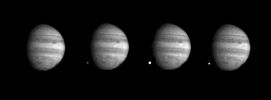
Shoemaker-Levy 9-1.jpgShoemaker-Levy 9: the W-impact (1)58 visiteThese four pictures, taken 2,3" apart, show the early meteor, or "bolide", stage of the impact of the last major fragment of Comet Shoemaker-Levy 9 into Jupiter's night side. In the first image (8:06:12 UTC), no impact is visible. In the second picture, a bright point of light appears superimposed on the dark side of Jupiter's Southern Hemisphere. In the third image, the impact has grown so bright that it saturates the CCD picture element at the center of the image of the impact flash. By remarkable coincidence, the HST took a picture of the W-impact, also in green light, within 1" of this image, providing a complementary view of very faint associated phenomena at very high altitudes in Jupiter's atmosphere, just above the planet's edge as seen from Earth. In the final Galileo image (8:06:19 UTC), the impact flash has faded appreciably.
These images are pictures 5 through 8 of a series of 56 placed on a single frame in time-lapse fashion. We interpret the rapid rise and fall of this initial peak over just 7 seconds to be the bolide phase of the W fragment's impact, analogous to the flash of light of meteors entering Earth's atmosphere. Images immediately following this show that the luminosity continues to fade over the next 15 seconds.
(5 voti)
|
|

L-Itokawa.jpgThe Target Marker separated from Hayabusa (close-up)60 visiteThe Target Marker that separated from Hayabusa carried the names of 880.000 people who participated in the campaign from the World.
It was placed in the South-West area of the MUSES-Sea.
When it hit to the surface, the descent speed was about 9 cm/sec. The Target Marker was specifically designed and fabricated with an aluminum shell filled with polyimide balls (so to absorb kinetic energy through multi-collisions). This design is capable to dramatically suppress the bouncing of the probe and its function has been tested and verified via drop tower tests in a vacuum chamber on Earth.
The Target Marker (è il minuscolo punto luminoso - cerchiato in nero - che si vede accanto all'ombra di Hayabusa nel close-up di Sx) was illuminated by onboard flash lamps every 2' (...).
(5 voti)
|
|

Itokawa-12.jpgNear Infrared Spectra of Candidates for Sampling Sites59 visiteIn view of the scientific results described above, JAXA has determined the landing/sampling sites candidates and the descent target point for rehearsal, along with their planned dates and times.
The landing/sampling sites must be free of obstacles and smooth enough to ensure safety, a top priority, while at the same time the surface inclination and the ground station coverage for Hayabusa must be taken into account. Taking these issues into consideration, the candidate
sites and schedule were determined.
The first site candidate is the regolith expanse in the middle of Itokawa, known as the MUSES-SEA Area and the second candidate site is the Woomera desert at the tip end of Itokawa, where the terrain is broad and flat. The rehearsal target is the area located close to the spin axis, a little east of the first site. The date and time of the planned events
(JST) are as follows:
1. Rehearsal Descent: Nov. 4, '05 - h.14:00
2. 1st Touch-down: Nov. 12, '05 - h. 15:00
3. 2nd Touch-down: Nov. 25., '05 - h. 15:00
(5 voti)
|
|

Itokawa-11.jpgThe Landing Procedure56 visiteThe gravity and slope information and estimates of the density of boulders and regolith distribution on the surface, combined with comparisons with meteorites, will advance our interpretation and understanding of asteroid planetology.
D) Using the laser altimeter and optical navigation camera, along with range and range-rate measurements fromground-tracking stations, have led to a successful mass and density estimate for Itokawa. The density has been estimated to be 2,3 +/-0,3 gram/cc, which is a little lower than that measured for rocks on the ground or for other S-type asteroids measured to date. This may indicate that there is substantial porosity for this body and forces conventional views of these small objects to be changed drastically. When the samples are successfully returned and recovered, the actual porosity will be clarified and our knowledge of how the Earth relates to meteorites will be greatly improved.
(5 voti)
|
|

Tenth_Planet-00.jpgThe 10th Planet? (1)60 visiteDa "NASA - Picture of the Day", del 31 Luglio 2005:"Is that a Tenth Planet? A faint, slowly moving dot discovered by computer shows clear signs of being a deep Solar System object at least as large as Pluto. The object, designated 2003 UB313, is currently situated nearly 100 times the Earth-Sun distance - over twice the average Pluto-Sun distance. That far out, the only way a single round object could be as bright as 2003 UB313 would be if it is at least as large as Pluto and completely reflective.
Since 2003 UB313 is surely not completely reflective, it could be substantially larger. One of the discovery frames is shown above digitally expanded and artificially brightened. 2003 UB313 was identified initially on frames taken by the automated 1.2-meter Samuel Oschin Telescope at Palomar Observatory in California, USA".
(5 voti)
|
|

Tempel1-Z-L-050719deepseq.jpgImpact Sequence58 visiteUn nuovo Sito (segnalatoci dal Dr Feltri) il quale, staccandosi dagli schemi di ricerca convenzionali, propone - sommessamente - un nuovo Modello Interpretativo per alcuni dei fenomeni dell'Universo ("...Exploring the electric universe: from ancient mythology to cosmic plasma discharge..."). Il Modello proposto dai Ricercatori di Thunderbolts è, secondo il nostro linguaggio, un "Modello di Confine": il confine che separa i dogmi della Scienza Convenzionale dagli Archetipi della Nuova Scienza. C'è molto da discutere, ovviamente, ma c'è anche molto da leggere, meditare ed apprendere, conservando il senso comune, ma adottando logiche di grande apertura.
EccoVi l'indirizzo: http://www.thunderbolts.info/default.htm
(5 voti)
|
|

Tempel1-XXX-streakoflight.jpgSpace Fireworks...61 visiteCaption NASA originale:"...In the almost 2 hours of time that elapsed during the imaging of the comet, its position changed against the background stars. When all of the images of the motion are added together, the resulting streak of light is shown in the image above. Starting from the left, the comet was its natural brightness. The streak brightens significantly in the middle, immediately after impact of the probe".
Nota: i primi resoconti sui risultati scientifici dell'esperimento ci dicono che la NASA ha "scoperto" che sulla superficie della cometa Tempel-1 c'era (c'è) uno strato di polvere simile al borotalco, ergo più sottile di quanto ci si aspettasse. Inutile dire che, se messo in questi termini, il significato dell'esperimento va ad esaurirsi in un qualcosa che fa solo sorridere (di imbarazzo).
La realtà è molto più complessa e coinvolge la natura, la struttura e la composizione dei cd. "corpi cometari" in rapporto agli altri "corpi rocciosi" presenti nel Sistema Solare...
(5 voti)
|
|

Tempel1-XX-HRI_937_1.jpgDeep-impact...67 seconds after collision!58 visitecaption NASA originale:"This spectacular image of comet Tempel 1 was taken 67 seconds after it obliterated Deep Impact's impactor spacecraft. The image was taken by the HR camera on the mission's flyby craft. Scattered light from the collision saturated the camera's detector, creating the bright splash seen here. Linear spokes of light radiate away from the impact site, while reflected sunlight illuminates most of the comet surface. The image reveals topographic features, including ridges, scalloped edges and possibly impact craters formed long ago".
(5 voti)
|
|

Tempel1-r-ImpactConfirmation.jpgDeep-impact...59 visiteTime of Impact: July 4, 05:52:15.0 +/- 17 sec UT as seen from Earth (1-sigma uncertainty)
Impact successfully occurred on July 4 at 05:52:24 UT as seen from Earth
(5 voti)
|
|
| 282 immagini su 24 pagina(e) |
 |
|
|
|
|
13 | |
|
|
|
|





