| Piú votate - Asteroids and Comets |
Lutetia-04-PCF-LXTT.jpgAsteroid "Lutetia" (possible Natural Colors; credits for the additional process. and color.: Dr Paolo C. Fienga - Lunexit Team)102 visiteMareKromium
(5 voti)
|
|

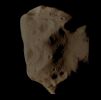
Lutetia-03.jpgAsteroid "Lutetia"58 visiteA closer look at the asteroid that orbits between Mars and Jupiter reveals that Lutetia's Surface is battered with many craters, indicating that during the 4,5 BY (Billion Years) of existence, the primitive survivor has suffered many impacts.
The information gathered also confirm that Lutetia, discovered by French painter turned astronomer Hermann Goldschmidt in 1852, is approx. 100 Km in diameter, has a elongated body, and its longest side measures about 130 Km.
In a statement, David Southwood, ESA Director of Science and Robotic Exploration, said:“It has been a great day for exploration, a great day for European science. The clockwork precision is a great tribute to the scientists and engineers in our Member States in our industry and, not least, in ESA itself”.MareKromium
(5 voti)
|
|

Itokawa.gifRevolving around Itokawa (a GIF-Movie by Dr Gianluigi Barca - Lunexit Team)60 visitenessun commentoMareKromium
(5 voti)
|
|

P-2010-A2-HST.jpgP/2010-A2: Extremely unusually-looking Asteroid58 visiteFirst discovered on ground based LINEAR images on January 6, 2010, the object appeared unusual enough to investigate further with the Hubble Space Telescope last week.
Pictured above, what Hubble saw indicates that P/2010 A2 is unlike any object ever seen before.
At first glance, the object appears to have the tail of a comet. Close inspection, however, shows an about 140-meter Nucleus offset from the tail center, very unusual structure near the Nucleus, and no discernable gas in the Tail. Knowing that the object orbits in the Asteroid Belt between Mars and Jupiter, a preliminary hypothesis that appears to explain all of the known clues is that P/2010 A2 is the debris left over from a recent collision between two small asteroids.
If true, the collision likely occurred at over 15.000 Km-per-hour (five times the speed of a rifle bullet) and liberated energy in excess of a nuclear bomb. Pressure from Sunlight would then spread out the debris into a trailing tail.
Future study of P/2010 A2 may better indicate the nature of the progenitor collision and may help humanity better understand the early years of our Solar System, when many similar collisions occurred. MareKromium
(5 voti)
|
|

Orcus-GIF.gif90482 Orcus59 visiteCaption NASA:"A newly discovered object in the Outer Solar System moves like an anti-Pluto. 90482 Orcus was first discovered in 2004 and is slightly smaller than Pluto, although still one of the largest Kuiper Belt objects known.
Orcus may one day have the same IAU designation as Pluto: a dwarf planet.
Orcus and Pluto have similar orbits: each achieves nearly the same maximum and minimum distances from the Sun, each orbits on a similarly shaped ellipse, and each orbital ellipse is tilted toward the other planets' orbital ellipse by roughly the same angle. The great mass of Neptune causes each to circle the Sun twice for every three Neptune orbits.
Orcus is like an anti-Pluto, however, because the two objects always remain across the Solar System from each other. Orcus can be found as the spot near the center of these discovery frames moving slightly down from the top.
Until the end of next week, the discoverers of Orcus ask for your help in naming its newly discovered moon".MareKromium
(5 voti)
|
|

Comets-Comet_Lulin-00.jpgComet Lulin is approaching...60 visiteDa "NASA - Picture of the Day", del giorno 2 Febbraio 2009:"How bright will Comet Lulin become? No one knows for sure. Although it is notoriously difficult to accurately predict the brightness of newly discovered comets, Comet Lulin could well become visible to the unaided eye later this month (such as February 2009).
As Comet Lulin moves into the Northern Sky in mid February to rise around midnight, it should at least be spotted by comet watchers with binoculars and a good sky chart. Tracking observations indicate that the comet officially designated C/2007 N3 (Lulin) has now swung by the Sun and is approaching Earth on a trajectory that will bring it within half the Earth-Sun distance in late February.
Comet Lulin's orbit indicates that this is likely the comet's first trip into the Inner Solar System. The comet was discovered by Quanzhi Ye of Sun Yat-sen University, on images obtained by Chi-Sheng Lin at the Lu-Lin Observatory of National Central University.
In this picture, taken from Italy last Friday, are Comet Lulin's coma and tails, one tail pointing away from the Sun, and an anti-tail - dust that trails the comet in its orbit and may appear to point toward the Sun".MareKromium
(5 voti)
|
|

EROS-PIA02905-1.jpgEros (Position of the BIG Pseudo-Anomaly)59 visitenessun commentoMareKromium
(5 voti)
|
|

Comets-Comet_Holmes-0.jpgA "Light Arrow" is heading towards "Heart & Soul"...69 visiteCaption NASA:"Two spectacular comets graced Earth's skies during 2007.
Both comets became bright enough to be seen by the unaided eye of the casual sky enthusiast. Early in 2007, Comet McNaught grew brighter than any comet in 40 years, displaying a beautiful dust tail that flowed across the sky.
Comet McNaught (a.k.a. c/2006 P1) became known as the "Great Comet" of 2007, sported unusual striations in its expansive dust tail, and showed unexpectedly complex chemistry in its ion tail.
Toward the year's end, normally docile and faint Comet Holmes brightened suddenly and unexpectedly to naked eye visibility. Remarkably, Comet 17P/Holmes stayed bright for weeks even though it lies beyond the orbit of Mars.
No distant comet in recent history has remained so bright for so long.
In this view, a white Comet Holmes was photographed in early December posing with the Heart and Soul Nebulae".MareKromium
(5 voti)
|
|

LLR-Itokawa-Impacts.jpgThe Craters of Itokawa79 visiteBravissimo, come sempre anche lui, il Dr Marco Faccin il quale, attraverso questo splendido e suggestivo collage, ci mostra e dimostra che, in fondo, NON E' VERO che sul piccolo Asteroide Itokawa non ci sono crateri.
Ci sono, eccome: non molti (e difficilmente discernibili), ma ci sono.
E come mai esistono dei crateri su un mondo che, a parere della NASA, dovrebbe avere una "consistenza" (rectius: densità) bassissima; tanto bassa da farlo risultare, alla fine, come un "mucchio di detriti spaziali tenuti gravitazionalmente assieme"? Un mondo che, laddove impattato da un macigno vagante, dovrebbe - semplicemente - andare in pezzi?
Ebbene la risposta è duplice e (relativamente) facile, a nostro avviso:
1) l'impatto fra Itokawa ed un corpo vagante di dimensioni ridottissime e/o avente una densità bassissima si potrebbe risolvere tranquillamente nella creazione di un cratere poco profondo e di piccole dimensioni;
2) le stime NASA sulla densità di Itokawa sono errate e questo piccolo asteroide - al pari di innumerevoli altri - è un grande macigno errante il quale può sopportare con relativa tranquillità gli impatti con altri corpi vaganti rocciosi e compatti, purchè aventi dimensioni (comunque) modeste.
Avete altre idee? Scriveteci! ...E, per adesso, GRANDI complimenti al bravissimo Dr Faccin!MareKromium
(5 voti)
|
|

LLP-Itokawa-ST_2539496392_v.pngFarewell to Itokawa! (3 - additional processing and coloring by Lunexit)58 visitenessun commentoMareKromium
(5 voti)
|
|

McNaught-9.jpgComet McNaught (10)57 visiteCaption NASA:"By January 19/20, 2007, Comet McNaught's magnificent dust tail stretched for about 150 MKM (~1 AU), requiring images from both Southern and Northern Hemispheres of planet Earth to take it all in. Two such views - from Cerro Paranal in Chile (left) and the Carnic Alps in Italy - are combined in this unique graphic that also outlines a perspective view of the Comet's orbit (dotted line) and relative position of the Sun. Driven by solar radiation pressure the dust tail initially points away from the Sun, but also trails outside the comet's orbit. Astronomers try to account for the complex structure along the tail, including the pronounced striations, by considering forces acting on the dust (e.g. gravity, solar wind and radiation) as well as the release time and size of the dust grains. In the diagram, the modeled location of dust grains released at approximately the same time relative to perihelion passage, synchrones, are shown as dashed lines. The location of grains of similar size, syndynes, are shown as solid lines".
(5 voti)
|
|

McNaught-01.jpgComet McNaught (2)57 visiteCaption NASA:"The brightest comet in decades is unexpectedly now visible. The most optimistic predictions have Comet McNaught (C/2006 P1) shortly becoming one of the brightest comets of the past century. For the next few days, its short tail and bright coma can be spotted with the unaided eye close to the Sun and near the horizon in both evening and morning skies. This dramatic picture of the comet shining through cloudy skies was taken near sunset on January 7, 2007, from Bad Mergentheim, Germany".
(5 voti)
|
|
| 282 immagini su 24 pagina(e) |
 |
|
|
|
|
12 | |
|
|
|
|





