| Piú votate - Asteroids and Comets |

Eris_Dysnomia.jpgEris and Dysnomia56 visiteNASA's HST has teamed up with the W.M. Keck Observatory to precisely measure the mass of Eris, the largest member of a new class of Dwarf Planets in our Solar System. Eris is 1,27 times the mass of Pluto, formerly the largest member of the Kuiper Belt of icy objects beyond Neptune.
Hubble observations in 2006 showed that Eris is slightly physically larger than Pluto. But the mass could only be calculated by observing the orbital motion of the moon Dysnomia around Eris. Multiple images of Dysnomia's movement along its orbit were taken by Hubble and Keck.
Astronomer Mike Brown of the California Institute of Technology in Pasadena, Calif. and colleagues also report in this week's Science Magazine that Dysnomia is in a nearly circular 16-day orbit. This favors the idea that Dysnomia was born out of a collision between Eris and another Kuiper Belt object (KBO).
A gravitationally captured object would be expected to be in a more elliptical orbit.
The satellites of Pluto, as well as the Earth-Moon system are also believed to have been born out of a collision process where debris from the smashup goes into orbit and coalesces into a satellite.
By comparing the mass and diameter, Brown has calculated a density for Eris of 2.3 grams per cubic centimeter. This is very similar to the density of Pluto, the large Kuiper Belt object 2003 EL61, and Neptune's moon Triton which is likely a captured KBO. These higher densities imply that these bodies are not pure ice but must have a significant rocky composition.
The discovery of Eris in 2005 (originally nicknamed Xena, and officially cataloged 2003 UB313) prompted a debate over the planetary status of Pluto because astronomers realized they would have to call it the "10th" planet if Pluto retained its own planetary status, which was already under debate. This led the International Astronomical Union, in 2006, to make a new class of solar system object called dwarf planets. These are spherical bodies in hydrostatic equilibrium (objects that have sufficient gravity to overcome their own rigidity and form a spherical shape) like the planets, but unlike the major planets in the solar system, they have not gravitationally cleared out the neighborhood of particles and small debris along their orbits.
MareKromium
(6 voti)
|
|

McNaught-05.jpgComet McNaught (6)57 visiteCaption NASA:"After a remarkable performance in the Northern Hemisphere, the brightest comet in decades is now showing off in the South. Recorded during evening twilight on January 17, 2007, this view features the bright coma and gorgeous, sweeping tail of Comet McNaught (c/2006 P1) over Lake Horowhenua in Levin, a small town on New Zealand's North Island.
Astronomer Noel Munford reports that the five second long digital camera exposure comes close to capturing the visual appearance of the comet in a sky coloured by smoke from distant brush fires in Australia. Discovered last summer by R. H. McNaught (Siding Spring Survey), the comet grew impressively bright in early January and has even been sighted in full daylight.
In the coming days Comet McNaught will continue to move south, for now a spectacle in Southern Skies as it heads for the outer Solar System".
(6 voti)
|
|
McNaught-06.jpgComet McNaught (7)58 visitenessun commento
(6 voti)
|
|

McNaught-02.jpgComet McNaught (3)56 visiteCaption NASA:" Bright Comet McNaught (C/2006 P1) graced the twilight this week, seen by many and often described with superlatives. Watching the skies over Krakow, Poland, Andrzej Sawow recorded this view on Wednesday - with an ordinary handheld digital camera. He notes that "... astronomy is really for everyone who loves to look at the night sky. And fortunately (sometimes) the sky generously rewards its observer". Now very close to the Sun, Comet McNaught (along with Mercury) is visible in realtime images from the SOHO spacecraft. Otherwise, skywatchers will find the comet hard to see this weekend. But southern hemisphere observers could be rewarded next week as Comet McNaught begins to climb higher in southern skies".
(6 voti)
|
|

McNaught-03.jpgComet McNaught (4)56 visiteCaption NASA:"This past weekend Comet McNaught peaked at a brightness that surpassed even Venus. Fascinated sky enthusiasts in the Earth's Northern Hemisphere were treated to an instantly visible comet head and a faint elongated tail near sunrise and sunset. Recent brightness estimates had Comet McNaught brighter than magnitude - 5 (minus five) over this past weekend, making it the brightest comet since Comet Ikeya-Seki in 1965, which was recorded at - 7 (minus seven). The Great Comet of 2007 reached its brightest as it rounded the Sun well inside the orbit of Mercury. Over the next week Comet McNaught will begin to fade as it moves south and away from the Sun. The unexpectedly bright comet should remain visible to observers in the Southern Hemisphere with unaided eyes for the rest of January.
The above image, vertically compressed, was taken at sunset last Friday from mountains above Catalonia, Spain".
(6 voti)
|
|

LLM-Itokawa.jpg25143-Itokawa57 visiteA Japanese spacecraft has provided one of the best arguments yet in favor of a conception of asteroids which was pioneered by PSI (Planet Science Institute) scientists Don Davis and Clark Chapman in the late 70's. The evidence comes in startling closeup pictures of the tiny asteroid 25143-Itokawa, photographed by the Japanese Hayabusa spacecraft during a two-month encounter in late 2005. The asteroid illustrates the concept of a "Rubble-Pile" asteroid, which is composed of a mixture of boulders and dust gravitationally bound together.
The scientific results, recently highlighted in the journal Science, show that, unlike other asteroids recently imaged by spacecraft, which are mostly rounded and potato-like, dotted by craters, and with a few scattered boulders on the surface, Itokawa appears to be composed of massive splinter-like boulders protruding from a matrix of smaller fragments.
The largest boulders sticking out of the body appear to be some tens of meters across.
The Hayabusa science team includes PSI scientists Paul Abell and Bob Gaskell, and PSI affiliate scientists Hirdy Miyamoto and Faith Vilas.
(6 voti)
|
|
Comets-Schwassmann_Wachmann_1-10.jpgComet Schwassmann-Wachmann 3: the whole "crumbling" Comet (4)60 visitenessun commento
(6 voti)
|
|

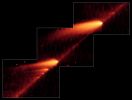
Comets-Schwassmann_Wachmann_1-05.jpgComet Schwassmann-Wachmann 3, M 57 and IC 129661 visiteAs dawn approached on May 8, 2006, astronomer Stefan Seip carefully watched Fragment "C" of broken Comet 73P/Schwassmann-Wachmann 3 approach M 57 - the Ring Nebula, and faint spiral galaxy IC 1296.
Of course, even though the trio seemed to come close together in a truly cosmic photo opportunity, the comet is in the inner part of our Solar System, a mere 0,5 Light-Minutes (LM) or so from Seip's telescope located near Stuttgart, Germany, planet Earth.
The Ring Nebula (upper right) is more like 2000 LY distant, well within our own Milky Way Galaxy. At a distance of 200 MLY, IC 1296 (between the Comet and the Ring Nebula) is beyond even the Milky Way's boundaries. Because the Comet is so close, it appears to move relatively rapidly against the distant stars. This dramatic telescopic view was composited from two sets of images; one compensating for the Comet's apparent motion and one recording the background stars and nebulae.
(6 voti)
|
|

Itokawa-08.jpgSurface details (1)57 visiteFor the scientific aspects of the mission, Hayabusa carries 4 instruments that have
performed successful observations to date:
1) AMICA, a Visible Imager with multi-band filters, has exposed 1500 images amounting to almost 1 GB of data;
2) NIRS, a near infrared spectrometer that has already taken 75.000 measurements distributed globally over the body;
3) LIDAR, a laser altimeter that has accumulated 1,4 million measurements globally, and
4) XRS, an X-ray spectrometer that has already received and integrated its signal for 700 hours.
In addition to these, spacecraft tracking data has been used to measure properties of the asteroid as well.
These unprecedented scientific measurements are briefly described and reported in what follows.
(6 voti)
|
|

Tenth_Planet-01.jpgThe 10th Planet? (2)58 visitePerchè escludere a priori, come fa la NASA, che il Decimo Pianeta abbia una superficie TOTALMENTE RIFLETTENTE?
Scusateci la provocazione, ma sarebbe sufficiente ipotizzare - per assurdo, se volete - che questo ipotetico Decimo Pianeta sia:
1) una sfera costituita prevalentemente di ghiaccio (un'eventualità tutt'altro che remota);
2) un corpo capace di emanare luce propria (una piccola stella?);
3) una sfera metallica (ossìa, per esempio, una gigantesca astronave che si trova "parcheggiata" ai confini del Sistema Solare).
Stupidaggini "Cosmiche"? Fantascienza di basso livello? Forse.
Ma se ci pensate (e se conoscete almeno un poco la storia del Sistema Solare e delle meccaniche - per lo più teoriche - che ci hanno permesso di stimarne le dimensioni complessive), l'ipotesi più improbabile (molto in voga negli anni '60/'70 ma poi ritenuta inverosimile ed abbandonata) è proprio quella che immagina il Decimo Pianeta come un corpo roccioso di dimensioni medio-grandi!
(6 voti)
|
|

Tempel1-XXXX-ITS_PressRelease2.jpgThe nucleus of comet Tempel-159 visite...e su questi aspetti (critici) dell'esperimento, non abbiamo ancora dati da presentare e commentare.
Dati che, a quanto dice il Prof. R. Hoagland, non verranno MAI (?) resi noti.
Vi suggeriamo, a tal proposito, di leggere il suo nuovo (discutibile, ma comunque interessante) editoriale, pubblicato sul Sito "The Enterprise Mission" e dal titolo "Captain's Blog - Space News & General Commentary by Richard C. Hoagland".
Nota: questa bella immagine del nucleo della cometa è stata ottenuta dai sensori di puntamento dell'Impactor, circa 5 minuti prima dell'urto.
L'impatto, a titolo di curiosità, è avvenuto fra i due piccoli crateri dal bordo scuro che possiamo vedere in basso, quasi a ridosso del margine inferiore del nucleo stesso (o del Polo Sud, se preferite).
(6 voti)
|
|

Tempel1-ZZ-ZHRI_PressRelease1-PIA02133-br.jpgOne hour after the impact60 visiteE', a nostro parere, la filosofia - perversa e pervertitrice? - che si cela dietro questi "esperimenti" (o presunti tali) che fa rabbrividire: essa dice, molto chiaramente, che la Terra ed il Cielo, per chi può (e 'chi può' vuol dire 'chi ha la FORZA di potere') sono soltanto luoghi di esercizio.
Sono oggetti, cose delle quali si può disporre come si vuole e quando si vuole. E non importa se, nel performare questi "esperimenti", si mette a repentaglio la Natura stessa: ciò che conta è fare, fare quello che si vuole, mascherando la reale arroganza con la falsa sete di conoscenza.
Ecco il punto (e perdonateci l'acredine che emerge da queste poche righe): i Padroni del Mondo non solo fanno quello che vogliono e lo fanno in maniera violenta e discutibile, ma lo fanno anche, sempre più spesso, mascherando la loro immensa ignoranza e presunzione dietro un volto amichevole che dice "quello che facciamo, lo facciamo per il bene di tutti".
Per il bene di tutti? Davvero?!?...
(6 voti)
|
|
| 282 immagini su 24 pagina(e) |
 |
|
|
|
|
10 | |
|
|
|
|





