| Piú votate - Before the Moon and Walking on the Moon (partially edited) |

58-Luna13 - Q-Detail 1.JPGLunik 13: Oceanus Procellarum (4)228 visite...(una modesta depressione del terreno, ricolma di polvere) proprio davanti al Lander (frame 2). Per quanto attiene i 2 splendidi detail mgnf che Fabio Italiano ci ha messo davanti, il discorso diventa complesso.
Questo non vuol dire che non intendiamo esprimerci, si badi: il problema è che abbiamo veramente pochissimi dati fra le mani e le immagini sono enigmatiche al punto da lasciarci spazi interpretativi così ampi che, alla fine, il rischio che si corre è quello di dire delle enormi stupidaggini. Comunque sia, ci affidiamo alla nostra (modesta) esperienza e (speriamo notevole) sensibilità.
A nostro parere, questa prima Anomalìa non è, in realtà, un'Anomalìa, bensì un boulder dalla forma bizzarra. L'oggetto (che collocheremmo ad un 8/10 mt dal Lander), ci ricorda le pseudo-rocce Marziane ma, nello specifico, diremmo che si potrebbe trattare di una coppia di macigni (a forma di geode) molto vicini (sovrapposti, in parte, dall'angolo visuale del Lander) e, forse, divisi da un'altra roccia più piccola.
(5 voti)
|
|
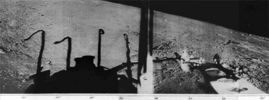
56-Luna13 - Panorama-02.jpgLunik 13: Oceanus Procellarum (2)135 visiteThe Luna 13 spacecraft was launched toward the Moon from an Earth-orbiting platform and accomplished a soft landing on December 24, 1966, in the Region of "Oceanus Procellarum". The petal encasement of the spacecraft was opened, antennas were erected, and radio transmissions to Earth began 4 minutes after the landing. On December 25 and 26, 1966, the spacecraft television system transmitted panoramas of the nearby lunar landscape at different sun angles. Each panorama required approximately 100 minutes to transmit. The spacecraft was equipped with a mechanical soil-measuring penetrometer, a dynamograph, and a radiation densitometer for obtaining data on the mechanical and physical properties and the cosmic-ray reflectivity of the lunar surface. It is believed that transmissions from the spacecraft ceased before the end of December 1966.
(5 voti)
|
|

50-The Shard-00.gifThe famous "Shard", on the Moon (1)143 visiteThe Shard is a very anomalous structure which rises above the Moon's surface by more than a mile (about 1750 mt). Its overall irregular spindly shape - containing a regular geometric pattern - with constricted nodes and swollen internodes, if natural, has got to be a real wonder of the Universe and no known natural processes can explain such a structure. Computer enhancement with about 190 feet (about 60 mt) resolution shows an irregular outline with more reflective and less reflective surfaces. The amount of sunlight reflecting from parts of the Shard indicate a composition inconsistent with that of most natural substances. Only crystal facets and glass can reflect that much light (polished metallic surfaces are unnatural). Single crystals the size of city blocks are currently unknown. Prof. Hoagland says that the Shard may be a highly eroded remnant of some sort of artificial structure made of glass-like material. Other larger structures and their reflectivity in the area support this theory.
(5 voti)
|
|

33-Ranger7.jpgGuericke Crater55 visiteCaption NASA originale:"Ranger 7 B-camera image of Guericke Crater (11.5° S, 14.1° W, diameter 63 Km) taken from a distance of 1335 Km. The dark flat floor of Mare Nubium dominates most of the image, which was taken 8,5 minutes before Ranger 7 impacted the Moon on 31 July 1964. The frame is about 230 Km across and north is at 12:30. The impact site is off the frame to the left (Ranger 7, B100)".
Location & Time Information
Date/Time (UT): 1964-07-31 T 13:17:12
Distance/Range (km): 1335.44
Central Latitude/Longitude (deg): -12.60, 013.79 W
Orbit(s): Impact - Hard Landing
(5 voti)
|
|

31-Ranger7.jpgMare Nubium: Alphonsus, Ptolemaeus and Arzachel Crater from Ranger 755 visiteCaption NASA originale:"Ranger 7 took this image, the first picture of the Moon by a U.S. spacecraft, on 31 July 1964 at 13:09 UT (9:09 AM EDT) about 17 minutes before impacting the Lunar Surface. The area photographed is centered at 13° S, 10° W and covers about 360 Km from top to bottom. The large crater at center right is the 108 Km diameter Alphonsus. Above it is Ptolemaeus and below it Arzachel. The terminator is at the bottom right corner. Mare Nubium is at center and left. North is at about 11:00 at the center of the frame. The Ranger 7 impact site is off the frame, to the left of the upper left corner (Ranger 7, B001)".
Location & Time Information
Date/Time (UT): 1964-07-31 T 13:08:44.90
Distance/Range (km): 2445.97
Central Latitude/Longitude (deg): -13.09,350.37
Orbit(s): Impact - Hard Landing
(5 voti)
|
|

20-Aristarchus Crater.jpgAristarchus Crater87 visiteCaption NASA originale:"Lunar Orbiter 5 view of Aristarchus Crater. Aristarchus is approximately 40 Km in diameter and 3,6 Km in depth from rim to floor. Note the hummocky ejecta blanket surrounding the crater and the concentric and radial valleys along the Crater walls, resulting from mass gravity wasting. North is up (Lunar Orbiter 5, frame M-197)".
Location & Time Information
Date/Time (UT): 1967-08-18 T 08:59
Distance/Range (km): 130
Central Latitude/Longitude (deg): +23.06/312.58
(5 voti)
|
|

13-Flamsteed Crater.jpgFlamsteed Crater and Oceanus Procellarum68 visiteCaption NASA originale:"Lunar Orbiter 4 image showing the 20 Km Flamsteed Crater on the Moon. Flamsteed is the large crater near the bottom of the image. A broken ring of bright ridges, probably the rim of an older crater nearly covered by the later Oceanus Procellarum mare basalts, can be seen. The ring is about 100 Km in diameter, and a concentric wrinkle ridge is evident within the ring. The Surveyor 1 spacecraft landed in the upper right portion of the ring. North is up (Lunar Orbiter 4, frame 143-H2)".
Location & Time Information
Date/Time (UT): 1967-05-21 T 17:28:22
Distance/Range (km): 2719
Central Latitude/Longitude (deg): -14.30/318.59
(5 voti)
|
|

09-Murchison and Ukert.jpgOblique view of Murchison and Ukert Crater140 visiteCaption NASA originale:"Lunar Orbiter 3 oblique view of Murchison Crater (foreground), 58 Km across, and Ukert Crater (back right-center) on the Moon. The southern edge of Mare Vaporum is visible in the background. Note the irregular features and rilles on the floor of Murchison. North is at 10:30 (Lunar Orbiter 3, frame M-85)".
Location & Time Information
Date/Time (UT): 1967-02-18 T 04:03
Distance/Range (km): 90.4
Central Latitude/Longitude (deg): +04.94/359.66
(5 voti)
|
|

07-Kepler Crater.jpgKepler Crater from Lunar Orbiter 3113 visiteCaption NASA originale:"Lunar Orbiter 3 oblique image of Kepler crater on the Moon. The crater is 32 km in diameter and is located near the outer rim of the Imbrium Basin. Kepler is located at 8° N, 38° W, southwest of Mare Imbrium. North is at 11:00 (Lunar Orbiter 3, frame M-162)".
Location & Time Information
Date/Time (UT): 1967-02-21 T 05:02
Distance/Range (km): 156
Central Latitude/Longitude (deg): +06.91/321.90
(5 voti)
|
|

05-Copernicus Crater.jpgOblique view of Copernicus Crater from Lunar Orbiter 2109 visiteCaption NASA originale:"Lunar Orbiter 2 northword - looking oblique view of Copernicus Crater on the Moon. Copernicus crater extends across the background of the picture, about 100 Km in diameter. Note the radial ridges, mounds and cones around the crater. The keyhole shaped Fauth crater sits atop one of the ridges 60 Km south of Copernicus (Lunar Orbiter 2, frame M-162)".
Location & Time Information
Date/Time (UT): 1966-11-24 T 00:05:43
Distance/Range (km): 130
Central Latitude/Longitude (deg): +05.48/340.00
(5 voti)
|
|

03-Korolev Basin.jpgThe "far side" of the Moon: Korolev Basin from Lunar Orbiter 190 visiteCaption NASA originale:"Lunar Orbiter 1 view of the Korolev Basin on the far side of the Moon. The basin is located at 3° S, 158° W and is about 440 Km in diameter, the largest crater in the image, to the left and slightly above the center. Adjacent to Korolev, at about 5:00, is the crater Galois and at 6:30 is the smaller Doppler crater. The rim of the South Pole - Aitken Basin - is faintly visible running just below these craters. North is up (Lunar Orbiter 1, frame M-40)".
Location & Time Information
Date/Time (UT): 1966-08-22 T 14:58
Distance/Range (km): 1466
Central Latitude/Longitude (deg): -06.44/211.26
(5 voti)
|
|

APOLLO 10 AS 10-30-4422.jpgAS 10-30-4422 - Streaks and craters164 visitenessun commento
(5 voti)
|
|
| 143 immagini su 12 pagina(e) |
 |
|
4 | |
|
|
|
|
|
|
|





