| Piú votate - Apollo 14: A New Success After The "Successful Failure"! |

APOLLO 14 AS 14-67-9389 SQUAREVISOR.jpgAS 14-67-9389 - Squarevisor!185 visiteUn'immagine divertente e frutto, supponiamo, di un difetto di sviluppo. Guardate attentamente l'astronauta fotografato e, in particolare, osservate il suo casco. Non servirà ingrandire l'immagine per accorgersi che è "quadrato".
Diciamo che si tratta di un'istantanea abbastanza curiosa. Non siamo in possesso, purtroppo, del frame originale e quindi non possiamo addentrarci in alcun tipo di speculazione.
(3 voti)
|
|

APOLLO 14 AS 14 66-9302.jpgAS 14-66-9302 - Moon Panorama248 visiteIn un posto diverso e ad un'altezza diversa, ma le caratteristiche della Fiaccola Blu sono del tutto simili a quelle che già si erano viste nel frame 9295. Ma adesso la questione è diversa e - per certi versi - sconcertante: nella fotografia, infatti, si vede benissimo l'altro astronauta che sta riprendendo l'oggetto luminoso e che non pare assolutamente turbato da quella "luminescente presenza".
Un incontro ravvicinato del Terzo Tipo sulla Luna?
Forse.
Di certo si è trattato di un evento storico.
(3 voti)
|
|

APOLLO_14_-_AS_14-66-9335-a-PCF-LXTT.jpgAS 14-66-9335 - Lunar Panorama with "Red Lights" (Credits for the additional process. and color.: Dr Paolo C. Fienga - Lunexit Team)142 visiteLe due "Bolle" (a forma quasi-sferica) di Luce Rossa - circondate da un alone pure rossastro - che brillano, appena percettibili, a ridosso dell'Orizzonte Lunare a noi sembrano evidenti e, dopo aver effettuato un'analisi approfondita del frame (pubblicato dalla NASA stessa sulla Rubrica "Picture of the Day" il giorno 5 Febbraio 2011), siamo giunti alla conclusione che NON si tratta di un'aberrazione del frame derivante da errata colorizzazione, oversaturazione, cattiva conservazione del negativo originale o altro artefatto di natura ignota: si tratta, a NOSTRO parere, di "luci" reali.
L'unica - ma essenziale - domanda, a questo punto non può che essere la seguente: sono "riflessi" (di luci - leds? - interni al LM), oppure sono effettivamente delle Luci Esterne (magari un outgassing)?
I Vostri commenti saranno, come sempre, apprezzati.MareKromium
(2 voti)
|
|

APOLLO_14_-_AS_14-66-9253-9256.jpgAS 14-66-9253 to 9256 - Tribute to the Braves (Image-Mosaic and True Colors; credits: Dr Marco Faccin - Lunexit Team)110 visitenessun commentoMareKromium
(2 voti)
|
|

ZZ-ZZ-ZZ-ZZ-ZZ-ZZ-ZZ-ZZ-ZZ-ZZ-ZZ-ZZ-ZZ-ZZ-ZZ-ZZ-ZZ-ZZ-ZZ-ZZ-APOLLO_14_-_AS_14-66-9224-0.jpgAS 14-66-9224 - Rising Earth (by Dr M. Faccin)108 visiteIn questa "elaborazione a strati multipli" (multiple-layers processing), il sempre eccezionale Dr Marco Faccin ci evidenzia un qualcosa che, intuito da molti, ma sino ad ora NON dimostrato, ci appare ora in tutta la sua chiarezza: non serve "taroccare" un frame per renderlo "insignificante"! Basta non processarlo e lasciarlo - in fondo ed insomma - "raw", e cioè "grezzo", magari leggermente sovraesposto e, comunque, inidoneo a fornire informazioni visive significative agli Interpreti (agli Anomaly Hunters intendiamo).
Moltissime foto orbitali della Luna sono suggestive...ma insignificanti. O forse no: non esistono foto "insignificanti", ci dice il Dr Faccin!
Esistono solo fotografie non processate in maniera adeguata. Guardate bene il foto-mosaico che segue...MareKromium
(2 voti)
|
|
APOLLO 14 AS 14 64-9060.jpgAS 14-64-9060 - Star-like Objects147 visitenessun commento
(2 voti)
|
|

APOLLO 14 AS 14 64-9058.jpgAS 14-64-9058 - Star-like Objects134 visiteMa in questi frames, a che cosa potrebbero essere dovuti questi Star-like Objects?
Bella domanda! Diciamo che è difficile che si tratti di stelle, poichè (al di là della perenne negazione NASA su questa eventualità) i frames sono tutti Up-Sun e la Sun Glare Area (zona/fascia di abbagliamento) che ne deriva, anche senza riprendere direttamente il Sole, dovrebbe essere comunque sufficiente a cancellare tutti gli oggetti (posti ad una distanza da chi riprende che, convenzionalmente, stimiamo "infinita" - ergo Stelle, Pianeti e quant'altro si trova sulla linea visuale della fotocamera) la cui luminosità non sia almeno pari o superiore a quella della Terra, come vista dalla Luna.
(2 voti)
|
|

APOLLO 14 AS 14 68-9487~0.jpgAS 14-68-9487 - Lunar Module, Astronaut and boulders (HD)108 visitenessun commento
(2 voti)
|
|

APOLLO 14 AS 14 64-9139.jpgAS 14-64-9139 - Mitchell and the Modularized Equipment Transporter (MET)101 visitenessun commento
(2 voti)
|
|

APOLLO 14 AS 14 67-9371 HR.jpgAS 14-67-9371 - Suprathermal Ion Detector Experiment - HR78 visiteOriginal caption:"117:21:31 MT. Close-up of the Suprathermal Ion Detector Experiment (SIDE).
This is one of the few ALSEP documentation photos taken during all of Apollo that shows a "level bubble" with any clarity. It is a large bubble, being about half the diameter of the dome that contains it.
Note that there is some dirt on the top of the SIDE, although not covering a large percentage of the surface".
(2 voti)
|
|

APOLLO 14 AS 14 66-9338 HR.jpgAS 14-66-9338 - Flag and tracks (HR)97 visiteEd Mitchell took this splendid picture after he and Shepard jettisoned the PLSSs in preparation for launch. Of particular interest are the tracks made by the crew and the MET during the traverse to the ALSEP deployment site and during the return to the LM. The ALSEP Central Station is about 180mt from the LM. Note the excursions the crew made around the rimless crater in the foreground and the large depression in the middle distance that they traversed in both directions. Without the visual clues provided by the tracks, the depression is not easy to pick out in this down-Sun photo. Note that the flag is now pointing on an azimuth of about 335 and undoubtedly moved from it prior pointing of about 120 as a result of the cabin depressurization done for the jettison. Journal Contributor Jim Scotti notes that we "can see the impact 'crater' and roll marks made by the PLSS farthest from the LM. It rolled on it's side and you can see a fair bit of detail in the hoses and straps on the righthand side of it".
(2 voti)
|
|
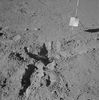
APOLLO 14 AS 14 64-9161.jpgAS 14-64-9161 - The sliding-down trench of Station "G"122 visiteOriginal caption:"134:36:42 MT. Second image in a stereopair Al took of the Station G trench. Every other trench that the Apollo Astronauts dug on the Moon held vertical walls. For some reason, this one would not, except near the left end".
Scan courtesy NASA Johnson.
(2 voti)
|
|
| 176 immagini su 15 pagina(e) |
 |
|
|
|
|
8 | |
|
|
|
|





