| Piú votate - Apollo 12: The "Magic" Is Already Over... |
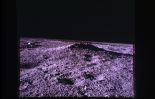
APOLLO 12 AS 12-46-6827.jpgAS 12-46-6827 - The "Mound", again... (1)187 visite...il suo comandante hanno confermato di aver notato la presenza di vapore..." (M. Light - "LUNA"). Prendiamo atto e passiamo ad altro. Ancora la "collinetta" di cui abbiamo parlato a lungo, ripresa da una distanza di circa 10 metri. Ancora una volta non possiamo non rilevare la (apparente) simmetria che la caratterizza.
(3 voti)
|
|

APOLLO 12 AS 12-46-6810.jpgAS 12-46-6810 - The "Mound", in the distance141 visiteIn questa immagine (e nelle prossime, eccetto AS 12-46-6811) possiamo di nuovo vedere la strana "collinetta" (mound) che tanto ha colpito sia noi, sia gli astronauti. Bisogna anche notare, quale elemento ulteriore di "stranezza", le caratteristiche del paesaggio Lunare circostante in rapporto all'Anomalia (secondo noi) di superficie che ora osserviamo. Praticamente si tratta di una zona...
(3 voti)
|
|

APOLLO 12 AS 12-46-6809.jpgAS 12-46-6809 - Approaching the "Mound"...110 visiteIn secondo luogo, già dopo la prima missione sulla Luna (e proprio grazie ai dati - anche fotografici - raccolti in quella sede) vennero apportate alcune modifiche sia agli strumenti di ripresa, sia alle pellicole. In questa sede (per ragioni di spazio) non possiamo entrare in dettaglio; ciò che si può dire è che la "diversa fattura" delle immagini Apollo 12 rispetto a quelle Apollo 11 dipende - a nostro parere - sia da fattori oggettivi (la diversità dei luoghi esplorati), sia da fattori soggettivi (la diversità della strumentazione adottata).
Ai "posteri", poi, "l'ardua sentenza"...
(3 voti)
|
|

APOLLO 12 AS 12-46-6808.jpgAS 12-46-6808 - Moon Panorama with a long shadow116 visiteCi siamo posti una domanda, analizzando queste immagini che, forse, Vi sarete posti anche Voi.
La domanda - del tutto logica e legittima - è: ma come mai la colorazione della superficie della Luna, osservando queste fotografie, appare così diversa rispetto a quanto si vedeva nei frames Apollo 11?
Una risposta certa al 100% non ci è possibile però qualche riflessione al riguardo si può svolgere tranquillamente.
In primo luogo le caratteristiche fisiche e geologiche dei due luoghi di allunaggio erano (e sono) completamente diverse.
(3 voti)
|
|

ZG-APOLLO12-lpi_trvrsmap.jpgWalking on the Moon, with Conrad and Bean111 visiteThis map is figure 10.15 from the Lunar Sourcebook, G.H. Heiken, D.T. Vaniman and B.M. French.
The traverses shown on this map were deduced from Hasselblad pictures taken by the crew and from their commentary.
NASA photo S69-59538 is another representation of the traverse.
(2 voti)
|
|

ZD-Surveyor Crater.jpgSurveyor Crater95 visite"I See the Surveyor!"
During the first few hours after landing, while he and Bean had a quick meal and began preparations for the first of two 4-hour EVAs, Conrad spent more than a little time trying to figure out just where he'd landed. It was a bit of a puzzle. The landmarks which had been so obvious during the approach weren't at all obvious from the ground. Looking west out the window, he and Bean saw an undulating and otherwise featureless plain. Among other things, there was no obvious sign of the Snowman's Head. Head Crater is about two hundred meters in diameter and should have been right in front of them. However, as they became accustomed to the subtleties of the view, they began to realize that there was, in fact, a big crater practically staring them in the face. They hadn't recognized it because they were back a bit from the east rim and were looking directly away from the early morning sun. There was a shadow in the bottom of Head Crater, but it was hidden by the near rim. There was also a lack of color variation in the scene and that, too, made the crater hard to see. However, once they realized that there was a big crater in front of them, they quickly decided that it had to be the Snowman's Head. If so, then Surveyor Crater had to be right behind them. Conrad jammed himself forward against his window as tightly as he could, probably wishing he had a rear window or at least a rear-facing mirror, and tried to peer as far around the back as possible. He was rewarded with a glimpse of the telltale slope of another large crater.
Fittingly, it was Dick Gordon, traveling overhead in the Command Module Yankee Clipper, who nailed down the landing coordinates. As he made his second post-landing pass, he put his eye to the sextant in hopes of getting a glimpse of the LM, a feat that Collins had never managed. Of course, Gordon had a real advantage in that he knew where Intrepid was supposed to be. As he picked up the Snowman, it wasn't long until he spotted the LM's fifty-meter shadow.
"I have him," he said. "He's on the Surveyor Crater; he's about a fourth of a Surveyor Crater diameter to the northwest...I'll tell you, he's the only thing that casts a shadow down there."
In seconds, he was directly overhead. "The Intrepid is just on the left shoulder of the Snowman. He is looking at me. He is about a third of the way from the Surveyor Crater to the (Snowman's) Head."
Then he really got excited. "I see the Surveyor! I see the Surveyor! Hey! That's almost as good as being there."
Now there was no doubt. Not only had Gordon seen the LM but he'd seen the Surveyor itself. Conrad and Bean had landed right on target and, thanks to Ewen Whitaker, they'd even been sent to the right crater! This was going to be fun.
(2 voti)
|
|

APOLLO 12 AS 12-46-6829 HR-1.jpgAS 12-46-6829 - The "Little Mound" and the shadow of the "Big One" (HR)134 visiteView to the South with the shadow of the large mound coming into the image from the left. Head Crater is in the near distance and Bench Crater is just below the local horizon a bit farther left but out-of-focus.
Scan courtesy NASA Johnson.
(2 voti)
|
|

APOLLO 12 AS 12-46-6783 HR.jpgAS 12-46-6783 - Alan Bean, RTG pack and LM (HR)108 visiteDown-Sun photograph of Alan Bean, who has just removed the RTG package from the SEQ Bay. We can see the "saddlebag" he is wearing at his left hip. The saddlebag material resembles the Teflon cloth used for the Sample Collection Bags (SCBs) used on Apollos 15, 16 and 17. Note that the transmitted light in the shadow of the saddlebag has a reddish-brown color. We can see the boom on which the RTG package rode as it was pulled out of the SEQ bay. We can also see the pulleys that were operated with the tapes. The SEQ bay door that covered the right-hand 2/3rds is folded up out of the way. At the left side of the bay, we can see the vertically hinged portion of the door pulled back out of the way. Note that the SEQ bay is not an integral part of the LM structure but, rather, hangs on the outside. Below the SEQ bay, we can see a shield which protects the landing radar (mounted on the bottom of the Descent Stage) from heat radiating from the engine bell.
Scan courtesy NASA Johnson.
(2 voti)
|
|
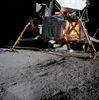
APOLLO 12 AS 12-46-6777.jpgAS 12-46-6777 - The Lunar Module without shadow and horizon (3) - HR127 visiteOriginal caption:"Rightward of 6776, showing the South-Eastern face of the Descent Stage with the doors to the Scientific Equipment (SEQ) Bay doors closed and the plutonium fuel cask in its upright, stowed position. (...)".
Nota: qualche "Ricercatore", guardando questa immagine, ha dedotto che il LM fosse fatto di "cartone". Non crediamo che sia il caso di trattare, in questa sede, le specifiche tecniche dal LM e, in particolare, i rivestimenti esterni i quali, effettivamente, ricordano la "carta da pacco" quando viene stropicciata ma, se siete curiosi e diffidenti, Vi rinviamo alle Technical Specs (con relative Procedures and Check-Lists) che vengono riportate, Missione per Missione, in un apposito paragrafo all'interno di ciascuno dei 7 Capitoli in cui è suddiviso l'Apollo Lunar Surface Journal.
(2 voti)
|
|

APOLLO 12 AS 12-46-6731 HR.jpgAS 12-46-6731 - The larger "Mound" (HR)117 visiteOriginal caption:"Rightward of AS 46-6730. Down-Sun view. The larger of the 2 mounds that Conrad and Bean will investigate after deploying the ALSEP is visible at the right side just below the local horizon. (...) The large mound is about 22° North-West, as seen from the LM. At the time Conrad took this picture (about 12:44 GMT on November 19, 1969), the Sun was almost exactly East of the spacecraft and at an elevation of 7,6°. The Northern rim of Head Crater is on a line about halfway between the tip of Conrad's shadow and the mound. (...).
Scan courtesy NASA Johnson SC".
(2 voti)
|
|

APOLLO 12 AS 12-46-6789.jpgAS 12-46-6789 - The RTG package124 visiteCaption NASA originale:"At 116:43:38 MCT Al has inserted the fuel element extraction tool. The dome is beyond his left leg, beneath the minus-Y (south) strut. We can also see the Handtool Carrier and the RTG. Pete took this photo from up-Sun of Al.
Photo AS12-48-7034 gives us another view of the dome".
(2 voti)
|
|

APOLLO 12 AS 12-46-6787.jpgAS 12-46-6787 - The RTG package132 visiteCaption NASA originale:"At about 116:43:02 MCT, Al is using the dome removal tool. The fuel element's temperature is at about 1500° and even the dome is hot enough that Al wants to avoid touching it. The RTG is the dark object at his right. The Handtool Carrier (HTC) is at his left with the hammer sticking up out of the corner nearest the camera.
The foreground object at the lower right is ALSEP Package 1, the one that Pete off-loaded. Note that Pete has removed the SIDE from the RTG pallet. It was attached on the side which is now facing the right edge of the picture. Pete took the SIDE off the RTG package at 116:41:29. Note that the Universal Handling Tool (UHT) is sticking out of the right side of the base of the RTG pallet. Pete used the UHT to release a Boyd Bolt that was holding the SIDE on".
(2 voti)
|
|
| 170 immagini su 15 pagina(e) |
 |
|
|
|
|
7 | |
|
|
|
|





