| Piú votate - The Moon from JAXA - The "Kaguya" Lunar Probe |

Kaguya-018-hdtv_001_2c_l.jpgSome Lunar Geography from Kaguya: Lavoisier and Ulugh Beigh53 visiteOceanus Procellarum RegionMareKromium
(3 voti)
|
|

Kaguya-007-20071113.jpgThe rising "Blue Marble", from Lunar Orbit (Kaguya is near the Lunar North Pole)75 visiteCaption JAXA:"The Japan Aerospace Exploration Agency (JAXA) and NHK (Japan Broadcasting Corporation) have successfully performed the world's first high-definition image taking of an Earth-rise* by the Lunar Explorer "KAGUYA" (SELENE,) which was injected into a lunar orbit at an altitude of about 100 km on October 18, 2007 (Japan Standard Time. Following times and dates are all JST.)
The Apollo project was the first mission to take images of Earth rising over the Moon. The KAGUYA successfully shot high-definition images of the Earth-rise showing an impressive image of the blue Earth which was the only floating object in pitch-dark space.
These are the World's first high-definition earth images taken from about 380.000 Km away from the Earth in space.
The image taking was performed by the KAGUYA's onboard High Definition Television (HDTV) for space use developed by NHK. The moving image data acquired by the KAGUYA was received at the JAXA Usuda Deep Space Center, and processed by NHK.
The satellite was confirmed to be in good health through telemetry data received at the Usuda Station".
* Note: we use the expression "Earth-rise" in this press release, but the Earth-rise is a phenomenon seen only from satellites that travel around the Moon, such as the KAGUYA and the Apollo Class spaceships.
The Earth-rise cannot be observed by a person who is on the Moon as they can always see the Earth at the same position.
This still image was cut out from a moving image (wide shot) taken by the HDTV onboard the KAGUYA at 02:52 p.m. on November 7, 2007 (JST) then sent to the JAXA Usuda Deep Space Center.
In the image, the Moon's surface is near the North Pole, and the Arabian Peninsula and Indian Ocean can be observed on the Earth disc.MareKromium
(3 voti)
|
|

Kaguya-008-20071113.jpgThe setting "Blue Marble", from Lunar Orbit (Kaguya is near the Lunar South Pole)76 visiteCaption JAXA:"This still image was cut out from a moving image (tele shot) taken by the HDTV onboard the KAGUYA at 12:07 p.m. on November 7, 2007 (Japan Standard Time, JST,) then sent to the JAXA Usuda Deep Space Center.
In the image, the Moon's surface is near the South Pole, and we can see the Australian Continent (center left) and the Asian Continent (lower right) on the Earth.
(In this image, the upper side of the Earth is the Southern Hemisphere, thus the Australian Continent looks upside-down)".MareKromium
(3 voti)
|
|

002-Kaguya-20071009_kaguya_03l.jpgRstar Separation from Kaguya (2) - after separation57 visiteCaption JAXA:"The Rstar has been released and moving toward the upper left of the image.
The right one, the VRAD satellite, was scheduled to be released on Oct. 12th, 2007).MareKromium
(3 voti)
|
|

004-Kaguya-20071009_kaguya_06l.jpgKaguya is approaching the Moon (2)84 visiteCaption JAXA:"Almost the same area as in the previous image, but closer to the Moon".
(This image was taken around 15:00 on Oct. 5th (JST) at a distance of about 1.200 Km from the Moon)MareKromium
(3 voti)
|
|

005-Kaguya-20071009_kaguya_07l.jpgKaguya is approaching the Moon (3)82 visiteCaption JAXA:"A boundary in the lower left is the line between the area that receives sunshine and the shaded area at around 80° North Latitude.
It was too dark to observe the North Pole".
(This image was taken around 15:10 on Oct. 5th (JST) at a distance of about 800 Km from the Moon)"MareKromium
(3 voti)
|
|

Kaguya-040-hdt.jpgThe "hidden colors" of the Moon (by Dr M. Faccin)66 visiteNote di Marco Faccin:"...stavo guardando queste immagini e, se ci fate caso, presentano una sorta di "disturbo a scalino"; ho quindi pensato di deinterlacciarle e poi ho scoperto che avevano dei "colori nascosti".
Provate anche Voi, con un qualsiasi programma di colorizzazione: aumentate la saturazione colore e vedrete!
Perchè sono state decolorate? Non ne ho idea.
Il problema è che sembra che si sia usato uno standard video diverso dal PAL. E' quindi difficile ricostruire l'esatta matrice del colore originale ripreso però possiamo accontentarci di quel poco che è rimasto...".
Note di Paolo C. Fienga:"La Luna ha dei colori suoi propri, del tutto specifici e peculiari? Si, certo: ovviamente: come TUTTO nell'Universo.
Perchè non li vediamo? Perchè i nostri occhi - ergo la nostra "vista" - per meravigliosi/a che sìano/sia, sono/è limitati/a. E perchè le Agenzie Spaziali "nascondono" i colori?
Ma è ovvio: perchè, come Vi abbiamo dimostrato più e più volte, l'informazione "colore" ci permette l'acquisizione di conoscenze ulteriori e profonde in ordine a quanto osservato (pensate al Cielo ed alla Superficie di Marte, come esempi più eclatanti).
Ed è evidente che l'acquisizione di dette conoscenze "ulteriori" e "profonde", nell'ottica di NASA, ESA, JAXA etc., non deve (ancora?) diventare/essere un "Patrimonio Comune".
E questo è quanto.MareKromium
(2 voti)
|
|

Kaguya-041-20090619_kaguya_hdtv_L1-1.jpgThe "hidden colors" of the Moon (by Dr M. Faccin)58 visiteNote di Marco Faccin:"...stavo guardando queste immagini e, se ci fate caso, presentano una sorta di "disturbo a scalino"; ho quindi pensato di deinterlacciarle e poi ho scoperto che avevano dei "colori nascosti".
Provate anche Voi, con un qualsiasi programma di colorizzazione: aumentate la saturazione colore e vedrete!
Perchè sono state decolorate? Non ne ho idea.
Il problema è che sembra che si sia usato uno standard video diverso dal PAL. E' quindi difficile ricostruire l'esatta matrice del colore originale ripreso però possiamo accontentarci di quel poco che è rimasto...".
Note di Paolo C. Fienga:"La Luna ha dei colori suoi propri, del tutto specifici e peculiari? Si, certo: ovviamente: come TUTTO nell'Universo.
Perchè non li vediamo? Perchè i nostri occhi - ergo la nostra "vista" - per meravigliosi/a che sìano/sia, sono/è limitati/a. E perchè le Agenzie Spaziali "nascondono" i colori?
Ma è ovvio: perchè, come Vi abbiamo dimostrato più e più volte, l'informazione "colore" ci permette l'acquisizione di conoscenze ulteriori e profonde in ordine a quanto osservato (pensate al Cielo ed alla Superficie di Marte, come esempi più eclatanti).
Ed è evidente che l'acquisizione di dette conoscenze "ulteriori" e "profonde", nell'ottica di NASA, ESA, JAXA etc., non deve (ancora?) diventare/essere un "Patrimonio Comune".
E questo è quanto.MareKromium
(2 voti)
|
|

Kaguya-041-20090619_kaguya_hdtv_L1.jpgThe very final images taken by the HDTV (1)60 visitePicture taken at 03:11 a.m.
Coord.: about 74° South Lat. and approx. 261° East Long.
Spacecraft altitude: 27,8 Km
Relative Position: near Zeeman "B" and Boltzmann CraterMareKromium
(2 voti)
|
|
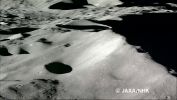
Kaguya-043-20090619_kaguya_hdtv_L3.jpgThe very final images taken by the HDTV (3)56 visitePicture taken at 03:13 a.m.
Coord.: about 79° South Lat. and approx. 261° East Long.
Spacecraft altitude: 23,0 Km
Relative Position: near side of Drygalski Crater (approx. 30 Km dia.)MareKromium
(2 voti)
|
|

Kaguya-040-hdtv_057_l.jpgPythagoras Crater66 visiteCaption JAXA:"Here is a snapshot around the Central Peak of Pythagoras Crater (the center is located at about 63,5° North and 63° West; D = approx. 142 Km), obtained by HDTV-TELE at 2008/12/12 08:36:00 (UT)".MareKromium
(2 voti)
|
|
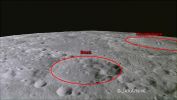
Kaguya-026-hdtv_002_4c.jpgSome Lunar Geography from Kaguya: Craters Kovalevskaya and Bronk (FarSide)54 visiteKovalevskaya Crater - Coord.: 30,8° North Lat. and 129,6° West Long.; Diam.: about 115 Km
Bronk Crater - Coord.: 26,1° North Lat. and 134,5° West Long.; Diam.: about 64 Km
MareKromium
(2 voti)
|
|
| 55 immagini su 5 pagina(e) |
 |
3 | |
|





