| Piú votate - The Moon from JAXA - The "Kaguya" Lunar Probe |

000-Kaguya.jpgThe Kaguya (SELENE) Probe70 visiteThe SELenological and ENgineering Explorer "KAGUYA"(SELENE), Japan’s 1st large Lunar Explorer, was launched by the H-IIA rocket on September 14, 2007 (JST). The mission, which is the largest Lunar Mission since the Apollo Program, is being keenly anticipated by many countries.
The major objectives of the Mission are to understand the Moon’s origin and evolution and to observe the Moon in various ways in order to utilize it in the future. The Lunar Missions that have been conducted so far have gathered a large amount of information on the Moon, but the mysteries of its origin and evolution have been left unsolved.
KAGUYA will investigate the entire Moon in order to obtain information on its elemental and mineralogical composition, geography, surface and sub-surface structure, the remnant of its magnetic field and its gravity field.
The results are expected to lead to a better overall understanding of the Moon’s evolution. At the same time, the observation equipment installed on the orbiting satellite will observe plasma, the electromagnetic field and high-energy particles. The data obtained in this way will be of great scientific importance for exploring the possibility of using the moon for human endeavors.MareKromium
(5 voti)
|
|

Kaguya-042-20090619_kaguya_hdtv_L2.jpgThe very final images taken by the HDTV (2)61 visitePicture taken at 03:12 a.m.
Coord.: about 77° South Lat. and approx. 261° East Long.
Spacecraft altitude: 25,4 Km
Relative Position: between Boltzmann and Drygalski CraterMareKromium
(4 voti)
|
|

Kaguya-031-Tycho-tc_012_d_l.jpgTycho: the Inner Rim (perspective view - natural colors; credits: Lunexit)57 visitenessun commentoMareKromium
(4 voti)
|
|

Kaguya-024-hdtv_002_5c.jpgSome Lunar Geography from Kaguya: Craters Stebbins and Van't Hoff (FarSide)63 visiteStebbins Crater - Coord.: 64,8° North Lat. and 141,8° West Long.; Diam.: about 131 Km
Van't Hoff Crater - Coord.: 62,1° North Lat. and 131,8 West Long.; Diam.: about 92 Km
MareKromium
(4 voti)
|
|

001-Kaguya-20071009_kaguya_02l.jpgRstar Separation from Kaguya (1) - before separation104 visiteKAGUYA consists of the Main Orbiter and two small satellites (Relay Satellite and VRAD Satellite). The Main Orbiter will reach the vicinity of the Moon. Once it has reached the Moon, it will be placed into a peripolar orbit at an altitude of 100 Km. The Relay Satellite will be placed in an elliptic orbit at an apogee of 2400 Km, and will relay communications between the Main Orbiter and the ground station.
The VRAD Satellite will play a significant role in measuring the gravitational field around the Moon.
The Main Orbiter will be employed for about one year and will observe the entire Moon.
(in this picture: on the left is the Rstar, and on the right is the VRAD Satellite).MareKromium
(4 voti)
|
|

003-Kaguya-20071009_kaguya_05l.jpgKaguya is approaching the Moon (1)73 visiteCaption JAXA:"The upper right dark area is a Lunar Ocean: it is the Western rim of the Oceanus Procellarum".
(This image was taken around 14:50 on Oct. 5th (JST), at a distance of about 1.500 Km from the Moon) MareKromium
(4 voti)
|
|

Kaguya-000-20071107.jpgThe North Pole of the Moon90 visiteCaption JAXA:"This is a still image taken out from the first moving image shooting when the KAGUYA Probe flew from the Northern Area of the Oceanus Procellarum (*1) to the center of the North Pole.
As the altitude near the North Pole is high, the angle of the coming sunlight was lower, thus the shade of the crater topography looks long in the image.
The moving image was taken at 04:07 a.m. on October 31st, 2007 (JST) by eight-fold speed intermittent shooting (eight minutes is converged to one minute) from the KAGUYA, and the data was received at the JAXA Usuda Deep Space Center on the same day.
(*1) Oceanus Procellarum:
The dark area on the Moon's surface called "ocean". It is located at the left end of the Northern Hemisphere on the front side of the Moon when we look up at it from the Earth. MareKromium
(4 voti)
|
|
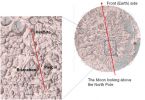
Kaguya-001-20071107.jpgThe View on Map: North Polar Region78 visiteThe area around the North Pole shot by the first image taking (encircled by a blue line) and KAGUYA's orbit (red arrow)
MareKromium
(4 voti)
|
|

Kaguya-003-20071107.jpgThe Western Side of the Oceanus Procellarum79 visiteCaption JAXA:"This is a still image taken out from the second moving image shooting when the KAGUYA Probe flew from the South to the North, on the Western Side of the "Oceanus Procellarum".
The dark part on the right of the above image is the Ocean and the light area on the left is called the "highland".
The moving image was taken at 05:51 a.m. on Oct. 31st, 2007 (JST) by eight-fold speed intermittent shooting (eight minutes is converged to one minute) from the KAGUYA, and the data was received at the JAXA Usuda Deep Space Center on the same day". MareKromium
(4 voti)
|
|

Kaguya-004-20071107.jpgThe View on Map: Oceanus Procellarum74 visiteThe West Area of the "Oceanus Procellarum" shot by the second image taking (encircled by a blue line) and KAGUYA's orbit (red arrow).
MareKromium
(4 voti)
|
|

Kaguya-005-20071107.jpgThe Western Side of the Oceanus Procellarum87 visiteCaption JAXA:"This is a still image taken out from the end part of the second moving image taking.
We can observe a crater called "Repsold," whose diameter is (about) 107 Km, at the center on the near side of this image. The channel that crosses this crater is called the "Repsold Valley", and its length is about 180 Km (equivalent to the distance between Tokyo and Shizuoka, on the Tokaido Line in Japan). The shooting time was 05:51, on October 31st, 2007.MareKromium
(4 voti)
|
|

Kaguya-038-Pico_Mons-tc_017_l-LXTT.jpgPico Mons (Absolute Natural Colors; credits: Dr Paolo C. Fienga - Lunexit Team)383 visiteMons Pico is a solitary Lunar Mountain that lies in the Northern part of the Mare Imbrium Basin, and to the South of the Dark-Floored Crater Plato.
Pico's peak forms part of the surviving Inner Ring of the Imbrium Basin. This Ring continues to the North-West, with the Montes Teneriffe and Montes Recti ranges. This mountain feature was most likely named by Schröter for the Pico von Teneriffe.
The Selenographic Coordinates of this Peak are 45,7° North Lat. and 8,9° West Longitude. It forms an elongated feature with a length of about 25 Km (oriented N/W-S/E) and a width of approx. 15 Km. The Peak rises to a height of only 2,4 Km, comparable to the maximum altitude of the Montes Teneriffe.
Due to its isolated location on the Lunar Mare Imbrium, however, this Peak can form prominent shadows when illuminated by oblique sunlight. Also, a smaller Peak to the South of Mons Pico (designated "Pico B") can be found. This Region of the Mare Imbrium is also notable for a number of Wrinkle Ridges.MareKromium
(3 voti)
|
|
| 55 immagini su 5 pagina(e) |
1 |
 |
|
|





