| |

| Piú votate - A Tribute To Mars Global Surveyor |

Controversial_Features-The_Villa-AB108405-SF-04.jpgUnusual Squared Structure on Mars (5)126 visite"...The deltaic dispersal at the base of the cliff face as well as the fluid's entire path from the conduit can be seen in this larger image, below. The four blue arcs coming from the pipe edge represent four separate flow rates and correspond to the 3 large gouges and 1 smaller gouge eroded away in that ledge beneath the pipe outflow. Note that the fluid streaming from the end of the pipe can be clearly seen as well as the fluids cascading down the lower cliff face and the deltaic dispersal of these fluids forming lobate "tongues". The dispersal of the fluids at the base of cliff clearly shows the change of albedo of the topography to a much lighter tone and the dispersal pattern due to the wet reflectance of the soils there.
NASA's satellite Mars Odyssey recently arrived at Mars with one of its primary objectives being -- finding water!. Perhaps they need to only ask those who are already there...".
(10 voti)
|
|
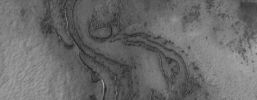
South_Polar_Features-00.JPGSouth Polar "River-like" Surface Features? (NASA-MGS/MOC RAW b/w frame)83 visiteCaption originale:"This MGS-MOC image shows layering in terrain at the high Southern Latitudes of Mars.
South Polar layers are commonly assumed to consist of varying amounts of dust and ice but there is an an alternative explanation saying that they may be exposures of ancient sedimentary rock".
Location near: 78,9° S; 10,1° W
Image width: ~3 Km (~1,9 mi)
Illumination from: upper left
Season: Southern Summer
(10 voti)
|
|
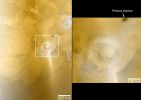
Volcanoes-Arsia_Mons.jpgArsia Mons with Water-Ice Clouds and the shadow of Phobos (credits NASA/JPL/MSSS)105 visiteCaption originale:"This pair of MGS-MOC color images shows early Autumn Clouds over the Arsia Mons Volcano, plus the shadow of the innermost of the Martain Moon Phobos. The picture on the left is taken from the MOC daily global map acquired at 7,5 km (~4,7 mi) per pixel on 28 January 2006, about a week after the start of Southern Autumn.
The picture on the right was taken at the same time, but at a higher resolution of 489 mt (~1604 ft) per pixel.
Both pictures are composites of MOC red and blue wide angle images, and both are oriented such that North is up and East is to the right. Arsia Mons and the other large Tharsis volcanoes commonly develop afternoon orographic (i.e., topographically-controlled) water ice clouds at this time of year. The equatorial Tharsis volcano, Pavonis Mons, is also under a deck of Water-Ice Clouds; it is located toward the upper right corner of the left, lower-resolution image.
Sunlight glints off the dusty Surface and the Clouds and Aerosols in the Atmosphere, producing the bright diagonal Streak located just South/East (lower right) of Arsia Mons. A Water-Ice Haze is seen on the left side of the lower-resolution image. The dark oval to the North-East of Arsia Mons, as noted above, is the shadow of Phobos".
(10 voti)
|
|

Volcanoes-Arsia_Mons-03-PIA04294.jpgArsia Mons and its "clouds" (3) - 25 February 2005 (Extremely Saturated Natural Colors; credits NASA/JPL/MSSS)112 visiteOriginal caption:"The spiral dust cloud over Arsia Mons repeats each year, but observations and computer calculations indicate it can only form during a short period of time each year. Similar spiral clouds have not been seen over the other large Tharsis volcanoes, but other types of clouds have been seen. The spiral dust cloud over Arsia Mons can tower 15 to 30 Km (9 to 19 miles) above the volcano. The white and bluish areas in the images are thin clouds of water ice. In the 2005 case, more water ice was present than in the previous years at the time the pictures were obtained. For scale, the caldera of Arsia Mons is about 110 Km (about 68 miles) across, and the summit of the volcano stands about 10 Km (6 miles) above its surrounding plains"
(10 voti)
|
|

Volcanoes-Arsia_Mons-02-PIA04294_fig2.jpgArsia Mons and its "clouds" (2) - 24 April 2003, Ls 173° (Extremely Saturated Natural Colors; credits NASA/JPL/MSSS)79 visiteOriginal caption:"This image was taken on April 24, 2003, such as in late Southern Autumn on Mars. These pictures prove that some parts of Mars experience weather phenomena that repeat each year, at about the same time. In some Regions, the repeated event may be a dust storm that appears every year, like clockwork, in such a way that we can only wish the weather were so predictable on Earth. One of the repeated weather phenomena occurs each year near the start of Southern Winter over Arsia Mons, which is located near 9° South Latitude, 121° West Longitude. Just before Southern Winter begins, sunlight warms the air on the slopes of the volcano. This air rises, bringing small amounts of dust with it. Eventually, the rising air converges over the volcano's caldera, the large, circular depression at its summit. The fine sediment blown up from the volcano's slopes coalesces into a spiraling cloud of dust that is thick enough to actually observe from orbit".
(10 voti)
|
|

Craters-South_Polar_Crater-M0702775Det.jpgUnnamed South Polar Crater (Original NASA/MGS/MSSS b/w Frame)99 visitenessun commento
(10 voti)
|
|

Utopia_Planitia-Smoke-B-M0202863-PCF-LXTT.jpgControversial Surface Feature in Utopia Planitia (EDM n.1)95 visitevedi il commento al frame che precede
(10 voti)
|
|

Craters-Crater_Cluster-Meridiani_Planum-PIA07151_modest-00.jpgCrater Cluster in Meridiani Planum (Original NASA/MGS/MSSS b/w Frame)132 visiteUna piccola porzione di Meridiani Planum, caratterizzata da un grande ed antico cratere (in alto) e da una moltitudine di crateri più piccoli che tanto ci ricordano il Cratere Endurance. certo, sarebbe bello andare a dare un'occhiata a questo strano paesaggio dal basso ma...Opportunity è troppo lontana e, in questa zona, quasi certamente, non ci arriverà mai.
Ma poi, in fondo, chissà...
(10 voti)
|
|

Phobos_from_Mgs-006-PIA01332.jpgPhobos from Mars Global Surveyor (6)234 visiteCaption NASA:"This image of Phobos, the inner and larger of the two moons of Mars, was taken by the Mars Global Surveyor on August 19, 1998. The Thermal Emission Spectrometer (TES) measured the brightness of thermal radiation at the same time the camera acquired this image. By analyzing the brightness, TES scientists could deduce the various fractions of the surface exposed to the Sun and their temperatures. This preliminary analysis shows that the surface temperature, dependent on slope and particle size, varies from a high of +25° F (-4° C) on the most illuminated slopes to -170° F (-112° C) in shadows. This large difference, and the fact that such differences can be found in close proximity, adds support to the notion that the surface of Phobos is covered by very small particles".
(10 voti)
|
|

Craters-Korolev_Crater-PIA06896-PCF-LXTT.jpgWave Clouds off Korolev Crater (Absolute Natural Colors; credits for the additional process. and color.: Dr Paolo C. Fienga - Lunexit Team)90 visiteCaption NASA:"This red wide angle Mars Global Surveyor (MGS) Mars Orbiter Camera (MOC) image shows a wavy Cloud Pattern formed in the lee of Korolev Crater, which is located near 72,8° North and 195,7° West (Vastitas Borealis Region). Korolev Crater is about 85 km (approx. 53 mi) in diameter and named for Sergei P. Korolev, a pioneering Russian rocket designer and engineer who died in the mid-1960s. The image, acquired in late Northern Summer, is illuminated by sunlight from the lower left".MareKromium
(9 voti)
|
|

Thaumasia_Region-The_Electric_Dunes-02.jpgThe Bright Dunes of Thaumasia (EDM - possible Natural Colors; credits: Lunar Explorer Italia)126 visiteIn questo splendido frame ottenuto dalla gloriosa Sonda Mars Global Surveyor e da noi colorizzato in Natural Colors, vediamo le "Dune Elettriche" (come scrivono gli Amici di Mars Unearthed) oppure, come diciamo noi, le "Dune Scintillanti" della "misteriosa" Regione Marziana di Thaumasia.
Ad ogni modo - e per quale che sia la definizione che vogliate adottare -, il quesito iniziale, che è naturalmente insito nella definizione, rimane: perchè queste "Huge Ripples" sono così brillanti?
Che cosa è, qual'è l'elemento "decisivo/scriminante" che conferisce loro un'albedo ed un colore (argenteo?) simile?
Provate a contestualizzare le dune, e Vi renderete conto subito dell'Anomalìa: il terreno che le circonda ed a cui esse accedono, infatti - per lo più si tratta di canaloni, depressioni simil-lacuali e greti di fiumi disseccati da ere -, non è affatto luminoso, anzi...
L'albedo ed il colore delle "Dune Elettriche" di Thaumasia sono quindi una caratterizzazione ESCLUSIVA delle dune stesse, il tutto a dispetto del fatto che le dune - come tutti sanno - di regola CONDIVIDONO LA NATURA dei rilievi sui quali giacciono (pensate, ad esempio, alle Ripples di Meridiani Planum, oppure all'Oceano di Dune (Erg) situato nelle prossimità del Polo Nord Marziano, oppure considerate le dune che si vedono nel Bacino di Gusev, oppure nella Regione di Arabia Terra etc.).
Certo, le dune - proprio perchè "disegnate" dai venti e quindi in "costante (sempre di regola) divenire" - si caratterizzano anche per la circostanza di avere un'albedo LEGGERMENTE MAGGIORE - nel loro versante più battuto dal vento - di quella del terreno su cui si trovano ma, se non altro in termini di general texture e colore, esse restano SEMPRE COERENTI con il resto del paesaggio che le comprende.
Ma non in questo caso: le Dune di Thaumasia, in definitiva, si STACCANO DECISAMENTE - per albedo, texture e colore - dal resto del paesaggio che le accoglie.
Quale spiegazione potremmo dare ad un simile fenomeno? Ebbene, senza per questo scomodare Hoagland e tanti altri Cultori di Eso-Archeologia, una risposta potremmo anche azzardarla. Anzi: due risposte (una, diciamo così, "Classica" ed un'altra "Esotica".
In accordo all'ipotesi "Classica", potremmo ritenere che le nostre Dune Scintillanti, in realtà, non sono affatto dune, bensì accumuli di sedimenti i quali sono stati prima dissepolti e poi - in parte - rimodellati dai venti che soffiano su Thaumasia.
In altre parole: non si tratterebbe di accumuli di detriti e polveri superficiali (eventualmente provenienti anche da Regioni più lontane) i/le quali, in fin dei conti, rappresentano il risultato finale dell'opera di raccolta e distribuzione di particelle realizzata dai venti, bensì di Yardangs sui generis, ossìa di strati di materiale fragile (ma compatto) che giaceva sepolto poco al di sotto del Datum di Thaumasia il quale è stato PRIMA "scoperto" dai venti che battono la Regione e poi parzialmente "rimodellato" a foggia di pseudo-dune.
Diciamo pseudo-dune poichè, in accordo a questa - certo fantasiosa, ma non completamente improbabile - ipotesi, i rilievi che vediamo SEMBRANO essere delle dune, MENTRE IN REALTA' NON LO SONO.
Si potrebbe trattare, dunque e per concludere, di materiali che, in un tempo remoto, giacevano sul fondo di laghi di modesta portata (stagni inclusi) e nei letti di fiumi piuttosto piccoli (più simili a torrenti) i quali, disegnati dalle (anche deboli) correnti di fondale che li caratterizzavano, sono stati riportati alla luce dai venti di Marte e, in parte, rimodellati.
Una seconda ipotesi, invece (decisamente più Esotica), potrebbe essere trovata nella circostanza per cui questi rilievi - che sarebbero sempre e comunque delle pseudo-dune - costituirebbero l'evidenza oggettiva della presenza, nella sub-superficie di Marte (ed in alcune Regioni più che in altre), di strutture organiche (o Bio-magnetiche) di dimensioni anche notevoli le quali, di fatto, rappresenterebbero l'"ossatura vitale" del Pianeta (la parola "ossatura" l'abbiamo scelta deliberatamente).
In altre parole, potrebbe trattarsi di residui - ormai morti, poichè esposti all'Atmosfera di Marte (diciamo "messi a cielo aperto") - di quelle Forme Vitali Esotiche ed Indigene che, secondo alcuni Scrittori e Ricercatori, popolerebbero il sottosuolo del Pianeta Rosso, a cominciare dalla sua sub-superficie (ossìa quello strato di terreno che si trova poco al di sotto del Datum - e cioè dai 20/30 cm sino a poche decine di metri di profondità).
Fantasia sfrenata anche questa? Fantascienza-trash? Giudicatelo Voi.
Se avete altre ipotesi da suggerire oppure se desideraste integrare e/o correggere le due che Vi abbiamo proposto...scrivete!MareKromium
(9 voti)
|
|

Craters-Unnamed_Crater_with_Dunefield_and_Windstreak-PIA07508-PCF-LXTT.jpgImpact Crater and Windstreak (Saturated Natural Colors; credits for the additional process. and color.: Dr Paolo C. Fienga - Lunar Explorer Italia)69 visiteCaption NASA:"This MGS-MOC image shows a 1,2-Km-diameter North mid-latitude crater with a bright wind streak".
Location near: 30,8° North Lat. and 131,8° West Long.
Image width: ~3 Km (~1,9 mi)
Illumination from: lower left
Season: Northern SummerMareKromium
(9 voti)
|
|
| 512 immagini su 43 pagina(e) |
|
|
|
5 | |
|
|
|
|
|
|
|
|








