| Piú votate - A Tribute To Mars Global Surveyor |

Phobos-00-HR-117-051004-6xSRC-6-col-01-Phobos.jpgDifferent views of Phobos (Original NASA/MGS/MSSS b/w Frames)91 visiteUna serie di immagini ottenute dalla Sonda ESA "Mars Express" le quali ci fanno gradualmente "avvicinare" a Phobos ed alla sua affascinante (ed in parte assolutamente inspiegabile) superficie. Molto ben visibile, in tutti i sub-frames, la più grande e conosciuta caratteristica superficiale di Phobos: lo Stickney Crater.
(8 voti)
|
|

South_Polar_Features-Crater_with_Ice-A-M1000628-02.jpgUnnamed South Polar Crater with residual Ice (Absolute Natural Colors; credits for the additional process. and color.: Dr Paolo C. Fienga - Lunexit Team)458 visitenessun commentoMareKromium
(8 voti)
|
|

Craters-Kunowsky_Crater-2004_06-PCF-LXTT.jpgFrost and Wavy Clouds on Kunowsky Crater (Absolute Natural Colors; credits for the additional process. and color.: Dr Paolo C. Fienga - Lunexit Team)217 visiteCaption NASA originale:"This red wide angle MGS-MOC image, acquired in March 2004, shows Kunowsky Crater ringed by seasonal Frost. Kunowsky Crater is about 67 Km (~42 mi) in diameter. Wavy Clouds form to the East of the Crater in early Spring as winds circulate from West to East. The Crater is located at about 57,1° North Lat. and 9,7° West Long.". MareKromium
(7 voti)
|
|
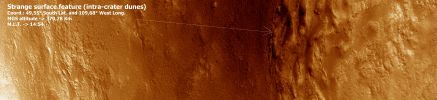
Craters-Unnamed_Crater_with_Intra-crater_Dunes-M0700566-00.jpgIntra-Crater Dunes (CTX Frame - Extremely Enhanced and Saturated Natural Colors; credits for the additional process. and color.: Dr Paolo C. Fienga - Lunexit Team)67 visitenessun commento
(7 voti)
|
|

Phobos_from_MGS-000.jpgPhobos from Mars Global Surveyor (1)192 visitePhobos, a quanto pensano gli Scienziati, potrebbe non essere una "luna originale" di Marte. Potrebbe (peraltro verosimilmente) trattarsi di un asteroide 'catturato' da Marte, in epoche remote, mentre transitava nei suoi paraggi. La velocità di rotazione di Phobos è estremamente elevata: questa luna, infatti, completa un'intera orbita intorno a Marte in circa 8 ore. Per quanto attiene, poi, il lato "esteriore" di Phobos, possiamo facilmente notare il grandissimo numero di crateri sulla sue superficie e l'enorme depressione (lo "Stickney Crater") che lo caratterizza in maniera davvero unica.
(7 voti)
|
|

Volcanoes-Arsia_Mons-01-PIA04294.jpgArsia Mons and its "clouds" (1) - 19 June 2001, Ls 180° (Extremely Saturated Natural Colors; credits NASA/JPL/MSSS)76 visiteVariazioni e ripetitività climatiche osservate sulla Regione dove sorge il grande vulcano Arsia Mons.
Original caption:"A wide angle view taken by the Mars Orbiter Camera on NASA's Mars Global Surveyor. At intervals of approximately one Mars year apart, similar spiral dust clouds over a volcano named Arsia Mons can be seen. This image was taken on June 19, 2001, such as the first day of Southern Winter on Mars".
(13 voti)
|
|

Thaumasia_Region-The_Electric_Dunes-03.jpgThaumasia Dunes: the brightest dunes of Mars (EDM n.2)102 visiteDa questa immagine, la luminosità di queste "dune" appare davvero in maniera inequivocabile. La prudenza, come sapete, non è mai troppa, ma la nostra sensazione è che stiamo guardando del ghiaccio o del metallo. L'immagine è stata ottenuta da un'altezza di 370 Km e sono le 14:48 MLT (cioè l'ora locale del luogo ripreso). Il Sole, a quell'ora, è decisamente alto sull'orizzonte e quindi la possibilità che l'albedo elevatissima di queste strutture dipenda proprio da un fenomeno di riflessione diretta della luce solare ci sembra, tutto sommato, accettabile.
Ciò che non ci sembra accettabile è l'atteggiamento della NASA riguardo a questo e ad altri fenomeni similari (ed eclatanti): un atteggiamento di TOTALE INDIFFERENZA.
Ma questa, come sapete, è tutta un'altra storia...
(13 voti)
|
|
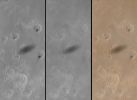
Martian_Eclipse-moc2_msss_3shadow100-01.jpgMOC Views of Martian Solar Eclipses (Original NASA/MGS/MSSS - Natural Color Frame)148 visiteThis picture shows wide angle red (left), blue (middle) and color composite (right) views of the shadow of Phobos (elliptical feature at center of each frame) as it was cast upon western Xanthe Terra on August 26, 1999, at about 2 p.m. local time on Mars. The image covers an area about 250 Km (155 miles) across and is illuminated from the left. The meandering Nanedi Valles is visible in the lower right corner of the scene. Note the dark spots on three crater floors - these appear dark in the red camera image (left) but are barely distingished in the blue image (middle), while the shadow is dark in both images. The spots on the crater floors are probably small fields of dark sand dunes.
(11 voti)
|
|

Controversial_Features-The_D_M_Pyramid-02.jpgThe D&M Pyramid (Original NASA/MGS/MSSS b/w Frame)161 visiteCaption NASA originale:"The mosaics shows a Cydonia landform popularly known as the "D&M Pyramid." It is located near 40.7°N, 9.6°W. Although it is not really shaped like a pyramid, the Cydonia landform is 1 of thousands of massifs, buttes, mesas, knobs and blocks that mark the transition from the far northwestern Arabia Terra cratered highlands down to the northeastern Acidalia Planitia lowlands. Each block, whether shaped like a face, a pyramid, or simply a mesa, massif or knob, is a remnant of the bedrock of northeastern Arabia that was left behind as erosion slowly degraded the terrain along this zone between the highlands and the lowlands. A few outcroppings of layers in this ancient bedrock can be seen in the mosaic of the pyramid-like landform shown here; much of the landform is covered with eroded mantling material that was deposited long after this highlands remnant became an isolated feature in Cydonia".
Lunar Explorer, questa volta, concorda pienamente con quanto riportato nella caption NASA.
(10 voti)
|
|

North_Polar_Regions-The_Erg-PIA07282.jpgOutcrops in the North polar Erg (Original NASA/MGS/MSSS b/w Frame)112 visiteCaption NASA originale:"This Mars Global Surveyor (MGS) Mars Orbiter Camera (MOC) image, acquired during Northern Summer in December 2004, shows dark, windblown Sand Dunes in the North Polar Erg: a vast Sea of Sand Dunes that surrounds the North Polar Cap. These landforms are located near 80,3° North Lat. and 144,1° West Long. Light-toned features in the image are exposures of the substrate that underlies the immense Erg. The image covers an area of about 3 Km (1,9 mi) wide and is illuminated by sunlight from the lower left".
Nota Lunexit: le "light-toned features", a nostro avviso, sono soltanto degli affioramenti rocciosi (Rocky Outcrops).
(10 voti)
|
|

Craters-Newton_Crater-PCF-LXTT-04.jpgNewton Crater's Gullies (Absolute Natural Colors; credits for the additional process. and color.: Dr Paolo C. Fienga - Lunexit Team)272 visitenessun commentoMareKromium
(5 voti)
|
|

Volcanic_Features-Collapse_Pits-Pavonis_Mons_Area.jpgPit Chain on the Eastern Flank of Pavonis Mons (Original NASA/MGS/MSSS b/w Frame)90 visiteCaption NASA originale:"Pavonis Mons is the middle of the 3 large Tharsis Montes Volcanoes in the Martian Western Hemisphere.
Located on the Equator at about 113° West Longitude, Pavonis Mons stands as much as 7 Km above the surrounding Plain. The MGS-MOC recently spied the above Chain of Elliptical Pits on the lower East Flank of Pavonis Mons. The picture covers an area approx. 3 Km wide by 3,4 Km in length. The Pits are aligned down the center of a 485 meters-(approx. 530 yards)-wide, shallow Trough.
The straight Trough and the Pits were both formed by collapse associated with faulting. The Scarp on each side of the Trough is a "Fault Line" - Troughs of this type are known to geologists as "Graben". Such features are typically formed when the ground is being moved apart by tectonic forces, or when the ground is uplifted by molten rock injected into the near sub-surface from deeper underground. Both processes may be contributing to the features seen on Pavonis Mons. The Pits follow the trend of these Faults, and indicate the locus of collapse".
(5 voti)
|
|
| 512 immagini su 43 pagina(e) |
 |
|
|
|
|
|
|
|
41 | |
|








