| Piú votate - A Tribute To Mars Global Surveyor |
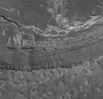
Chaotic_Terrain-Eos_Chaos-02.jpgFeatures of Eos Chaos: High Slope (Original NASA/MGS/MSSS b/w Frame - 2)69 visiteLocation near: 12,9° South Lat. and 49,5° West Long.
Image width: ~3 Km (~1,9 mi)
Illumination from: lower left
Season: Southern Summer
(5 voti)
|
|

Craters-Unnamed_Craters-Utopia_Planitia-00.jpgOld Buried Unnamed Craters in Northern Utopia Planitia (Original NASA/MGS/MSSS b/w Frame)66 visiteOriginal caption:"This MGS-MOC image shows 2 circular features on the Plains of Northern Utopia. A common sight on the Martian Northern Plains, these rings indicate the locations of Buried Impact Craters".
Location near: 65,1° North Lat. and 261,2° West Long.
Image width: ~2 Km (~1,2 mi)
Illumination from: lower left
Season: Northern Summer
(5 voti)
|
|

Craters-Eberswalde_Crater-5-PIA04293_fig3.jpgEberswalde Crater and Delta (Sub-meter-per-pixel cPROTO - detail mgnf)80 visiteOriginal caption:"After the sediments were deposited to form the delta, the material was further buried by other materials - probably sediments - that are no longer present. The entire package of buried material became cemented and hardened to form rock. Later, erosive processes - such as wind - stripped away the overlying rock, re-exposing the delta. Now preserved essentially as a fossil, the former floors of channels in the delta became inverted, to form ridges, by erosion. Channels can be inverted by erosion on both Earth and Mars. Usually this happens when the channel floor, or the material filling the channel, is harder to erode than the surrounding material into which the channel was cut. In some cases, the channels on Earth and Mars have been filled by lava to make them more resistant to erosion. In the case of Eberswalde, there are no lava flows; instead, the channel floors may have been rendered resistant to erosion either by being better-cemented than the surrounding material, or composed of coarser-grained sediment (such as sand and gravel as opposed to silt), or both".
(5 voti)
|
|

South_Polar_Features-South_Polar_Cap-PIA04287.jpgThe South Pole of Mars (Original NASA/MGS/MSSS b/ Frame)79 visiteOn 8 September 2005 (UT), the MGS-MOC resumed imaging of Mars after a nearly 2-week hiatus to recover the spacecraft from a glitch that put MGS into a protective "safe mode". The MOC was turned on during MGS orbit 29053, while the spacecraft was flying across day side of the Planet. MOC then resumed taking pictures on the next orbit. Shown here is a portion of the first picture acquired following MOC turn-on. The image shows a view of the Martian South Polar Region, as it appeared on September 8, 2005. The image was taken by MOC's red wide angle camera. In this case, the spacecraft began imaging Mars as it passed across the southern terminator, at the bottom of the image. MGS then flew southward, over the Polar Cap, then northward toward the Equator. The Equatorial Region is further north than the area shown here. The equatorial region is further north than the area shown here. The image not only provided the MOC team a confirmation that MOC imaging has resumed, this particular image, in the map-projected form shown here, is being used by the team to assist in setting the exposures for MOC narrow angle camera images that will be acquired from the south polar region over the next several days.
(5 voti)
|
|

Troughs-Tharsis_Region-PIA04103-000.jpgWhat's inside the Trough? (CTX Frame - Original NASA/MGS/MSSS b/w Frame)90 visiteCaption NASA originale:"This MGS-MOC image shows Channels carved by catastrophic Floods in the Tharsis Region of Mars. This area is located North/West of Jovis Tholus, and East of the large Martian Volcano Olympus Mons. The Terrain is presently mantled with fine Dust".
Location near: 10,5° North Lat. and 203,4° West Long.
Image width: width: ~3 Km (~1,9 mi)
Illumination from: lower left
Season: Northern Autumn
(5 voti)
|
|

Craters-Rabe_Crater-I-M0203079-02.jpgThe "Pitted" West Floor of Rabe Crater (3) - EDM (Original NASA/MGS/MSSS b/w Frame)80 visitenessun commento
(5 voti)
|
|

Volcanic_Features-Fissure-Tharsis_Region-M0806311Det.jpgMartian "Freeway" in Tharsis Region (Original NASA/MGS/MSSS b/w Frame)80 visiteUn'autostrada Marziana (come ci piacerebbe pensare...) o un gigantesco e lunghissimo crack che attraversa la suggestiva regione dove sorgono i vulcani Ascraeus e Pavonis Montes?
Uno splendido fotogramma MGS-MOC che ci mostra l'antico letto di un fiume Marziano o, più probabilmente, il risultato di un grande evento sismico occorso in ere remote. Non possediamo informazioni al riguardo ma potrebbe anche darsi che questo grande canale sia stato disegnato, in prima battuta, da un sisma e poi sia stato "perfezionato", nella sua struttura di dettaglio, da qualche altro evento vulcanico (la Regione è quella giusta...). Le solite dune che appaiono in qualche sua sezione ci fanno anche considerare l'ipotesi che questa gola, un tempo e solo in qualche suo punto preciso, sia anche stata invasa dalle acque.
(5 voti)
|
|

Craters-Holden_Crater-4-M0302733.jpgHolden Crater floor near intersection with Uzboi Vallis82 visitenessun commento
(5 voti)
|
|

Clouds-Chasma_Australe-M0904026-01.jpgClouds over Chasma Australe (Original NASA/MGS/MSSS b/w Frame - EDM)79 visiteQuesta immagine è stata ottenuta dalla Sonda MGS quando si trovava ad un'altitudine di circa 370 Km; l'ora locale del rilievo ripreso segna le 16 circa, MLT.
(5 voti)
|
|

Clouds-Chasma_Australe-M0904026-00.jpgClouds over Chasma Australe (Original NASA/MGS/MSSS b/w CTX Frame)83 visiteUn'altra immagine completamente enigmatica che, nel silenzio della NASA, proviamo ad interpretare. Chasma Australe è un profondissimo crepaccio (Chasm/a--->abisso) sul cui fondo, forse, si potrebbe trovare qualcosa (acqua allo stato liquido magari, in alcuni periodi dell'anno?). Se così effettivamente fosse, allora non sarebbe del tutto improponibile la circostanza per cui, al di sopra di questa zona così "umida", si sia potuta formare una spessa coltre di nuvole. In effetti, come potrete vedere nel detail mgnf che segue questo frame, è difficile vedere qualcosa di diverso dalle nuvole sul lato Dx dell'immagine e, quindi, proprio al di sopra dell'Abisso Australe. Certo, potremmo sbagliarci, ma questa interpretazione, dati alla mano, non è meno credibile di tante altre...
(5 voti)
|
|

Tithonium_Chasma-PIA03968-PCF-LXTT-00.jpgFeatures of Tithonium Chasma (Original NASA/MGS/MSSS b/w Frame)78 visiteCaption NASA originale:"This MGS-MOC image shows dark rippled surfaces and a patch of light-toned, perhaps sedimentary rock exposed on the floor of western Tithonium Chasma, part of the vast Valles Marineris Canyon System".
Location near: 5,0° South Lat. and 90,3° West Long.
Image width: ~3 Km (~1,9 mi)
Illumination from: lower left
Season Southern Spring
(5 voti)
|
|

Craters-Unnamed_Crater_in_Argyre_Planitia-M1000443Det.jpgUnnamed (and small) Crater in Argyre Planitia (Original NASA/MGS/MSSS b/w Frame)105 visitenessun commento
(5 voti)
|
|
| 512 immagini su 43 pagina(e) |
 |
|
|
|
|
30 | |
|
|
|
|








