| Piú votate - A Tribute To Mars Global Surveyor |

Channels-Inverted_Channels_in_Arabia_Terra-PIA03643-01.jpgInverted channels of Arabia Terra (1 - Natural Colors; credits for the additional process. and color.: Dr Paolo C. Fienga - Lunexit Team)167 visiteOriginal caption:"This MGS-MOC image shows a somewhat sinuous, nearly flat-topped Ridge, located in Eastern Arabia Terra. The ridgetop was once the Floor of a Valley, perhaps carved by running water. The Valley Floor, or material that covered the Floor, was more resistant to erosion than the surrounding rock into which the Valley was cut. Thus, over time, the Valley disappeared and its Floor was left standing high as a Ridge. Inverted Valleys are common on Mars, but they also occur on Earth".
Location near: 10,8° North Lat. and 313,2° West Long.
Image width: width: ~3 Km (~1,9 mi)
Illumination from: lower left
Season: Northern WinterMareKromium
(5 voti)
|
|

Channels-Inverted_Channels_in_Arabia_Terra-PIA03643-04.jpgInverted channels of Arabia Terra (2 - Natural Colors; credits for the additional process. and color.: Dr Paolo C. Fienga - Lunexit Team)165 visiteOriginal caption:"This MGS-MOC image shows a somewhat sinuous, nearly flat-topped Ridge, located in Eastern Arabia Terra. The ridgetop was once the Floor of a Valley, perhaps carved by running water. The Valley Floor, or material that covered the Floor, was more resistant to erosion than the surrounding rock into which the Valley was cut. Thus, over time, the Valley disappeared and its Floor was left standing high as a Ridge. Inverted Valleys are common on Mars, but they also occur on Earth".
Location near: 10,8° North Lat. and 313,2° West Long.
Image width: width: ~3 Km (~1,9 mi)
Illumination from: lower left
Season: Northern WinterMareKromium
(5 voti)
|
|

Volcanoes-Ascraeus_Mons-PIA07149-PCF-LXTT-1.jpgAscraeus Mons (Absolute Natural Colors; credits for the additional process. and color.: Dr Paolo C. Fienga - Lunexit Team)273 visiteCaption NASA originale:"This red wide angle Mars Global Surveyor (MGS) Mars Orbiter Camera (MOC) image shows Ascraeus Mons, the northernmost of the three Tharsis Montes shield volcanoes. Ascraeus Mons is about 460 Km (~286 mi) across and its summit is at an elevation of about 18 km (11 mi) above the "Martian Datum" (or Mars' Ground Zero, such as the elevation designated as 0 km). The center of the Summit Caldera is near 11° North Lat. and 104° West Long.". MareKromium
(5 voti)
|
|

North_Polar_Features-Dunes-Dark_Dunes-PCF-LXTT.jpgDark Dunes in Vastitas Borealis (Absolute Natural Colors; credits for the additional process. and color.: Dr Paolo C. Fienga - Lunexit Team)193 visiteCaption NASA originale:"This MGS-MOC image shows dark North Polar Dunes overlying other materials in the North Polar Region".
Location near: 79,1° North Lat. and 228,8° West Long.
Image width: ~3 Km (~1,9 mi)
Illumination from: lower left
Season: Northern SummerMareKromium
(5 voti)
|
|

Hills-Zephyria_Region-PIA07859-00.jpgFlow Features and Hills in Zephyria Planum (Absolute Natural Colors; credits for the additional process. and color.: Dr Paolo C. Fienga - Lunexit Team) 288 visiteCaption NASA originale:"This MGS-MOC image shows a Plain covered by Flow Material that surrounded and banked against 3 older, rounded Hills in the Zephyria Region. Although some investigators have proposed that the Flows covering Plains in this Region are the remains of an ice-covered lake, others have found considerable evidence, including small Volcanoes, to suggest that the Flows are Volcanic. The textures on these Flows resemble that of some of the Lava Flows in the Tharsis Region of Mars".
Location near: 2,7° South Lat. and 195,7° West Long.
Image width: ~3 Km (~1,9 mi)
Illumination from: lower left
Season: Southern WinterMareKromium
(5 voti)
|
|

Craters-Lyot_Crater-PCF-LXTT.jpgFretted Terrain and Lyot Crater (Absolute Natural Colors; credits for the additional process. and color.: Dr Paolo C. Fienga - Lunexit Team) 155 visiteCaption NASA:"Martian "fretted (--->corrugato/increspato) terrain" occurs in Regions of "Buttes" (--->colline "a ceppo") and "Mesas" (--->altopiani) that stand at the erosional margin where Northern low-lying Plains meet the higher-standing Cratered Uplands. Found mostly in the Mid-Northern Latitudes, some of the best examples of "Fretted Terrain" occur in the Deuteronilus Mensae Region. Here, the interaction of the process that creates the Mesas and Buttes, the processes that modify these surfaces after they form, and the relationship of both of these processes with the near-instantaneous event that formed the large Crater Lyot, provide us places to look to decipher this small but important piece of Martian Geological History.MareKromium
(5 voti)
|
|

North_Polar_Features-North_Polar_Margin-Chasma_Boreale-PIA07052-PCF-LXTT.jpgNorth Polar "Scarp" (Absolute Natural Colors; credits for the additional process. and color.: Dr Paolo C. Fienga - Lunexit Team)260 visiteCaption NASA:"This 1,6 meters (~5 feet) per pixel Mars Global Surveyor (MGS) Mars Orbiter Camera (MOC) image shows a typical North Polar Scarp and associated dark windblown Sand Dunes. Layers of material -- possibly Dust and Ice -- are exposed by the Scarp. The small white patches in the image are remnants of seasonal Frost. When this North Polar image was acquired in late September 2004, most of the Polar Frost had sublimed away. This image is located near 85,1° North Lat. and 210,8°West Longitude. The scene covers an area of approximately 3 Km (about 1,9 mi) across, and is illuminated by sunlight from the lower left.MareKromium
(5 voti)
|
|

Craters-Unnamed_Crater-PIA07202-PCF-LXTT.jpgUnnamed Crater with Pedestal (Absolute Natural Colors; credits for the additional process. and color.: Dr Paolo C. Fienga - Lunar Explorer Italia)250 visiteThis Mars Global Surveyor (MGS) Mars Orbiter Camera (MOC) image shows an Unnamed Impact Crater, a little over 2 Km (> 1,2 mi) in diameter, located in Noachis Terra near 50,4° South and 14,3° West. The Crater's Bouldery Ejecta Blanket has protected underlying material from being eroded away by wind, leaving the Ejecta up on a low Pedestal. This picture covers an area about 3 Km (approx. 1,9 miles) across, and is illuminated by sunlight from the lower left.MareKromium
(5 voti)
|
|

Craters-Tikhonravov_Crater-PIA03962-01.jpgSedimentary Rocks inside Tikhonravov Crater - Arabia Terra (Saturated Natural Colors; credits for the additional process. and color.: Dr Paolo C. Fienga - Lunexit Team)145 visiteCaption NASA originale:"This MGS-MOC image shows Layered Sedimentary Rocks exposed by erosion, then mantled by Dust, in Tikhonravov Crater in central Arabia Terra. Dark Slope Streaks occur where some of the Dust has slid down the layered Slopes".
Location near: 13,8° North Lat. and 324,8° West Long.
Image width: ~3 Km (~1,9 mi)
Illumination from: lower left
Season: Northern AutumnMareKromium
(5 voti)
|
|

Volcanoes-Olympus_Mons-MGS-2003_09-PCF-LXTT-01.jpgOlympus Mons (Natural Colors; credits for the additional process. and color: Dr Paolo C. Fienga - Lunexit Team)245 visite...Alla NASA, Marte in generale, ed Olympus Mons in particolare, piacciono così...MareKromium
(5 voti)
|
|
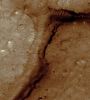
Acidalia_Planitia-Unusual_Landforms-M0300102-PCF-LXTT-01.jpgUnusual Landforms in Acidalia Planitia (EDM n.1 - Enhanced Absolute Natural Colors; credits for the additional process. and color.: Dr Paolo C. Fienga - Lunexit Team)158 visitenessun commentoMareKromium
(5 voti)
|
|

Acidalia_Planitia-Unusual_Landforms-M0300102-PCF-LXTT-02.jpgUnusual Landforms in Acidalia Planitia (EDM n.2 - Enhanced Absolute Natural Colors; credits for the additional process. and color.: Dr Paolo C. Fienga - Lunexit Team)149 visitenessun commentoMareKromium
(5 voti)
|
|
| 512 immagini su 43 pagina(e) |
 |
|
|
|
|
25 | |
|
|
|
|








