| Piú votate - A Tribute To Mars Global Surveyor |

Craters-Unnamed_Crater_with_Dark_Streaks-2003_08.jpgDark Slope Streaks on the edge of an Unnamed Crater (Saturated Natural Colors; credits: NASA/MGS/MSSS)112 visiteCaption NASA originale:"This June 2003 MGS-MOC image shows a crater rim mantled with fine dust near 7.6°N, 171.8°W. Occasional avalanches of dust have created dark streaks that are tapered at their source and broaden downslope.
A suite of particularly large streaks are seen in the lower right quarter of the picture. The MOC narrow angle camera does not take color images; this full-resolution (1,5 m/pixel; 5 ft/pixel) picture has been "colorized" using data from a previous color image of Mars.
Sunlight illuminates this scene from the lower left".
(16 voti)
|
|

Volcanoes-Olympus_Mons-MGS.jpgOlympus Mons (Natural Colors; NASA/JPL/MSSS)367 visitenessun commento
(16 voti)
|
|

Dunes-S2200554sub-00.jpgMigrating Dunes (Original NASA/MGS/MSSS b/w Frame)118 visiteCaption NASA originale:"This MGS-MOC image shows a suite of dunes in one of the several North Polar Dune Fields. The bright surfaces adjacent to some of the dunes are patches of frost. These dunes spend much of the Autumn, Winter, and Spring seasons covered with CO2 frost. Only in late Spring and in Summer are the dark windblown sands fully exposed.
Over the course of the 9+ years of the MGS mission, the MOC team has sought evidence that sand dunes may be migrating downwind over time. However, no clear examples of the movement of a whole dune have been identified. On Earth, such movement is typically detectable in air photos of the smallest active dunes over periods of a few years. Owing to the fact that the North Polar Dunes spend much of each Martian Year under a cover of frost, perhaps these move much more slowly than their frost-free, terrestrial counterparts. The sand may also be somewhat cemented by ice or minerals, likewise preventing vigorous dune migration in the present environment.
This view covers an area approximately 3 km (1.9 mi) wide and is illuminated by sunlight from the lower left. The dunes are located near 79.8°N, 127.1°W, and the picture was acquired on 11 September 2006.
(15 voti)
|
|

Craters-Newton_Crater-03.jpgNewton Crater's Gullies (Original NASA/MGS/MSSS b/w Frame)206 visiteDa "NASA - Picture of the Day" del 26.6.2000:"...Inside a small crater that lies inside large Newton Crater on Mars, numerous narrow channels run from the top down to the crater floor. The above picture covers a region spanning about 3000 meters across. These and other gullies have been found on Mars in recent HR pictures taken by the orbiting Mars Global Surveyor robot spacecraft. Similar channels on Earth are formed by flowing water, but on Mars the temperature is normally too cold and the atmosphere too thin to sustain liquid water. Nevertheless, many scientists now hypothesize that liquid water did burst out here from underground Mars, eroded the gullies and pooled at the bottom as it froze and evaporated. If so, life-sustaining ice and water might exist even today below the Martian surface (...)". L'idea che ci sia acqua allo stato liquido sotto la superficie di Marte non è nuova, anzi: la NASA stessa lo ipotizzava 4 anni fa. Oggi, dopo mesi di esplorazione "in loco", tutto tace. Forse un ripensamento?
(15 voti)
|
|

Aeolian_Features-Windstreaks-V17253016-00.jpgWindstreaks, Pseudo-Windstreaks and Surface Striations (1 - False Colors)74 visiteUn grazie di cuore al Dr Gianluigi Barca per aver selezionato (assieme a molti altri) questi 3 frames MGS che, in accordo a quanto dice la NASA, dovrebbero tutti rappresentare dei "Windstreaks".
Ebbene, pur rendendoci conto si quanto spinosa sia la questione dei rilievi superficiali aventi una natura (presumibilmente) eolica, a noi sembra opportuno cercare di non "ammassare" sotto la medesima categoria una serie di fenomeni "visivamente" (e, forse, SOLO visivamente...) simili - talvolta, magari, anche MOLTO simili.
Una serie di fenomeni che, in realtà, potrebbero non solo essere il frutto di eventi sostanzialmente DIVERSI, ma che potrebbero anche costituire la rappresentazione visibile (quella che noi chiamiamo Evidenza Oggettiva) di un medesimo evento il quale, tuttavia, dopo aver influito sulla superficie del Pianeta Rosso (modellandola) in un certo modo all'atto del suo verificarsi, si è poi esaurito ed ha quindi lasciato che le sue tracce/conseguenze, in un certo senso, si evolvessero e degradassero, in accordo alle Leggi del Tempo ed agli accadimenti geologici ed atmosferici propri della realtà in cui esso ebbe a verificarsi.
Una storia di "nascita", "evoluzione" - "invecchiamento", se si vuole... - ed "estinzione", in fondo. Una storia che ci rammenta che tutto, in questo Universo (a nostro parere, ovviamente), ha una origine, si evolve - cambiando - e quindi si deteriora e scompare: sulla Terra, su Marte, nelle Stelle e Galassie più lontane.
Una storia molto simile a quella degli Esseri Umani, se volete...MareKromium
(14 voti)
|
|
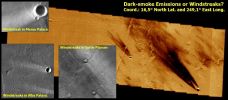
Aeolian_Features-Windstreaks-Comparison.jpgWindstreaks inside Becquerel Crater (CTX Frame: False Colors - insets: Original NASA/MGS/MSSS and NASA/JPL/ASU b/w Frames)67 visiteUn piccolo mosaico, tanto per evidenziare la notevole (sempre e solo a nostro avviso, naturalmente) diversità esistente fra alcuni Windstreaks.
Tanto per prevenire possibili malintesi, ribadiamo che il Windstreak, tecnicamente, è (o forse sarebbe meglio dire "dovrebbe essere") l'espressione visibile di un'area superficiale "protetta" da un rilievo la quale, di conseguenza ed a differenza delle aree ad essa latistanti, NON viene spazzata dal vento (diciamo che è "risparmiata").
Ma alcuni Windstreaks, a differenza di quanto detto qui di sopra, esprimono invece il risultato visibile di quanto il vento ha DIRETTAMENTE trasportato su una specifica area superficiale (il che vuol dire che essi non rappresentano un'area "coperta", bensì un'area "battuta").
Questa distinzione costituisce una mera "finezza/sottigliezza" interpretativa, forse? Secondo noi no. No perchè una cosa è guardare cosa accade ad un'area su cui il vento non arriva a battere direttamente (a causa della presenza di un ostacolo) ed un'altra osservare che cosa il vento ha trasportato su una certa superficie, battendo direttamente su di essa.
Osservate l'omogeneità iniziale del tre Windstreaks presenti nei frames in b/n (si tratta dunque di Windstreaks che evidentemente esprimono delle aree "protette") e la forma a "V" dei Windstreaks individuati nelle prossimità di Ascraeus (i quali, ora ed altrettanto evidentemente, esprimono aree "battute").
Le implicazioni derivanti da questa (sommaria, ma non insignificante) classificazione dei Windstreaks ci paiono talmente evidenti da non necessitare, in questa sede, di ulteriori spiegazioni.MareKromium
(14 voti)
|
|

Craters-Pollack_Crater-01.jpgThe "White Rock" inside Pollack Crater94 visiteCaption NASA originale:"The layering in White Rock suggests that the material is sediment deposited at some time in the distant past within Pollack Crater. The fact that the material erodes to form steep cliffs suggests that it is hard like rock. Thus, White Rock is interpreted to be an outcrop of sedimentary rock. It is probably a small remnant of a larger body of rock that may have once covered the entire floor of Pollack Crater; this view is supported by the observation that more extensive layered rocks are seen in other craters across the surface of the Red Planet (e.g., the crater at 8°N, 7°W)".
(14 voti)
|
|

North_Polar_Regions-North_Pole.jpgThe North Pole of Mars (Natural Colors; credits: NASA/MGS/MSSS)324 visiteNon ci sono parole sufficienti per descrivere questa meravigliosa immagine ad HD del Polo Nord di Marte ed il volume di dettagli che risultano percepibili è davvero enorme. EccoVi il testo originale di commento al frame:"Spring reached the North Pole of Mars (foto del Maggio 2002) and brought with it the usual dust storms. As the North Polar Cap begins to thaw, a temperature difference occurs between the cold frost region and recently thawed surface, resulting in swirling winds between the adjacent regions. In the above image mosaic from the Mars Global Surveyor spacecraft, the white material is frozen carbon dioxide that covers much of the extreme north. The choppy clouds of at least three dust storms can be identified". Che altro dire???
(14 voti)
|
|

North_Polar_Regions-Frozen_Dunes-MGS-01.jpgPolar Dunes and Ice (False Colors; credits: NASA)97 visitenessun commento
(13 voti)
|
|

Volcanoes-Elysium_Mons.jpgElysium Mons (NASA/JPL/MSSS)77 visitenessun commento
(13 voti)
|
|

Hellas_Planitia.jpgHellas Planitia in Winter (Natural Colors; credits: NASA/MGS/MSSS)143 visite"This picture captures two dust storms, each large enough to cover Arizona or New Mexico. One is located near the lower left, the other at the lower right. Taken on April 8, 2001 (Mid-Southern Winter), this is a mosaic of six MOC daily global images centered around Hellas Planitia in the Martian Southern Hemisphere. Hellas Planitia is the dominant elliptical feature just below the center of the picture. The bright, nearly white surfaces along the lower (southern) edge of the picture are covered by wintertime frost. The strong temperature difference between the winter frost and the warmer air just off the edge of this Polar Cap generates winds that - at this time of year - are often strong enough to lift Dust into large, reddish-brown, billowy clouds".
(13 voti)
|
|

Phobos_from_Mgs-011.jpgMartian Limb and Phobos (Natural Colors; credits: NASA/MGS/MSSS)145 visiteUna spettacolare veduta del bordo ("limb") di Marte e della sua luna "misteriosa", Phobos, la quale costituisce anche uno degli oggetti più "bui" dell'intero Sistema Solare. Ecco il commento originale a questa immagine:
"Phobos is one of the darkest objects in the Solar System. Thus, 4 wide angle images were obtained to make the picture of Phobos over the martian limb: a pair of red and blue wide angle images was acquired for the limb and a pair of separate images were required to see Phobos. The wide angle images illustrate the fact that Phobos is mostly colorless (dark gray); the faint orange/red hue in the wide angle picture is a combination of slight differences in the focal lengths of the blue and red cameras and the orange/red illumination provided by reflection of sunlight off Mars. To a person standing on Phobos, the Red Planet would fill most of the sky".
(13 voti)
|
|
| 512 immagini su 43 pagina(e) |
2 |  |
|
|
|
|
|
|
|
|
|








