| Piú votate - A Tribute To Mars Global Surveyor |

North_Polar_Cap-M0303936-PCF-LXTT-1.jpgFrame M0303936 - The North Polar Cap (Absolute Natural Colors; credits for the additional process. and color.: Dr Paolo C. Fienga - Lunexit Team)246 visitenessun commentoMareKromium
(6 voti)
|
|

North_Polar_Features-Layers-MGS-2-PCF-LXTT.jpgNorth Polar Layers (Enhanced Natural Colors; credits for the additional process. and color.: Dr Paolo C. Fienga - Lunexit Team)237 visitenessun commentoMareKromium
(6 voti)
|
|

Craters-Unnamed_Crater_with_Tiled_Floor-MGS-PCF-LXTT.jpgUnnamed Crater in Vastitas Borealis (Natural Colors; credits for the additional process. and color.: Dr Paolo C. Fienga - Lunexit) 230 visiteCaption NASA originale:"This MGS-MOC image shows Polygonal Cracks formed in the material that nearly fills an Impact Crater on the Martian Northern Plains. The light-toned patches in the Cracks are the remains of Ice, left over from the preceding Winter.
On Earth, Polygons such as these are most common in the Polar Regions and form in the presence of ground ice. Whether the same is true for Mars remains to be determined, but, certainly, this is a good possibility".
Location near: 65,7° North; 277,5° West
Image width: ~3 Km (~1,9 mi)
Illumination from: lower left
Season: Northern Spring MareKromium
(6 voti)
|
|

South_Polar_Features_-_The_Lake-A1-M0901354-02.jpgSouth Polar "Pseudo-Lake" (False Colors; credits for the additional process. and color.: Dr Paolo C. Fienga - Lunexit Team)321 visitenessun commentoMareKromium
(6 voti)
|
|
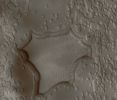
South_Polar_Regions-SPRC.jpgSublimation at the South Polar Residual Cap (Absolute Natural Colors; credits: Dr Paolo C. Fienga - Lunexit Team)124 visiteCaption NASA:"This MGS-MOC image shows a portion of the South Polar Residual Cap where the effects of Sublimation are apparent.
Over extended periods of time, Sublimation "eats" away at the smoother appearing material (largely composed of frozen CO2), darkening the Scarps and creating the irregularly shaped depressions that are present throughout much of the scene".
Location near: 87,1° South Lat. and 69,3° West Long.
Image width: ~3 Km (~1,9 miles)
Illumination from: upper left
Season: Southern SummerMareKromium
(6 voti)
|
|

Marte_Vallis-MGS-PCF-LXTT.jpgThe alleged "Frozen Ocean" of Marte Vallis (Natural Colors; credits for the additonal process. and color.: Dr Paolo C. Fienga - Lunexit Team)104 visitenessun commentoMareKromium
(6 voti)
|
|

Craters-Unnamed_Crater_with_Windstreak_in_Sirtis_Major_Planum-PCF-LXTT.jpgCrater and Windstreak in Syrtis Major Planum (Enhanced Natural Colors; credits for the additional process. and color.: Dr Paolo C. Fienga)90 visitenessun commentoMareKromium
(6 voti)
|
|

Craters-Schiaparelli_Crater-Layers-02.gifLayers in Schiaparelli Crater (Natural Colors; credits: Lunexit)67 visiteDa "NASA - Picture of the Day", del giorno 29 Novembre 2009:"Is this a picture of Mars or Earth?
Oddly enough, it is a picture of Mars. What may appear to some as a terrestrial coastline is in fact a formation of ancient layered hills and wind-blown sand on Mars.
The above-pictured region spans about 3 Km in Schiaparelli Crater. What created the layers of sediment is still a topic of research. Viable hypotheses include ancient epochs of deposit either from running water or wind-blown sand. Winds and sandstorms have smoothed and eroded the structures more recently.
The "water" that appears near the bottom is actually dark colored sand. The image was taken with the Mars Global Surveyor Spacecraft that operated around Mars from 1996-2006 and returned over 200.000 images".MareKromium
(6 voti)
|
|

Channels-Auqakuh_Vallis-MGS-PCF-LXTT.jpgAuqakuh Vallis: "Old Riverbed" or "Windblown Ripples"? (Natural Colors; credits for the additional process. and color.: Dr Paolo C. Fienga - Lunar Explorer Italia)71 visiteCaption NASA originale:"This MGS-MOC image shows windblown ripples on the floor of Auqakuh Vallis.
The light-toned area, running diagonally across the scene from South-West to North-East, may be dust that has accumulated in the bottom of the valley and on top of the ripples".
Location near: 31,3° North; 299,3° West
Image width: ~3 Km (~1,9 mi)
Illumination from: lower left
Season: Northern SpringMareKromium
(6 voti)
|
|

Layers-Sinus_Meridiani-MGS-PCF-LXTT.jpgWe see the Island; we don't see the Sea... (Natural Colors; credits for the additional process. and color.: Dr Paolo C. Fienga - Lunar Explorer Italia)66 visiteCaption originale:"This MGS-MOC image shows layered, sedimentary rock exposures in the Sinus Meridiani Region".
Location near: 4,8° N; 1,2° W
Image width: ~1 Km (~0,6 mi)
Illumination from: lower left
Season: Northern Autumn
Nota: titolo dell'immagine assolutamente autoesplicativo. Non ci sembra difficile vedere, infatti (ed a parte l'asciutto commentino NASA), quello che rimane di un'isola e delle stratificazioni che hanno segnato il lento ritrarsi delle acque dai suoi dintorni. Dunque la domanda è: dov'è andata a finire il lago (o il fiume o l'oceano) che la circondava?MareKromium
(6 voti)
|
|

North_Polar_Regions-The_Erg-MO.jpgThe North Polar Erg (Natural Colors; credits for the additional process. and color.: Dr Paolo C. Fienga - Lunar Explorer Italia)70 visiteCaption NASA:"With the surface frost removed by the Summer Sun, different polar textures are exposed. This image contains Polar Dunes and a large region just off the Permanent Polar Cap".
Coord.: 82,1° North Lat. and 113,5° East Long.MareKromium
(6 voti)
|
|

South_Polar_Features-Fog_over_Chasma_Australe-PCF-LXTT.jpgFog over Chasma Australe (Absolute Natural Colors; credits for the additional process. and color: Dr Paolo C. Fienga - Lunexit Team)67 visiteCaption NASA originale:"Fog is a common occurrence in some areas of the retreating South Polar Seasonal Frost Cap. Fogs are commonly banked-up against steep Slopes or found inside Defrosting Craters.
This MGS-MOC image captured mid-afternoon Fog banked against the Layered Walls of Chasma Australe, a Trough in the South Polar Region of Mars. The Frost-covered Layers of Chasma Australe can be seen on the right side of this image, while the billowy Fog is to the left.
Sunlight illuminates this scene from the upper left. The Fog, probably composed of water ice crystals, casts shadows on the Chasm's Wall.
This picture is located near 83,5° South Lat. and 257,9° West Long; it covers an area about 3 Km (1.9 mi) wide". MareKromium
(6 voti)
|
|
| 512 immagini su 43 pagina(e) |
 |
|
|
|
|
18 | |
|
|
|
|








