| |

| Piú votate - The Universe in Super Definition |

NGC-2976.jpgNGC 2976 - Galaxy or "Galactic Star-Factory"?63 visiteGalaxies throughout the Universe are ablaze with star birth. But for a nearby, small spiral galaxy, the star-making party is almost over. Astronomers were surprised to find that star-formation activities in the outer regions of NGC 2976 have been virtually asleep because they shut down millions of years ago. The celebration is confined to a few die-hard partygoers huddled in the galaxy's inner region.
The explanation, astronomers say, is that a raucous interaction with the neighboring M 81 group of galaxies ignited star birth in NGC 2976.
Now the star-making fun is beginning to end. Images from NASA's Hubble Space Telescope show that star formation in the galaxy began fizzling out in its outskirts about 500 MY ago as some of the gas was stripped away and the rest collapsed toward the center. With no gas left to fuel the party, more and more regions of the galaxy are taking a much-needed nap. The star-making region is now confined to about 5000 LY around the core.
NGC 2976 does not look like a typical Spiral Galaxy, as this Hubble image shows. In this view of the oddball galaxy's inner region, there are no obvious spiral arms. Dusty filaments running through the disk show no clear spiral structure. Although the gas is centrally concentrated, the galaxy does not have a central bulge of stars. Astronomers pieced together the galaxy's star-formation story with the help of Hubble's sharp vision. The galaxy's relatively close distance to Earth allowed Hubble's Advanced Camera for Surveys (ACS) to resolve hundreds of thousands of individual stars. What look like grains of sand in the image are actually individual stars.
Studying the individual stars allowed astronomers to determine their color and brightness, which provided information about when they formed. The astronomers combined the Hubble results with a map, made from radio observations, showing the current distribution of hydrogen across the galaxy. By analyzing the combined data, the Hubble research team then reconstructed the star-making history for large areas of the galaxy. The Hubble observations are part of the ACS Nearby Galaxy Survey Treasury (ANGST) program. The map is part of The HI Nearby Galaxy Survey by the National Radio Astronomy Observatory's Very Large Array in New Mexico.
The blue dots are fledgling blue giant stars residing in the remaining active star-birth regions. NGC 2976 resides on the fringe of the M 81 Group of Galaxies, located about 12 MLY away in the constellation Ursa Major.MareKromium
(4 voti)
|
|
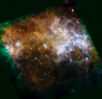
Milky_Way-PIA12251.jpgCold Region in the Milky Way62 visiteSome of the coldest and darkest dust in space shines brightly in this InfraRed image from the Herschel Observatory, a European Space Agency Mission with important participation from NASA.
The image is a composite of light captured simultaneously by two of Herschel's three instruments -- the photodetector array camera and spectrometer, and its spectral and photometric imaging receiver.
The image reveals a cold and turbulent region where material is just beginning to condense into new stars. It is located in the plane of our Milky Way galaxy, 60° from the center. Blue shows warmer material, red the coolest, while green represents intermediate temperatures.
The red filaments are made up of the coldest material pictured here -- material that is slightly warmer than the coldest temperature theoretically attainable in the Universe.
Light captured by the photodetector array camera and spectrometer is colored blue and green (blue represents 70-micron light, and green, 160 micron light). The light detected by the spectral and photometric imaging receiver is colored red (and shows the combined wavelengths of 250, 350 and 500 microns). The image spans a region 2.1 by 2.2 degrees.MareKromium
(4 voti)
|
|

ARP194-HST-2009-18-a-full_jpg.jpgArp 194 (Galaxy Cluster)65 visiteTo commemorate the Hubble Space Telescope's 19 years of historic, trailblazing science, the orbiting telescope has photographed a peculiar system of galaxies known as Arp 194. This interacting group contains several galaxies, along with a "cosmic fountain" of stars, gas, and dust that stretches over 100.000 LY.
The Northern (upper) component of Arp 194 appears as a haphazard collection of dusty spiral arms, bright blue star-forming regions, and at least two Galaxy Nuclei that appear to be connected and in the early stages of merging. A third, relatively normal, spiral galaxy appears off to the right.
The Southern (lower) component of the galaxy group contains a single large spiral galaxy with its own blue star-forming regions.
However, the most striking feature of this galaxy troupe is the impressive blue stream of material extending from the Northern Component. This "fountain" contains complexes of "Super Star Clusters", each one of which may contain dozens of individual young Star Clusters. The blue color is produced by the hot, massive stars which dominate the light in each cluster. Overall, the "fountain" contains many millions of stars.
These young star clusters probably formed as a result of the interactions between the galaxies in the Northern Component of Arp 194. The compression of gas involved in galaxy interactions can enhance the star-formation rate and give rise to brilliant bursts of star formation in merging systems.
Hubble's resolution shows clearly that the stream of material lies in front of the southern component of Arp 194, as evidenced by the dust that is silhouetted around the star-cluster complexes. It is therefore not entirely clear whether the southern component actually interacts with the northern pair.
The details of the interactions among the multiple galaxies that make up Arp 194 are complex. The shapes of all the galaxies involved appear to have been distorted, possibly by their gravitational interactions with one another.
Arp 194, located in the constellation Cepheus, resides approximately 600 MLY away from Earth. It contains some of the many interacting and merging galaxies known in our relatively nearby universe. These observations were taken in January of 2009 with the Wide Field Planetary Camera 2. Images taken through blue, green, and red filters were combined to form this picturesque image of galaxy interaction.MareKromium
(4 voti)
|
|

M-033-PIA11970.jpgM 33 - Spiral Galaxy62 visiteOne of our closest galactic neighbors shows its awesome beauty in this new image from NASA's Spitzer Space Telescope.
M 33, also known as the "Triangulum Galaxy", is a member of what's known as our Local Group of galaxies. Along with our own Milky Way, this group travels together in the universe, as they are gravitationally bound.
In fact, M 33 is one of the few galaxies that is moving toward the Milky Way despite the fact that space itself is expanding, causing most galaxies in the universe to grow farther and farther apart.
When viewed with Spitzer's InfraRed eyes, this elegant spiral galaxy sparkles with color and detail. Stars appear as glistening blue gems (many of which are actually foreground stars in our own galaxy), while dust in the spiral disk of the galaxy glows pink and red. But not only is this new image beautiful, it also shows M 33 to be surprising large —bigger than its Visible-Light appearance would suggest.
With its ability to detect cold, dark dust, Spitzer can see emission from cooler material well beyond the visible range of M 33's disk. Exactly how this cold material moved outward from the galaxy is still a mystery, but winds from giant stars or supernovas may be responsible.
M 33 is located about 2,9 MLY away in the constellation Triangulum. This composite image was taken by Spitzer's InfraRed Array Camera (a.k.a.: IRAC). The color blue indicates InfraRed Light of 3.6 microns, green shows 4.5-micron light, and red 8.0 microns.MareKromium
(4 voti)
|
|
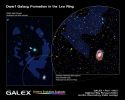
PIA11805.JPGBaby Dwarf Galaxies63 visiteThe unique Ultraviolet (UV) Vision of NASA's Galaxy Evolution Explorer reveals, for the first time, dwarf galaxies forming out of nothing more than pristine gas likely leftover from the early universe. Dwarf galaxies are relatively small collections of stars that often orbit around larger galaxies like our Milky Way.
The forming dwarf galaxies shine in the far UV Spectrum, rendered as blue in the call-out on the right hand side of this image. Near UV Light, also obtained by the Galaxy Evolution Explorer, is displayed in green, and Visible Light from the blue part of the spectrum here is represented by red. The clumps (in circles) are distinctively blue, indicating they are primarily detected in far UV Light.
The faint blue overlay traces the outline of the Leo Ring, a huge cloud of Hydrogen and helium that orbits around two massive galaxies in the constellation Leo (left panel). The cloud is thought likely to be a primordial object, an ancient remnant of material that has remained relatively unchanged since the very earliest days of the universe. Identified about 25 years ago by radio waves, the ring cannot be seen in Visible Light.
Only a portion of the Leo Ring has been imaged in the UV, but this section contains the telltale UV signature of recent massive star formation within this ring of pristine gas. Astronomers have previously only seen dwarf galaxies form out of gas that has already been cycled through a galaxy and enriched with metals — elements heavier than Helium — produced as stars evolve.
The visible data come from the Digitized Sky Survey of the Space Telescope Science Institute in Baltimore, Md. The Leo Ring visible image (left) represents the survey's blue, red, and infrared bands with the colors blue, green, and red. The overlay indicating the location of Hydrogen gas in the Leo Ring is based on observations made at the Arecibo Observatory in Puerto Rico.MareKromium
(4 voti)
|
|

PIA11417.jpgQuartz-like Crystals found in Planetary Disks62 visiteNASA's Spitzer Space Telescope has, for the first time, detected tiny quartz-like crystals sprinkled in young planetary systems. The crystals, which are types of silica minerals called Cristobalite and Tridymite, can be seen close-up in the black-and-white insets (Cristobalite is on the left, and Tridymite on the right). The main picture is an artist's concept of a young star and its swirling disk of planet-forming materials.
Cristobalite and Tridymite are thought to be two of many planet ingredients. On Earth, they are normally found as tiny crystals in volcanic lava flows and meteorites from space. These minerals are both related to quartz. For example, if you were to heat the familiar quartz crystals often sold as mystical tokens, the quartz would transform into Cristobalite and Tridymite.
Because Cristobalite and Tridymite require rapid heating and cooling to form, astronomers say they were most likely generated by shock waves traveling through the planetary disks.
The insets are Scanning Electron Microscope pictures courtesy of George Rossman of the California Institute of Technology, Pasadena, Calif.MareKromium
(4 voti)
|
|
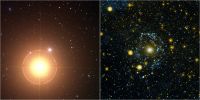
NGC-0404-PIA11393-1.jpgNGC 404 - The 'Ghost of Mirach' rears its Spooky Head67 visiteThe "Ghost of Mirach" Galaxy is shown in visible light on the left, and in UltraViolet as seen by NASA's Galaxy Evolution Explorer on the right. The fields of view are identical in both pictures, with the Ghost of Mirach — a galaxy also known as NGC 404 — seen as the whitish spot in the center of the images.
Mirach is a Red Giant star that looms large in visible light. Because NGC 404 is lost in the glare of this star, it was nicknamed the "Ghost of Mirach".
But when the galaxy is viewed in ultraviolet light, it comes to "life", revealing a never-before-seen ring. This ring, seen in blue in the picture on the right, contains new stars — a surprise considering that the galaxy was previously thought to be, essentially, dead.
The field of view spans 55.000 Light Years across. The Ghost of Mirach is located 11 MLY from Earth. The star Mirach is very close in comparison — since it is only 200 LY away and is visible with the naked eye.
The visible data come from the Digitized Sky Survey of the Space Telescope Science Institute in Baltimore, Md.MareKromium
(4 voti)
|
|
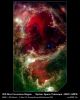
W5-SST.jpgW 5 - Stellar "Nursery"66 visiteGenerations of stars can be seen in this new infrared portrait from NASA's Spitzer Space Telescope. In this wispy star-forming region, called W5, the oldest stars can be seen as blue dots in the centers of the two hollow cavities (other blue dots are background and foreground stars not associated with the region). Younger stars line the rims of the cavities, and some can be seen as pink dots at the tips of the elephant-trunk-like pillars. The white knotty areas are where the youngest stars are forming. Red shows heated dust that pervades the region's cavities, while green highlights dense clouds.
W5 spans an area of sky equivalent to four full moons and is about 6500 Light-Years away in the constellation Cassiopeia. The Spitzer picture was taken over a period of 24 hours.
Like other massive star-forming regions, such as Orion and Carina, W5 contains large cavities that were carved out by radiation and winds from the region's most massive stars. According to the theory of triggered star-formation, the carving out of these cavities pushes gas together, causing it to ignite into successive generations of new stars.
This image contains some of the best evidence yet for the triggered star-formation theory. Scientists analyzing the photo have been able to show that the ages of the stars become progressively and systematically younger with distance from the center of the cavities.
This is a three-color composite showing infrared observations from two Spitzer instruments. Blue represents 3,6-micron light and green shows light of 8 microns, both captured by Spitzer's infrared array camera. Red is 24-micron light detected by Spitzer's multiband imaging photometer.MareKromium
(4 voti)
|
|
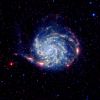
M-101-PIA10968.jpgM 101 - The "Pinwheel Galaxy"62 visiteThe Pinwheel Galaxy, otherwise known as Messier 101, sports bright reddish edges in this new infrared image from NASA's Spitzer Space Telescope. Research from Spitzer has revealed that this outer red zone lacks organic molecules present in the rest of the galaxy. The red and blue spots outside of the spiral galaxy are either foreground stars or more distant galaxies.
The organics, called Polycyclic Aromatic Hydrocarbons (PAH), are dusty, carbon-containing molecules that help in the formation of stars. On Earth, they are found anywhere combustion reactions take place, such as barbeque pits and exhaust pipes. Scientists also believe this space dust has the potential to be converted into the stuff of life.
Spitzer found that the PAH decrease in concentration toward the outer portion of the Pinwheel Galaxy, then quickly drop off and are no longer detected at its very outer rim. According to astronomers, there's a threshold at the rim where the organic material is being destroyed by harsh radiation from stars. Radiation is more damaging at the far reaches of a galaxy because the stars there have less heavy metals, and metals dampen the radiation.
The findings help researchers understand how stars can form in these harsh environments, where PAH are lacking. Under normal circumstances, the PAH help cool down star-forming clouds, allowing them to collapse into stars. In regions like the rim of the Pinwheel — as well as the very early universe — stars form without the organic dust. Astronomers don't know precisely how this works, so the rim of the Pinwheel provides them with a laboratory for examining the process relatively close up.
In this image, infrared light with a wavelength of 3,6 microns is colored blue; 8-micron light is green; and 24-micron light is red.
All three of Spitzer's instruments were used in the study: the infrared array camera, the multiband imaging photometer and the infrared spectrograph.MareKromium
(4 voti)
|
|

BLG-109.jpgBLG-109: A Distant Version of our own Solar System67 visiteCaption NASA:"How common are planetary systems like our own?
Perhaps quite common, as the first system of planets like our own Solar System has been discovered using a newly adapted technique that, so far, has probed only six planetary systems.
The technique, called "Gravitational Microlensing", looks for telling brightness changes in measured starlight when a foreground star with planets chances almost directly in front of a more distant star. The distant star's light is slightly deflected in predictable ways by the gravity of the closer system.
Recently a detailed analysis of Microlensing System OGLE-2006-BLG-109 has related brightness variations to two planets that are similar to Jupiter and Saturn of our own Solar System. This discovery carries the tantalizing implication that interior planets, possibly including Earth-like planets, might also be common.
Pictured above is an artistic conception of how the BLG-109 planetary system might look".MareKromium
(4 voti)
|
|
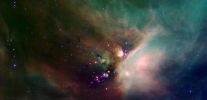
Rho_Ophiuci-PIA10181.jpgRho Ophiuci68 visiteNewborn stars peek out from beneath their natal blanket of dust in this dynamic image of the Rho Ophiuchi dark cloud from NASA's Spitzer Space Telescope. Called "Rho Oph" by astronomers, it's one of the closest star-forming regions to our own solar system. Located near the constellations Scorpius and Ophiuchus, the nebula is about 407 light years away from Earth.
Rho Oph is a complex made up of a large main cloud of molecular hydrogen, a key molecule allowing new stars to form from cold cosmic gas, with two long streamers trailing off in different directions. Recent studies using the latest X-ray and infrared observations reveal more than 300 young stellar objects within the large central cloud. Their median age is only 300,000 years, very young compared to some of the universe's oldest stars, which are more than 12 billion years old.
This false-color image of Rho Oph's main cloud, Lynds 1688, was created with data from Spitzer's infrared array camera, which has the highest spatial resolution of Spitzer's three imaging instruments, and its multiband imaging photometer, best for detecting cooler materials. Blue represents 3.6-micron light; green shows light of 8 microns; and red is 24-micron light. The multiple wavelengths reveal different aspects of the dust surrounding and between the embedded stars, yielding information about the stars and their birthplace.
The colors in this image reflect the relative temperatures and evolutionary states of the various stars. The youngest stars are surrounded by dusty disks of gas from which they, and their potential planetary systems, are forming. These young disk systems show up as red in this image. Some of these young stellar objects are surrounded by their own compact nebulae. More evolved stars, which have shed their natal material, are blue.
The extended white nebula in the center right of the image is a region of the cloud which is glowing in infrared light due to the heating of dust by bright young stars near the right edge of the cloud. Fainter multi-hued diffuse emission fills the image. The color of the nebulosity depends on the temperature, composition and size of the dust grains. Most of the stars forming now are concentrated in a filament of cold, dense gas that shows up as a dark cloud in the lower center and left side of the image against the bright background of the warm dust. Although infrared radiation at 24 microns pierces through dust easily, this dark filament is incredibly opaque, appearing dark even at the longest wavelengths in the image.
MareKromium
(4 voti)
|
|
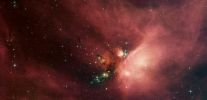
Rho_Ophiuci-PIA10182.jpgRho Ophiuci63 visiteNewborn stars peek out from beneath their natal blanket of dust in this dynamic image of the Rho Ophiuchi dark cloud from NASA's Spitzer Space Telescope. Called "Rho Oph" by astronomers, it's one of the closest star-forming regions to our own solar system. Located near the constellations Scorpius and Ophiuchus, the nebula is about 407 light years away from Earth.
Rho Oph is a complex made up of a large main cloud of molecular hydrogen, a key molecule allowing new stars to form from cold cosmic gas, with two long streamers trailing off in different directions. Recent studies using the latest X-ray and infrared observations reveal more than 300 young stellar objects within the large central cloud. Their median age is only 300,000 years, very young compared to some of the universe's oldest stars, which are more than 12 billion years old.
This false-color image of Rho Oph's main cloud, Lynds 1688, was created with data from Spitzer's infrared array camera, which has the highest spatial resolution of Spitzer's three imaging instruments. Blue represents 3.6 micron light, green is 4.5 micron light, orange is 5.8, and red is 8.0. The multiple wavelengths reveal different aspects of the dust surrounding and between the embedded stars, yielding information about the stars and their birthplace.
The colors in this image reflect the relative temperatures and evolutionary states of the various stars. The youngest stars are surrounded by dusty disks of gas from which they, and their potential planetary systems, are forming. These young disk systems show up as yellow-green tinted stars in this image. Some of these young stellar objects are surrounded by their own compact nebulae. More evolved stars, which have shed their natal material, are blue-white.
The extended white nebula in the center right of the image is a region of the cloud which is glowing in infrared light due to the illumination of dust by bright young stars near the right edge of the cloud. Red and pink diffuse emission from carbon-rich dust molecules fills the image. Most of the stars forming now are concentrated in a filament of cold, dense gas that shows up as a dark cloud in the lower center and left side of the image against the bright background of the warm dust. Although infrared radiation at 8 microns pierces through dust easily, this dark filament is incredibly opaque, appearing dark even at the longest wavelengths in the image.
MareKromium
(4 voti)
|
|
| 157 immagini su 14 pagina(e) |
|
|
|
|
|
9 | |
|
|
|
|
|
|





