| |

| Piú votate - The Universe in Super Definition |
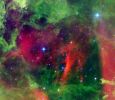
NGC-2237_and_NGC-2244.jpgHot Stars in the Rosette Nebula61 visiteWinds and radiation from massive hot stars in the Rosette Nebula have cleared the natal gas and dust from the center of the nearby star-forming region. They also pose a danger to planet forming disks around young, cooler stars in the neighborhood. This Spitzer Space Telescope (SST) infrared image of dust clouds near the Rosette's central region, shows the cleared-out cavity.
The view spans about 45 LY at the the nebula's estimated distance of 5.200 LY. MareKromium
(5 voti)
|
|
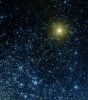
NGC-0362-PIA09653.jpgNGC 362 - Globular Star Cluster62 visiteThe Galaxy Evolution Explorer's ultraviolet eyes have captured a globular star cluster, called NGC 362, in our own Milky Way galaxy. In this new image, the cluster appears next to stars from a more distant neighboring galaxy, known as the Small Magellanic Cloud.
Globular clusters are densely packed bunches of old stars scattered in galaxies throughout the universe. NGC 362, located 30,000 light-years away, can be spotted as the dense collection of mostly yellow-tinted stars surrounding a large white-yellow spot toward the top-right of this image. The white spot is actually the core of the cluster, which is made up of stars so closely packed together that the Galaxy Evolution Explorer cannot see them individually.
The light blue dots surrounding the cluster core are called extreme horizontal branch stars. These stars used to be very similar to our sun and are nearing the end of their lives. They are very hot, with temperatures reaching up to about four times that of the surface of our sun (25,000 Kelvin or 45,500 degrees Fahrenheit).
A star like our sun spends most of its life fusing hydrogen atoms in its core into helium. When the star runs out of hydrogen in its core, its outer envelope will expand. The star then becomes a red giant, which burns hydrogen in a shell surrounding its inner core. Throughout its life as a red giant, the star loses a lot of mass, then begins to burn helium at its core. Some stars will have lost so much mass at the end of this process, up to 85 percent of their envelopes, that most of the envelope is gone. What is left is a very hot ultraviolet-bright core, or extreme horizontal branch star.
Blue dots scattered throughout the image are hot, young stars in the Small Magellanic Cloud, a satellite galaxy of the Milky Way located approximately 200,000 light-years away. The stars in this galaxy are much brighter intrinsically than extreme horizontal branch stars, but they appear just as bright because they are farther away. The blue stars in the Small Magellanic Cloud are only about a few tens of millions of years old, much younger than the approximately 10-million-year-old stars in NGC 362.
Because NGC 362 sits on the northern edge of the Small Magellanic Cloud galaxy, the blue stars are denser toward the south, or bottom, of the image.
Some of the yellow spots in this image are stars in the Milky Way galaxy that are along this line of sight. Astronomers believe that some of the other spots, particularly those closer to NGC 362, might actually be a relatively ultraviolet-dim family of stars called "blue stragglers." These stars are formed from collisions or close encounters between two closely orbiting stars in a globular cluster.
This image is a false-color composite, where light detected by the Galaxy Evolution Explorer's far-ultraviolet detector is colored blue, and light from the telescope's near-ultraviolet detector is red.
MareKromium
(5 voti)
|
|

NGC-2237-PIA09267.jpgNGC 2237 - The "Rosette Nebula", and Globular Star Cluster NGC 224461 visiteThis infrared image from NASA's Spitzer Space Telescope shows the Rosette nebula, a pretty star-forming region more than 5,000 light-years away in the constellation Monoceros. In optical light, the nebula looks like a rosebud, or the "rosette" adornments that date back to antiquity.
But lurking inside this delicate cosmic rosebud are so-called planetary "danger zones" (see spheres illustrations in figure 1). These zones surround super hot stars, called O-stars (blue stars inside spheres), which give off intense winds and radiation. Young, cooler stars that just happen to reside within one of these zones are in danger of having their dusty planet-forming materials stripped away.
While O-star danger zones were known about before, their parameters were not. Astronomers used Spitzer's infrared vision to survey the extent of the five danger zones shown here. The results showed that young stars lying beyond 1.6 light-years, or 10 trillion miles, of any O-stars are safe, while young stars within this zone are likely to have their potential planets blasted into space.
Radiation and winds from the super hot stars have collectively blown layers of dust (green) and gas away, revealing the cavity of cooler dust (red). The largest two blue stars in this picture are in the foreground, and not in the nebula itself.
This image shows infrared light captured by Spitzer's infrared array camera. Light with wavelengths of 24 microns is red; light of 8 microns is green; and light of 4.5 microns is blue.
MareKromium
(5 voti)
|
|
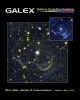
Z-Camelopardalis-PIA09219.jpgZ-Camelopardalis64 visiteThis composite image shows Z Camelopardalis, or Z Cam, a double-star system featuring a collapsed, dead star, called a white dwarf, and a companion star, as well as a ghostly shell around the system. The massive shell provides evidence of lingering material ejected during and swept up by a powerful classical nova explosion that occurred probably a few thousand years ago.
The image combines data gathered from the far-ultraviolet and near-ultraviolet detectors on NASA's Galaxy Evolution Explorer on Jan. 25, 2004. The orbiting observatory first began imaging Z Cam in 2003.
Z Cam is the largest white object in the image, located near the center. Parts of the shell are seen as a lobe-like, wispy, yellowish feature below and to the right of Z Cam, and as two large, whitish, perpendicular lines on the left.
Z Cam was one of the first known recurrent dwarf nova, meaning it erupts in a series of small, "hiccup-like" blasts, unlike classical novae, which undergo a massive explosion. That's why the huge shell around Z Cam caught the eye of astronomer Dr. Mark Seibert of Carnegie Institution of Washington in Pasadena, Calif. - it could only be explained as the remnant of a full-blown classical nova explosion. This finding provides the first evidence that some binary systems undergo both types of explosions. Previously, a link between the two types of novae had been predicted, but there was no evidence to support the theory.
The faint bluish streak in the bottom right corner of the image is ultraviolet light reflected by dust that may or may not be related to Z Cam. Numerous foreground and background stars and galaxies are visible as yellow and white spots. The yellow objects are strong near-ultraviolet emitters; blue features have strong far-ultraviolet emission; and white objects have nearly equal amounts of near-ultraviolet and far-ultraviolet emission.
(5 voti)
|
|
![SN-1987A-PIA09119_fig1[1].jpg](albums/userpics/10060/small_SN-1987A-PIA09119_fig1%5B1%5D.jpg "Nome del file=SN-1987A-PIA09119_fig1[1].jpg
Dimensione del file=576KiB
Dimensioni=3000x2400
Aggiunta il=Mar 06, 2007")
SN-1987A-PIA09119_fig1[1].jpgSupernova 1987A and the Bipolar Nebula around HD16862562 visitenessun commentoMareKromium
(5 voti)
|
|
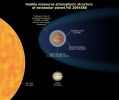
HD-209458b-01.jpgExtra-Solar Planet HD-209458b (2)61 visiteAlthough HD 209458b does not have a twin in our Solar System, it has plenty of relatives beyond our Solar System. About 10 to 15% of the more than 200 known extrasolar planets are hot Jupiters. A recent HST survey netted 16 hot Jupiter candidates in the central region of our Milky Way Galaxy, suggesting that there may be billions of these gas-giant star huggers in our galaxy.
HD 209458b is one of the most intensely studied extrasolar planets because it is one of the few known alien worlds that can be seen passing in front of, or transiting, its star, causing the star to dim slightly. In fact, the gas giant is the first such alien world discovered to transit its star.
HD 209458b is 150 LY from Earth, in the Constellation of Pegasus.
The planet's transits allow astronomers to analyze the structure and chemical makeup of the gas giant's atmosphere by sampling the starlight that passes through it. The effect is similar to finding fingerprints on a window by watching how sunlight filters through the glass.
Previous HST observatoins revealed Oxygen, Carbon and Sodium in the planet's atmosphere, as well as a huge Hydrogen upper atmosphere with a comet-like tail. These landmark studies provided the first detection of the chemical makeup of an extrasolar planet's atmosphere.
Additional observations by NASA's SST captured the infrared glow from the planet's hot atmosphere.
The new study by Ballester and her team is based on an analysis of archival observations made in 2003 with HST's Imaging Spectrograph by David Charbonneau of the Harvard-Smithsonian Center for Astrophysics in Cambridge, Mass. Ballester's team analyzed spectra from hot hydrogen atoms in the planet's upper atmosphere, a region not studied by Charbonneau's group.
(5 voti)
|
|

M 42-PIA08656.jpgOrion's "Sword"60 visiteThis image composite outlines the region near Orion's sword that was surveyed by NASA's Spitzer Space Telescope (white box). The view on the left (figure 1) is from a visible-light telescope, and the view on the right (figure 2) shows infrared light captured by a previous infrared mission, the Infrared Astronomical Satellite.
The Orion nebula, our closest massive star-making factory, is the brightest spot near the hunter's sword. On a dark night, it can appear to the naked eye as a fuzzy star, and it looks like a ghostly blob through a pair of binoculars. The Orion constellation is one of the most prominent winter constellations, and can be seen from all northern latitudes starting in the fall.
Spitzer used its infrared eyes to probe the dusty clouds of a region called Orion cloud A. outlined here in the hockey stick-shaped box (see PIA08655). This giant cloud stretches almost a quarter of the length of the constellation, an area equivalent to 18 full moons. The small box within the hockey stick shows the location of another image released by Spitzer (see PIA08653), which mainly features the Orion nebula itself.
The bright spot that shows up in the infrared view in the area of Orion's belt is known as Orion cloud B. Together, Orion clouds A and B make up the Orion cloud complex. In a survey of this entire complex, Spitzer unearthed 2,300 stars circled by disks of planet-forming dust and 200 stellar embryos too young to have developed disks.
The Infrared Astronomical Satellite was a joint effort between NASA, the Science and Engineering Research Council, United Kingdom and the Netherlands Agency for Aerospace Programmes, the Netherlands. Spitzer has extended the legacy of the satellite by providing much better resolution and sensitivity.
The visible-light image comes courtesy of Howard McCallon of the Infrared Processing and Analysis Center at the California Institute of Technology of Pasadena.
(5 voti)
|
|

M 74-PIA08533_fig2.jpgSupernova SN2003gd in July 2004 (1)60 visiteThe dust factory, also known as supernova SN 2003gd, is shown at the center of the two small insets from Spitzer's infrared array camera. A white arrow points to its exact location.
The yellow-green dot shown in the July 2004 inset (here) shows that the source's temperature is warmer than the surrounding material. This is because newly formed dust within the Supernova is just starting to cool.
(5 voti)
|
|

Proxima_Centauri_B_-_5.jpgOverview of Proxima and its Parent Star104 visiteOverview and comparison of the orbital distance of the habitable zones of Proxima Centauri compared to the Solar System.MareKromium
(4 voti)
|
|
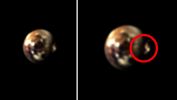
Proxima_Centauri_B_-_1.jpgProxima Centauri "b" - Alien City Lights or Super-volcanic Activity? (1)177 visiteE', a mio umile avviso, un Fenomeno di Super-vulcanismo che accade su scala (di fatto) planetaria. Guardate BENE! E guardate bene le foto di "Io"...MareKromium
(4 voti)
|
|

Unusual_Phenomenon~1.jpgUnusual Phenomenon in the Space of Saturn (sometime things go wrong...)154 visitenessun commentoMareKromium
(4 voti)
|
|

Wasp_12b-PIA13691.jpgExo-Planet "Wasp 12b"136 visiteCaption NASA:"This artist's concept shows the searing-hot Gas Planet WASP-12b (the orange orb) and its Parent (or Host) Star. NASA's Spitzer Space Telescope discovered that the Planet has more Carbon than Oxygen, making it the first Carbon-rich Planet ever observed. Our Earth has relatively little amounts of Carbon - which it is made largely of Oxygen and Silicon.
Other gas planets in our Solar System, for example Jupiter, are expected to have less Carbon than Oxygen, but this is not known. Unlike WASP-12b, these Planets harbor water, the main Oxygen carrier, deep in their Atmospheres, where it is difficult to measure.
Concentrated Carbon can take the form of diamond, so Astronomers say that Carbon-rich Gas Planets could have abundant diamond in their interiors. WASP-12b is located roughly 1200 LY (Light Years) away in the constellation Auriga. It swings around its Parent Star every 1,1 days. Because the Planet is so close to its Parent Star, the Star's gravity stretches it slightly into an egg shape. The Star's gravity also pulls material off the Planet thus creating a disk around the Parent Star itself (shown here in transparent, white hues)".MareKromium
(4 voti)
|
|
| 157 immagini su 14 pagina(e) |
|
|
|
|
|
8 | |
|
|
|
|
|
|





