| |

| Piú votate - The Universe in Super Definition |
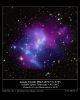
MACS-J0717_5+3745-hs-2009-17-a-print.jpgMACS J0717.5+3745 (Galaxy Cluster)63 visiteThis composite image shows the massive Galaxy Cluster MACS J0717.5+3745 (MACS J0717, for short), where four separate Galaxy Clusters have been involved in a collision — the first time such a phenomenon has been documented. Hot gas is shown in an image from NASA's Chandra X-ray Observatory, and galaxies are shown in an optical image from NASA's Hubble Space Telescope.
The hot gas is color-coded to show temperature, where the coolest gas is reddish purple, the hottest gas is blue, and the temperatures in between are purple.
The repeated collisions in MACS J0717 are caused by a 13 MLY-long stream of galaxies, gas, and dark matter — known as a "Filament" — pouring into a region already full of matter. A collision between the gas in two or more clusters causes the hot gas to flow down. However, the massive and compact galaxies do not slow down as much as the gas does, and so move ahead of it. Therefore, the speed and direction of each cluster's motion — perpendicular to the line of sight — can be estimated by studying the offset between the average position of the galaxies and the peak in the hot gas.
MACS J0717 is located about 5,4 BLY from Earth. It is one of the most complex Galaxy Clusters ever seen. Other well-known Clusters, like the Bullet Cluster and MACS J0025.4-1222, involve the collision of only two galaxy clusters and show much simpler geometry.MareKromium
(5 voti)
|
|

M-087-HST-2009-03-a-print.jpgHubble witnesses spectacular flaring in Gas Jet from M 87's Black Hole65 visiteA flare-up in a jet of matter blasting from a monster Black Hole is giving astronomers an incredible light show.
The outburst is coming from a blob of matter, called HST-1, embedded in the jet, a powerful narrow beam of hot gas produced by a supermassive Black Hole residing in the core of the giant elliptical galaxy M 87. HST-1 is so bright that it is outshining even M 87's brilliant core, whose monster black hole is one of the most massive yet discovered.
The glowing gas clump has taken astronomers on a rollercoaster ride of suspense.
Astronomers watched HST-1 brighten steadily for several years, then fade, and then brighten again. They say it's hard to predict what will happen next. NASA's Hubble Space Telescope has been following the surprising activity for seven years, providing the most detailed UltraViolet-Light view of the event.
Other telescopes have been monitoring HST-1 in other wavelengths, including radio and X-rays. The Chandra X-ray Observatory was the first to report the brightening in 2000. HST-1 was first discovered and named by Hubble astronomers in 1999. The gas knot is 214 LY from the galaxy's core.
The flare-up may provide insights into the variability of black hole jets in distant galaxies, which are difficult to study because they are too far away.
M 87 is located 54 MLY away in the Virgo Cluster, a region of the nearby universe with the highest density of galaxies.
"I did not expect the jet in M 87 or any other jet powered by accretion onto a Black Hole to increase in brightness in the way that this jet does," says astronomer Juan Madrid of McMaster University in Hamilton, Ontario, who conducted the Hubble study. "It grew 90 times brighter than normal. But the question is, does this happen to every single jet or active nucleus, or are we seeing some odd behavior from M 87?" Hubble gives astronomers a unique Near-UltraViolet view of the flare that cannot be accomplished with ground-based telescopes. "Hubble's sharp vision allows it to resolve HST-1 and separate it from the black hole," Madrid explains.
Despite the many observations by Hubble and other telescopes, astronomers are not sure what is causing the brightening. One of the simplest explanations is that the jet is hitting a dust lane or gas cloud and then glows due to the collision.
Another possibility is that the jet's magnetic field lines are squeezed together, unleashing a large amount of energy.
This phenomenon is similar to how solar flares develop on the Sun and is even a mechanism for creating Earth's auroras.
The disk around a rapidly spinning Black Hole has Magnetic Field lines that entrap ionized gas falling toward the Black Hole. These particles, along with radiation, flow rapidly away from the black hole along the Magnetic Field Lines. The rotational energy of the spinning accretion disk adds momentum to the outflowing jet.
Madrid assembled seven years' worth of Hubble archival images of the jet to capture changes in the HST-1's behavior over time. Hubble's view of the event. Some of the images came from observing programs that studied the galaxy, but not the jet.
He found data from the Space Telescope Imaging Spectrograph (STIS) that showed a noticeable brightening between 1999 and 2001.
In images from 2002 to 2005, HST-1 continued to rise steadily in brightness. In 2003 the jet knot was more brilliant than M 87's luminous core. In May 2005 HST-1 became 90 times brighter than it was in 1999. After May 2005 the flare began to fade, but it intensified again in November 2006. This second outburst was fainter than the first one.
"By watching the outburst over several years, I was able to follow the brightness and see the evolution of the flare over time," Madrid says. "We are lucky to have telescopes like Hubble and Chandra, because without them we would see the increase in brightness in the core of M 87, but we would not know where it was coming from."
Madrid hopes that future observations of HST-1 will reveal the cause of the mysterious activity. "We hope the observations will yield some theories that will give us some good explanations as to the mechanism that is causing the flaring," Madrid says. "Astronomers would like to know if this is an intrinsic instability of the jet when it plows its way out of the galaxy, or if it is something else."
The study's results are published in the April 2009 issue of the Astronomical Journal.MareKromium
(5 voti)
|
|

ARP_274-HST-2009-14-a-print.jpgGalaxy Triplet Arp 27463 visiteArp 274, also known as NGC 5679, is a system of 3 galaxies that appear to be partially overlapping in the image, although they may be at somewhat different distances. The spiral shapes of 2 of these galaxies appear mostly intact. The third galaxy (to the far left) is more compact, but shows evidence of star formation.
Two of the three galaxies are forming new stars at a high rate. This is evident in the bright blue knots of star formation that are strung along the arms of the galaxy on the right and along the small galaxy on the left.
The largest component is located in the middle of the triplet. It appears as a Spiral Galaxy, which may be barred. The entire system resides at about 400 Million Light-Years away from Earth in the Virgo constellation.
Hubble's Wide Field Planetary Camera 2 was used to image Arp 274. Blue, visible, and infrared filters were combined with a filter that isolates hydrogen emission. The colors in this image reflect the intrinsic color of the different stellar populations that make up the galaxies. Yellowish older stars can be seen in the central bulge of each galaxy.
A bright central cluster of stars pinpoint each nucleus. Younger blue stars trace the spiral arms, along with pinkish nebulae that are illuminated by new star formation. Interstellar dust is silhouetted against the starry population. A pair of foreground stars inside our own Milky Way are at far right.MareKromium
(5 voti)
|
|
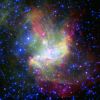
NGC-0346-PIA11227.jpgNGC 346 in the Small Magellanic Cloud64 visiteThis painterly portrait of a star-forming cloud, called NGC 346, is a combination of multiwavelength light from NASA's Spitzer Space Telescope (infrared), the European Southern Observatory's New Technology Telescope (visible), and the European Space Agency's XMM-Newton space telescope (X-ray).
The infrared observations highlight cold dust in red, visible data show glowing gas in green, and X-rays show very warm gas in blue. Ordinary stars appear as blue spots with white centers, while young stars enshrouded in dust appear as red spots with white centers.
The colorful picture demonstrates that stars in this region are being created by two different types of triggered star formation — one involving wind, and the other, radiation.
Triggered star formation occurs when massive stars spur new, smaller stars into existence. The first radiation-based mechanism is demonstrated near the center of the cloud. There, radiation from the massive stars is eating away at the surrounding dust cloud, creating shock waves that compress gas and dust into new stars. This compressed material appears as an arc-shaped orange-red filament, while the new stars within this filament are still blanketed with dust and cannot be seen.
The second wind-based mechanism is at play higher up in the cloud. The isolated, pinkish blob of stars at the upper left was triggered by winds from a massive star located to the left of it. This massive star blew up in a supernova explosion 50,000 years ago, but before it died, its winds pushed gas and dust together into new stars. While this massive star cannot be seen in the image, a bubble created when it exploded can be seen near the large, white spot with a blue halo at the upper left (this white spot is actually a collection of three stars).
NGC 346 is the brightest star-forming region in the Small Magellanic Cloud, an irregular dwarf galaxy that orbits our Milky Way galaxy, 210.000 LY away.MareKromium
(5 voti)
|
|

NGC-3324-HST.jpgNGC 3324 - Star-forming Region64 visiteThe landmark 10th anniversary of the Hubble Space Telescope's Hubble Heritage Project is being celebrated with a 'landscape' image from the cosmos. Cutting across a nearby star-forming region are the "hills and valleys" of gas and dust displayed in intricate detail. Set amid a backdrop of soft, glowing blue light are wispy tendrils of gas as well as dark trunks of dust that are light-years in height.
The Hubble Heritage Project, which began in October 1998, has released nearly 130 images mined from the Hubble data archive as well as a number of observations taken specifically for the project. By releasing a new, previously unseen Hubble image every month, the team's intent was to showcase some of the most attractive images ever taken by the Hubble telescope, and share them with a wide audience. The Heritage team continues to create aesthetic images that present the universe from an artistic perspective.
This month's three-dimensional-looking Hubble image shows the edge of the giant gaseous cavity within the star-forming region called NGC 3324. The glowing nebula has been carved out by intense ultraviolet radiation and stellar winds from several hot, young stars. A cluster of extremely massive stars, located well outside this image in the center of the nebula, is responsible for the ionization of the nebula and excavation of the cavity.
The image also reveals dramatic dark towers of cool gas and dust that rise above the glowing wall of gas. The dense gas at the top resists the blistering ultraviolet radiation from the central stars, and creates a tower that points in the direction of the energy flow. The high-energy radiation blazing out from the hot, young stars in NGC 3324 is sculpting the wall of the nebula by slowly eroding it away.
Located in the Southern Hemisphere, NGC 3324 is at the northwest corner of the Carina Nebula (NGC 3372), home of the Keyhole Nebula and the active, outbursting star Eta Carinae. The entire Carina Nebula complex is located at a distance of roughly 7,200 light-years, and lies in the constellation Carina.
This image is a composite of data taken with two of Hubble's science instruments. Data taken with the Advanced Camera for Surveys (ACS) in 2006 isolated light emitted by hydrogen. More recent data, taken in 2008 with the Wide Field Planetary Camera 2 (WFPC2), isolated light emitted by sulfur and oxygen gas. To create a color composite, the data from the sulfur filter are represented by red, from the oxygen filter by blue, and from the hydrogen filter by green.
The Heritage project has released images using several of Hubble's optical cameras: the Wide Field Planetary Camera (WF/PC), which was installed when the telescope was first deployed in 1990; WFPC2, which replaced WFPC in 1993 and is still in service today; and ACS, which was added in 2002. After the Hubble Servicing Mission in early 2009, the Hubble Heritage team hopes to continue using ACS as well as the newest of the optical cameras, Wide Field Camera 3.
MareKromium
(5 voti)
|
|

W5-PIA11047.jpgW 5 - Stellar "Nursery" (natural colors)63 visiteGenerations of stars can be seen in this new infrared portrait from NASA's Spitzer Space Telescope. In this wispy star-forming region, called W5, the oldest stars can be seen as blue dots in the centers of the two hollow cavities (other blue dots are background and foreground stars not associated with the region). Younger stars line the rims of the cavities, and some can be seen as dots at the tips of the elephant-trunk-like pillars. The white knotty areas are where the youngest stars are forming.
W5 spans an area of sky equivalent to four full moons and is about 6500 Light-Years away in the constellation Cassiopeia. The Spitzer picture was taken over a period of 24 hours.
Like other massive star-forming regions, such as Orion and Carina, W5 contains large cavities that were carved out by radiation and winds from the region's most massive stars. According to the theory of triggered star-formation, the carving out of these cavities pushes gas together, causing it to ignite into successive generations of new stars.
This image contains some of the best evidence yet for the triggered star-formation theory. Scientists analyzing the photo have been able to show that the ages of the stars become progressively and systematically younger with distance from the center of the cavities.
This picture was taken with Spitzer's infrared array camera. It is a four-color composite, in which light with a wavelength of 3,6 microns is blue; 4,5-micron light is green; 5,8-micron light is orange; and 8-micron light is red.MareKromium
(5 voti)
|
|
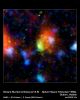
PIA10932.jpgBaby Boom!63 visiteThe green and red splotch in this image is the most active star-making galaxy in the very distant universe. Nicknamed "Baby Boom", the galaxy is churning out an average of up to 4000 stars per year, more than 100 times the number produced in our own Milky Way galaxy. It was spotted 12,3 Billion Light-Years away by a suite of telescopes, including NASA's Spitzer Space Telescope.
Baby Boom is a type of galaxy called a "Starburst".
Like some other Starbursts, it is thought to be a collection of colliding galaxies. As the galaxies smash together, gas becomes compressed, triggering the birth of stars. In this multi-wavelength portrait, the color red shows where loads of new stars are forming in Baby Boom, and where warm dust heated by the stars is giving off infrared light.
Green (visible-light wavelengths) denotes gas in the Baby Boom galaxy, while blue (also visible light) shows galaxies in the foreground that are not producing nearly as many stars. Yellow/orange (near-infrared light) indicates starlight from the outer portion of Baby Boom. The red blob to the left is another foreground galaxy that is not producing a lot of stars.
This composite contains data from NASA's Hubble Space Telescope, Spitzer and Japan's Subaru Telescope in Hawaii.MareKromium
(5 voti)
|
|
M-001.jpgM 1 - The "Crab Nebula"62 visitenessun commentoMareKromium
(5 voti)
|
|
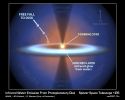
NGC-1333-PIA09966.jpgWater Vapor inside NGC 133362 visiteThis diagram illustrates the earliest journeys of water in a young, forming Star System. Stars are born out of icy cocoons of gas and dust. As the cocoon collapses under its own weight in an inside-out fashion, a stellar embryo forms at the center surrounded by a dense, dusty disk.
The stellar embryo "feeds" from the disk for a few million years, while material in the disk begins to clump together to form planets.
NASA's Spitzer Space Telescope was able to probe a crucial phase of this stellar evolution - a time when the cocoon is vigorously falling onto the pre-planetary disk. The infrared telescope detected water vapor as it smacks down on a disk circling a forming star called NGC 1333-IRAS 4B.
This vapor started out as ice in the outer envelope, but vaporized upon its arrival at the disk.
By analyzing the water in the system, astronomers were also able learn about other characteristics of the disk, such as its size, density and temperature.
How did Spitzer see the water vapor deep in the NGC 1333-IRAS 4B system?
This is most likely because the system is oriented in just the right way, such that its thicker disk is seen face-on from our Earthly perspective. In this "face-on" orientation, Spitzer can peer through a window carved by an outflow of material from the embryonic star. This system in this drawing is shown in the opposite "edge-on" configuration.MareKromium
(5 voti)
|
|

NGC-1333-PIA09965.jpgWater Vapor inside NGC 133365 visiteThis plot of infrared data, called a Spectrum, shows the strong signature of water vapor deep within the core of an Embryonic Star System called NGC 1333-IRAS 4B.
The data were captured by NASA's SST using an instrument called Spectrograph.
A spectrograph collects light and sorts it according to color, or wavelength. In this case, infrared light from NGC 1333-IRAS 4B was broken up into the wavelengths listed on the horizontal axis of the plot. The sharp spikes, called spectral lines, occur at wavelengths at which the stellar object is particularly bright. The signature of water vapor is revealed in the pattern of wavelengths at which the spikes appear.
By comparing the observed data to a model (lower curve), astronomers can also determine the physical and chemical details of the region.
F.e.: Astronomers say these data suggest that ice in a cocoon surrounding the forming star is falling inward. The ice then smacks supersonically into a dusty planet-forming disk surrounding the stellar embryo, heats up and vaporizes quickly, releasing the infrared light that Spitzer collected.
MareKromium
(5 voti)
|
|
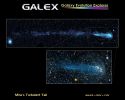
Mira-PIA09958-1.jpgMira: anatomy of a "Celestial Shooting Star"...64 visiteA close-up view of a star racing through space faster than a speeding bullet can be seen in this image from NASA's Galaxy Evolution Explorer. The star, called Mira (pronounced My-rah), is traveling at 130 kilometers per second, or 291,000 miles per hour. As it hurls along, it sheds material that will be recycled into new stars, planets and possibly even life.
In this image, Mira is moving from left to right. It is visible as the pinkish dot in the bulb shape at right. The yellow dot below is a foreground star. Mira is traveling so fast that it's creating a bow shock, or build-up of gas, in front of it, as can be seen here at right.
Like a boat traveling through water, a bow shock forms ahead of the star in the direction of its motion. Gas in the bow shock is heated and then mixes with the cool hydrogen gas in the wind that is blowing off Mira. This heated hydrogen gas then flows around behind the star, forming a wake.
Why is the wake of material glowing? When the hydrogen gas is heated, it transitions into a higher-energy state, which then loses energy by emitting ultraviolet light - a process called fluorescence. The Galaxy Evolution Explorer has special instruments that can detect this ultraviolet light.
A similar fluorescence process is responsible for the Northern Lights -- a glowing, green aurora that can be seen from northern latitudes. However, in that case nitrogen and oxygen gas are fluorescing with visible light.
Streams and a loop of material can also be seen coming off Mira. Astronomers are still investigating what these streams are, but they suspect that they are denser parts of Mira's wind perhaps flowing out of the star's poles.
This image consists of data captured by both the far- and near-ultraviolet detectors on the Galaxy Evolution Explorer between November 18 and December 15, 2006. It has a total exposure time of about 3 hours.
MareKromium
(5 voti)
|
|
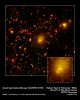
PIA09955_fig1.jpgFearsome Foursome (Figure 1)62 visiteOne of the biggest galaxy collisions ever observed is taking place at the center of this image. The four yellow blobs in the middle are large galaxies that have begun to tangle and ultimately merge into a single gargantuan galaxy. The yellowish cloud around the colliding galaxies contains billions of stars tossed out during the messy encounter. Other galaxies and stars appear in yellow and orange hues.
NASA's Spitzer Space Telescope spotted the four-way collision, or merger, in a giant cluster of galaxies, called CL0958+4702, located nearly 5 BLY away.
The dots in the picture are a combination of galaxies in the cluster; background galaxies located behind the cluster; and foreground stars in our own Milky Way galaxy.
Infrared data from Spitzer are colored red in this picture, while visible-light data from a telescope known as WIYN are green. Areas where green and red overlap appear orange or yellow.
Since most galaxies in the cluster contain old stars that are visible to Spitzer and WIYN, those galaxies appear orange.
MareKromium
(5 voti)
|
|
| 157 immagini su 14 pagina(e) |
|
|
|
|
|
7 | |
|
|
|
|
|
|





