| |

| Piú votate - The Universe in Super Definition |
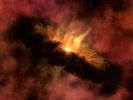
NGC-1333-PIA09967.jpgNGC 133364 visiteNASA's Spitzer Space Telescope observed a fledgling Solar System like the one depicted in this artist's concept, and discovered deep within it enough water vapor to fill the oceans on Earth five times. This water vapor starts out in the form of ice in a cloudy cocoon (not pictured) that surrounds the embryonic star, called NGC 1333-IRAS 4B (buried in center of image).
Material from the cocoon, including ice, falls toward the center of the cloud. The ice then smacks down onto a dusty pre-planetary disk circling the stellar embryo (doughnut-shaped cloud) and vaporizes.
Eventually, this water might make its way into developing planets.MareKromium
(6 voti)
|
|
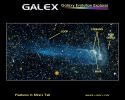
Mira-PIA09959.jpgMira: anatomy of a "Celestial Shooting Star"...64 visiteA close-up view of a star racing through space faster than a speeding bullet can be seen in this image from NASA's Galaxy Evolution Explorer. The star, called Mira (pronounced My-rah), is traveling at 130 kilometers per second, or 291,000 miles per hour. As it hurls along, it sheds material that will be recycled into new stars, planets and possibly even life.
In this image, Mira is moving from left to right. It is visible as the pinkish dot in the bulb shape at right. The yellow dot below is a foreground star. Mira is traveling so fast that it's creating a bow shock, or build-up of gas, in front of it, as can be seen here at right.
Like a boat traveling through water, a bow shock forms ahead of the star in the direction of its motion. Gas in the bow shock is heated and then mixes with the cool hydrogen gas in the wind that is blowing off Mira. This heated hydrogen gas then flows around behind the star, forming a wake.
Why is the wake of material glowing? When the hydrogen gas is heated, it transitions into a higher-energy state, which then loses energy by emitting ultraviolet light - a process called fluorescence. The Galaxy Evolution Explorer has special instruments that can detect this ultraviolet light.
A similar fluorescence process is responsible for the Northern Lights -- a glowing, green aurora that can be seen from northern latitudes. However, in that case nitrogen and oxygen gas are fluorescing with visible light.
Streams and a loop of material can also be seen coming off Mira. Astronomers are still investigating what these streams are, but they suspect that they are denser parts of Mira's wind perhaps flowing out of the star's poles.
This image consists of data captured by both the far- and near-ultraviolet detectors on the Galaxy Evolution Explorer between November 18 and December 15, 2006. It has a total exposure time of about 3 hours.
MareKromium
(6 voti)
|
|
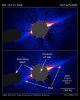
HD-15115.jpgLopsided debris disk around the young star HD 1511563 visiteThe disk, seen edge-on, is the dense blue line extending from the star to the upper right and lower left of the image. As seen from Earth, the edge-on disk resembles a needle sticking out from the star. The disk appears thicker and longer at upper right than at lower left, evidence of the disk's lopsided structure.
Astronomers think the disk's odd imbalanced look is caused by dust particles following a highly elliptical orbit around the star, which is slightly brighter than the Sun. The lopsidedness may have been caused by planets sweeping up debris in the disk or by the gravity of a nearby star.
Astronomers used an occulting mask on Hubble's Advanced Camera for Surveys to block out the bright starlight so they could see the dim disk. The occulting masks can be seen in the image as the dark circle in the center and the dark bar on the left. The star is behind the central mask.
HD 15115 is among nearly 30 stars that belong to the Beta Pictoris Moving Group. Moving groups are expanded clusters of stars believed to have a common birthplace and age, in this case about 12 million years, that are traveling together loosely through space. HD 15115 is 150 light-years from Earth.
Dusty disks are known to exist around at least 100 stars, but because of the difficulty in observing material close to the brightness of a star, less than a dozen have been studied closely.
Astronomers described the disk as one of the most peculiar debris disks that Hubble has ever imaged. They in fact made follow-up observations with the W.M. Keck Observatory in Hawaii to confirm the disk's presence.
Hubble's Advanced Camera for Surveys snapped the image on July 17, 2006.
MareKromium
(6 voti)
|
|

BHR71-PIA09338.jpgProtostellar Jet in BHR 71 Dark Cloud65 visiteTwo rambunctious young stars are destroying their natal dust cloud with powerful jets of radiation, in an infrared image from NASA's Spitzer Space Telescope.
The stars are located approximately 600 light-years away in a cosmic cloud called BHR 71. In visible light (left panel), BHR 71 is just a large black structure. The burst of yellow light toward the bottom of the cloud is the only indication that stars might be forming inside. In infrared light (center panel), the baby stars are shown as the bright yellow smudges toward the center. Both of these yellow spots have wisps of green shooting out of them. The green wisps reveal the beginning of a jet. Like a rainbow, the jet begins as green, then transitions to orange, and red toward the end. The combined visible-light and infrared composite (right panel) shows that a young star's powerful jet is responsible for the rupture at the bottom of the dense cloud in the visible-light image. Astronomers know this because burst of light in the visible-light image overlaps exactly with a jet spouting-out of the left star, in the infrared image.
The jets' changing colors reveal a cooling effect, and may suggest that the young stars are spouting out radiation in regular bursts. The green tints at the beginning of the jet reveal really hot hydrogen gas, the orange shows warm gas, and the reddish wisps at the end represent the coolest gas. The fact that gas toward the beginning of the jet is hotter than gas near the middle suggests that the stars must give off regular bursts of energy -- and the material closest to the star is being heated by shockwaves from a recent stellar outburst. Meanwhile, the tints of orange reveal gas that is currently being heated by shockwaves from a previous stellar outburst. By the time these shockwaves reach the end of the jet, they have slowed down so significantly that the gas is only heated a little, and looks red. The combination of views also brings out some striking details that evaded visible-light detection. For example, the yellow dots scattered throughout the image are actually young stars forming inside BHR 71. Spitzer also uncovered another young star with jets, located to the right of the powerful jet seen in the visible-light image. Spitzer can see details that visible-light telescopes don't, because its infrared instruments are sensitive to "heat."
The infrared image is made up of data from Spitzer's infrared array camera. Blue shows infrared light at 3.6 microns, green is light at 4.5 microns, and red is light at 8.0 microns.
MareKromium
(6 voti)
|
|

NGC-2808-0.jpgNGC 2808 - Globular Star Cluster62 visiteAstronomers have long thought that globular star clusters had a single "baby boom" of stars early in their lives and then settled into a quiet existence.
New observations by NASA's Hubble Space Telescope, however, are showing that this idea may be too simple. The Hubble analysis of the massive globular cluster NGC 2808 provides evidence that star birth went "boom, boom, boom," with three generations of stars forming very early in the cluster's life.
"We had never imagined that anything like this could happen," said Giampaolo Piotto of the University of Padova in Italy and leader of the team that made the discovery. "This is a complete shock."
Globular clusters are the homesteaders of our Milky Way Galaxy, born during our galaxy's formation. They are compact swarms of typically hundreds of thousands of stars held together by gravity.
"The standard picture of a globular cluster is that all of its stars formed at the same time, in the same place, and from the same material, and they have co-evolved for billions of years," said team member Luigi Bedin of the European Space Agency, the European Organization for Astronomical Research in the Southern Hemisphere (ESO), in Garching, Germany, and the Space Telescope Science Institute in Baltimore, Md. "This is the cornerstone on which much of the study of stellar populations has been built. So we were very surprised to find several distinct populations of stars in NGC 2808. All of the stars were born within 200 million years very early in the life of the 12.5-billion-year-old massive cluster."
Finding multiple stellar populations in a globular cluster so close to home has deep cosmological implications, the researchers said.
"We need to do our best to solve the enigma of these multiple generations of stars found in these Hubble observations so that we can understand how stars formed in distant galaxies in our early universe," Piotto explained.
The astronomers used Hubble's Advanced Camera for Surveys to measure the brightness and color of the cluster stars. Hubble's exquisite resolution allowed the astronomers to sort out the different stellar populations. The Hubble measurements showed three distinct populations, with each successive generation appearing slightly bluer. This color difference suggests that successive generations contain a slightly different mix of some chemical elements.
"One assumption, although we have no direct proof," said team member Ivan King of the University of Washington in Seattle, "is that the successively bluer color of the stellar populations indicates that the amount of helium increases with each generation of stars. Perhaps massive star clusters like NGC 2808 hold onto enough gas to ignite a rapid succession of stars."
The star birth would be driven by shock waves from supernovae and stellar winds from giant stars, which compress the gas and make new stars, King explained. The gas would be increasingly enriched in helium from previous generations of stars more massive than the Sun.
Astronomers commonly assume that globular clusters produce only one stellar generation, because the energy radiating from the first batch of stars would clear out most of the residual gas needed to make more stars. But a hefty cluster like NGC 2808, which is two to three times more massive than a typical globular cluster, may have enough gravity to hang onto that gas, which has been enriched by helium from the first stars. Of the about 150 known globular clusters in our Milky Way Galaxy, NGC 2808 is one of the most massive, containing more than 1 million stars.
Another possible explanation for the multiple stellar populations is that NGC 2808 may only be masquerading as a globular cluster. The stellar grouping may have been a dwarf galaxy that was stripped of most of its material due to gravitational capture by our galaxy.
Omega Centauri, the only other stellar system Piotto's group found to have multiple generations of stars, is suspected to be the remnant core of a dwarf galaxy, Bedin said.
Although the astronomers' search is only in its infancy, they say multiple stellar populations may be a typical occurrence in other massive clusters.
"No one would make the radical step of suggesting that previous work on other clusters is no longer valid," King said. "But this discovery shows that the study of stellar populations in globular clusters now opens up in a new direction."
The team plans to use ESO's Very Large Telescope in Chile to make spectroscopic observations of the chemical abundances in NGC 2808, which may offer further evidence that the stars were born at different times and yield clues to how they formed. They also will use Hubble to hunt for multiple generations of stars in about 10 more hefty globular clusters.
The team's results have been accepted for publication in the Astrophysical Journal Letters.
MareKromium
(6 voti)
|
|
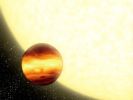
LonelyPlanet-PIA09118.jpgWhat's the weather like over there?67 visiteCaption NASA:"An artist's conception shows a gas-giant planet orbiting very close to its parent star, creating searingly hot conditions on the planet's surface.
New research suggests that for three such planets lying from 50 to 150 light-years from Earth, strong winds thousands of miles per hour mix the atmosphere so that the temperature is relatively uniform from the permanently light side to the permanently dark side.
This illustration represents an infrared view of a planetary system, in which brightness indicates warmer temperatures. For example, the bright band around the equator of the planet denotes warmer temperatures on both the dark and sunlit sides.
The planet's poles, shown in darker colors, would be cooler".MareKromium
(6 voti)
|
|

M 42-PIA08655-ed.jpgThe "Great Cloud" around Orion61 visiteThis image composite shows a part of the Orion constellation surveyed by NASA's Spitzer Space Telescope. The shape of the main image was designed by astronomers to roughly follow the shape of Orion cloud A, an enormous star-making factory containing about 1,800 young stars. This giant cloud includes the famous Orion nebula (bright circular area in "blade" part of hockey stick-shaped box at the bottom), which is visible to the naked eye on a clear, dark night as a fuzzy star in the hunter constellation's sword.
The region that makes up the shaft part of the hockey stick box stretches 70 light-years beyond the Orion nebula. This particular area does not contain massive young stars like those of the Orion nebula, but is filled with 800 stars about the same mass as the sun. These sun-like stars don't live in big "cities," or clusters, of stars like the one in the Orion nebula; instead, they can be found in small clusters (right inset), or in relative isolation (middle insert).
In the right inset, developing stars are illuminating the dusty cloud, creating small wisps that appear greenish. The stars also power speedy jets of gas (also green), which glow as the jets ram into the cloudy material.
Since infrared light can penetrate through dust, we see not only stars within the cloud, but thousands of stars many light-years behind it, which just happen to be in the picture like unwanted bystanders. Astronomers carefully separate the young stars in the Orion cloud complex from the bystanders by looking for their telltale infrared glow.
The infrared image shows light captured by Spitzer's infrared array camera. Light with wavelengths of 8 and 5.8 microns (red and orange) comes mainly from dust that has been heated by starlight. Light of 4.5 microns (green) shows hot gas and dust; and light of 3.6 microns (blue) is from starlight.
(6 voti)
|
|

M 74-PIA08533_fig3.jpgSupernova SN2003gd in January 2005 (2)60 visiteBy January 2005, the dust had cooled and completely faded from the camera's view (here). However, it was still detected in January 2005 by another instrument aboard Spitzer called the Multiband Imaging Photometer.
All the images are false-color, infrared composites, in which 3,6-micron light is blue, 4,5-micron light is green, and 8-micron light is red.
(6 voti)
|
|

Proxima_Centauri_B_-_4.jpgNightside of Proxima Centauri "b" (Imagination)126 visitenessun commentoMareKromium
(5 voti)
|
|
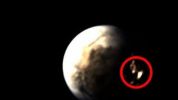
Proxima_Centauri_B_-_3~0.jpgProxima Centauri "b" - Just like Tharsis, BUT ACTIVE! (Extra Mgnf - 3)137 visiteE' come Tharsis, attiva, enorme e situata sul Pianeta (una "Super-Terra") Proxima Centauri b.MareKromium
(5 voti)
|
|

DR22.jpgCygnus Region (DR22; NGC 4145 and NGC 4361)65 visiteThese images are some of the first to be taken during Spitzer's warm mission -- a new phase that began after the telescope, which operated for more than five-and-a-half years, ran out of liquid coolant. The pictures were snapped with the two InfraRed Channels that still work at Spitzer's still-quite-chilly temperature of 30 Kelvin (about - 406 degrees Fahrenheit). The two InfraRed Channels are part of Spitzer's InfraRed Array Camera: 3.6-micron light is blue and 4.5-micron light is orange.
The main image shows a cloud, known as DR22, bursting with new stars in the Cygnus Region of the sky.
Spitzer's infrared eyes can see dust, and see through dust, giving it a unique view into star-forming nests. The blue areas are dusty clouds, and the orange is mainly hot gas.MareKromium
(5 voti)
|
|

From_HST-2009-19-a-print.jpgStarbursts in Dwarf Galaxies are a Global Affair63 visiteBursts of star making in a galaxy have been compared to a Fourth of July fireworks display: They occur at a fast and furious pace, lighting up a region for a short time before winking out.
But these fleeting starbursts are only pieces of the story, astronomers say. An analysis of archival images of small, or dwarf, galaxies taken by NASA's Hubble Space Telescope suggests that starbursts, intense regions of star formation, sweep across the whole galaxy and last 100 times longer than astronomers thought. The longer duration may affect how dwarf galaxies change over time, and therefore may shed light on galaxy evolution.
"Our analysis shows that starburst activity in a dwarf galaxy happens on a global scale", explains Kristen McQuinn of the University of Minnesota in Minneapolis and leader of the study. "There are pockets of intense star formation that propagate throughout the galaxy, like a string of firecrackers going off". According to McQuinn, the duration of all the starburst events in a single dwarf galaxy would total 200 to 400 MYs.
These longer timescales are vastly more than the 5 to 10 MYs proposed by astronomers who have studied star formation in dwarf galaxies. "They were only looking at individual clusters and not the whole galaxy, so they assumed starbursts in galaxies lasted for a short time".
Dwarf galaxies are considered by many astronomers to be the building blocks of the large galaxies seen today, so the length of starbursts is important for understanding how galaxies evolve.
"Astronomers are really interested to find out the steps of galaxy evolution", McQuinn says. "Exploring these smaller galaxies is important because, according to popular theory, large galaxies are created from the merger of smaller, dwarf galaxies. So understanding these smaller pieces is an important part of filling in that scenario".
McQuinn's team analyzed archival Advanced Camera for Surveys data of three dwarf galaxies, NGC 4163, NGC 4068 and IC 4662. Their distances range from 8 to 14 MLYs away. The trio is part of a survey of starbursts in 18 nearby dwarf galaxies. Hubble's superb resolution allowed McQuinn's team to pick out individual stars in the galaxies and measure their brightness and color, two important characteristics astronomers use to determine stellar ages.
By determining the ages of the stars, the astronomers could reconstruct the starburst history in each galaxy.
Two of the galaxies, NGC 4068 and IC 4662, show active, brilliant starburst regions in the Hubble images. The most recent starburst in the third galaxy, NGC 4163, occurred 200 MYs ago and has faded from view. The team looked at regions of high and low densities of stars, piecing together a picture of the starbursts. The galaxies were making a few stars, when something, perhaps an encounter with another galaxy, pushed them into high star-making mode. Instead of forming eight stars every thousand years, the galaxies started making 40 stars every thousand years, which is a lot for a small galaxy, McQuinn says. The typical dwarf is 10 to 30.000 LYs wide. By comparison, a normal-sized galaxy such as our Milky Way is about 100.000 LYs wide.
About 300 to 400 MYs ago star formation occurred in the outer areas of the galaxies. Then it began migrating inward as explosions of massive stars triggered new star formation in adjoining regions. Starbursts are still occurring in the inner parts of NGC 4068 and IC 4662.
The total duration of starburst activity depends on many factors, including the amount of gas in a galaxy, the distribution and density of the gas, and the event that triggered the starburst. A merger or an interaction with a large galaxy, for example, could create a longer starburst event than an interaction with a smaller system.
McQuinn plans to expand her study to a larger sample of more than 20 galaxies. "Studying nearby dwarf galaxies, where we can see the stars in great detail, will help us interpret observations of galaxies in the distant universe, where starbursts were much more common because galaxies had more gas with which to make stars".
McQuinn's results appeared in the April 10 issue of The Astrophysical Journal.MareKromium
(5 voti)
|
|
| 157 immagini su 14 pagina(e) |
|
|
|
|
6 | |
|
|
|
|
|
|
|





