| |

| Piú votate - The Universe in Super Definition |

M 74-PIA08533_fig1.jpgM 74 and Supernova SN2003gd60 visiteThis image is the galaxy M 74, as seen by SST's infrared array camera. The white box to the left of the Galaxy's center identifies the location of the Supernova Remnant. In all the images, the blue dots represent hot gas and stars. The galaxy's cool dust is shown in red.
Astronomers using NASA's SST have spotted a "dust factory" 30 MLY away in the spiral galaxy M 74. The factory is located at the scene of a massive star's explosive death, or supernova.
While astronomers have suspected for years that supernovae could be producers of cosmic dust particles, the technology to confirm this suspicion has only recently become available.
(7 voti)
|
|

Kepler_10b-PIA13776.jpgExo-Planet "Kepler 10b"162 visiteCaption NASA:"Artist's concept of the first rocky world discovered by NASA's Kepler Mission. The Planet, called Kepler 10-b, is shown in front of its Host (Parent) Star".MareKromium
(6 voti)
|
|

Black_Hole-PIA13275.jpgDisk around a massive "Baby Star"?80 visiteCaption NASA:"Astronomers have obtained the first clear look at a Dusty Disk closely encircling a massive "Baby Star", providing direct evidence that massive stars do form in the same way as their smaller brethren -- and closing an enduring debate.
This artist's concept shows what such a massive Disk might look like. The Flared Disk extends to about 130 times the Earth-Sun distance (such as 130 UA), and has a mass similar to that of the star, roughly twenty times the Sun. The inner parts of the Disk are shown to be devoid of dust).
Nota Lunexit: questa è dunque, according to NASA, la rappresentazione artistica di un Disco di polveri e materiale Primordiale posizionato attorno ad una giovane stella supermassiva.
Può anche darsi, ma secondo noi la NASA ha scelto male l'immagine da abbinare alla caption e questa, in effetti, è la rappresentazione artistica di un Buco Nero, oppure di un Quasar.
Chissà...MareKromium
(6 voti)
|
|

Blue_Star-PIA12174.jpgSpace "Cube"80 visiteThis drawing illustrates the extent to which astronomers have been underestimating the proportion of small to big stars in certain galaxies. Data from NASA's Galaxy Evolution Explorer Spacecraft and the Cerro Tololo Inter-American Observatory in Chile have shown that, in some cases, there can be as many as four times more small stars compared to large ones.
In the drawing, a massive blue star is shown next to a stack of lighter, yellow stars. These big blue stars are 3 to 20 times more massive than our Sun, while the smaller stars are typically about the same mass as the Sun or smaller.
Before the Galaxy Evolution Explorer study, astronomers assumed there were 500 small stars for every massive one (lower stack on right). The new observations reveal that, in certain galaxies, this estimation is off by a factor of four; for every massive star, there could be as many as 2000 small counterparts (such as the entire stack - the "Cube" - on the right).MareKromium
(6 voti)
|
|
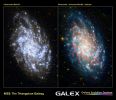
M-033-a.jpgM 33 - The "Triangulum" Spiral Galaxy (a.k.a. NGC 598)61 visiteNASA's Galaxy Evolution Explorer Mission celebrates its sixth anniversary studying galaxies beyond our Milky Way through its sensitive UltraViolet telescope, the only such far-UltraViolet detector in space.
The mission studies the shape, brightness, size and distance of distant galaxies across 10 BY of cosmic history, giving scientists a wealth of data to help us better understand the origins of the universe. One such object is pictured here, the galaxy NGC 598, more commonly known as M 33.
The image shows a map of the recent star formation history of M 33. The bright blue and white areas are where star formation has been extremely active over the past few million years. The patches of yellow and gold are regions where star formation was more active 100 MY ago.
In addition, the UltraViolet image shows the most massive young stars in M 33. These stars burn their large supply of Hydrogen fuel quickly, burning hot and bright while emitting most of their energy at UV wavelengths. Compared with low-mass stars like our Sun, which live for billions of years, these massive stars never reach old age, having a lifespan as short as a few million years.
The California Institute of Technology, in Pasadena, Calif., leads the Galaxy Evolution Explorer Mission and is responsible for science operations and data analysis. NASA's Jet Propulsion Laboratory, also in Pasadena, manages the mission and built the science instrument. The mission was developed under NASA's Explorers Program managed by the Goddard Space Flight Center, Greenbelt, Md. South Korea and France are the mission's international partners.MareKromium
(6 voti)
|
|
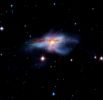
NGC-6240-PIA11828.jpgNGC 6240 - Colliding Galaxies64 visiteThis image of a pair of colliding galaxies called NGC 6240 shows them in a rare, short-lived phase of their evolution just before they merge into a single, larger galaxy. The prolonged, violent collision has drastically altered the appearance of both galaxies and created huge amounts of heat turning NGC 6240 into an "InfraRed Luminous" Active Galaxy.
A rich variety of active galaxies, with different shapes, luminosities and radiation profiles exist. These galaxies may be related astronomers have suspected that they may represent an evolutionary sequence. By catching different galaxies in different stages of merging, a story emerges as one type of active galaxy changes into another. NGC 6240 provides an important "missing link" in this process.
This image was created from combined data from the infrared array camera of NASA's Spitzer Space Telescope at 3.6 and 8.0 microns (red) and Visible Light from NASA's Hubble Space Telescope (green and blue).MareKromium
(6 voti)
|
|
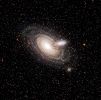
NGC-0253-HST.jpgCosmic Alignment! (2MASX J00482185-2507365)62 visiteNASA's Hubble Space Telescope has captured a rare alignment between two spiral galaxies. The outer rim of a small, foreground galaxy is silhouetted in front of a larger background galaxy. Skeletal tentacles of dust can be seen extending beyond the small galaxy's disk of starlight.
Such outer dark dusty structures, which appear to be devoid of stars, like barren branches, are rarely so visible in a galaxy because there is usually nothing behind them to illuminate them. Astronomers have never seen dust this far beyond the visible edge of a galaxy. They do not know if these dusty structures are common features in galaxies.
Understanding a galaxy's color and how dust affects and dims that color are crucial to measuring a galaxy's true brightness. By knowing the true brightness, astronomers can calculate the galaxy's distance from Earth.
Astronomers calculated that the background galaxy is 780 MLY away. They have not as yet calculated the distance between the two galaxies, although they think the two are relatively close, but not close enough to interact. The background galaxy is about the size of the Milky Way Galaxy and is about 10 times larger than the foreground galaxy.
Most of the stars speckled across this image belong to the nearby spiral galaxy NGC 253, which is out of view to the right. Astronomers used Hubble's Advanced Camera for Surveys to snap images of NGC 253 when they spied the two galaxies in the background. From ground-based telescopes, the two galaxies look like a single blob. But the Advanced Camera's sharp "eye" distinguished the blob as two galaxies, cataloged as 2MASX J00482185-2507365. The images were taken on Sept. 19, 2006.
The results have been submitted for publication in The Astronomical Journal.
For additional information, contact:
Donna Weaver/Ray Villard
Space Telescope Science Institute, Baltimore, Md.
410-338-4493 / 410-338-4514
dweaver@stsci.edu / villard@stsci.edu
Benne Holwerda
Space Telescope Science Institute, Baltimore, Md.
/University of Cape Town, South Africa
holwerda@stsci.edu
Object Name: 2MASX J00482185-2507365
MareKromium
(6 voti)
|
|

Abell-1689.jpgGravitational "Lensing" for Abell 168966 visiteA massive cluster of yellowish galaxies is seemingly caught in a spider web of eerily distorted background galaxies in the left-hand image, taken with the Advanced Camera for Surveys (ACS) aboard NASA's Hubble Space Telescope.
The gravity of the cluster's trillion stars acts as a cosmic "zoom lens," bending and magnifying the light of the galaxies located far behind it, a technique called gravitational lensing. The faraway galaxies appear in the Hubble image as arc-shaped objects around the cluster, named Abell 1689. The increased magnification allows astronomers to study remote galaxies in greater detail.
One galaxy is so far away, however, it does not show up in the visible-light image taken with ACS [top, right], because its light is stretched to invisible infrared wavelengths by the universe's expansion.
Astronomers used Hubble's Near Infrared Camera and Multi-Object Spectrometer (NICMOS) and NASA's Spitzer Space Telescope with its Infrared Array Camera (IRAC)—with help from the gravitational lensing cluster—to see the faraway galaxy.
The distant galaxy, dubbed A1689-zD1, appears as a grayish-white smudge in the close-up view taken with Hubble's NICMOS [center, right], and as a whitish blob in the Spitzer IRAC close-up view [bottom, right]. The galaxy is brimming with star birth. Hubble and Spitzer worked together to show that it is one of the youngest galaxies ever discovered. Astronomers estimate that the galaxy is 12.8 billion light-years away. Abell 1689 is 2.2 billion light-years away.
A1689-zD1 was born during the middle of the "dark ages," a period in the early universe when the first stars and galaxies were just beginning to burst to life. The dark ages lasted from about 400,000 to roughly a billion years after the Big Bang. Astronomers think that A1689-zD1 was one of the galaxies that helped end the dark ages.
The ACS images were taken in 2002, the NICMOS images in 2005 and 2007, and the Spitzer IRAC images in 2006.
MareKromium
(6 voti)
|
|

GLS-SDSSJ0946+1006.jpgHubble Finds Double "Einstein Ring"75 visiteNASA's Hubble Space Telescope has revealed a never-before-seen optical alignment in space: a pair of glowing rings, one nestled inside the other like a bull's-eye pattern. The double-ring pattern is caused by the complex bending of light from two distant galaxies strung directly behind a foreground massive galaxy, like three beads on a string.
More than just a novelty, this very rare phenomenon can offer insight into dark matter, dark energy, the nature of distant galaxies, and even the curvature of the universe.
The ring was found by an international team of astronomers led by Raphael Gavazzi and Tommaso Treu of the University of California, Santa Barbara. The discovery is part of the ongoing Sloan Lens Advanced Camera for Surveys (SLACS) program. The team is reporting its results at the 211th meeting of the American Astronomical Society in Austin, Texas. A paper has been submitted to The Astrophysical Journal.
The phenomenon, called gravitational lensing, occurs when a massive galaxy in the foreground bends the light rays from a distant galaxy behind it, in much the same way as a magnifying glass would. When both galaxies are exactly lined up, the light forms a circle, called an "Einstein ring," around the foreground galaxy. If another background galaxy lies precisely on the same sightline, a second, larger ring will appear.
Because the odds of seeing such a special alignment are estimated to be 1 in 10,000, Tommaso says that they "hit the jackpot." The odds of seeing this phenomenon are less than winning two consecutive bets on a single number at Roulette.
"Such stunning cosmic coincidences reveal so much about nature. Dark matter is not hidden to lensing," added Leonidas Moustakas of the Jet Propulsion Laboratory in Pasadena, Calif. "The elegance of this lens is trumped only by the secrets of nature that it reveals."
The massive foreground galaxy is almost perfectly aligned in the sky with two background galaxies at different distances. The foreground galaxy is 3 billion light-years away. The inner ring and outer ring are comprised of multiple images of two galaxies at a distance of 6 billion and approximately 11 billion light-years.
SLACS team member Adam Bolton of the University of Hawaii's Institute for Astronomy in Honolulu first identified the lens in the Sloan Digital Sky Survey (SDSS). "The original signature that led us to this discovery was a mere 500 photons (particles of light) hidden among 500,000 other photons in the SDSS spectrum of the foreground galaxy," commented Bolton.
"The twin rings were clearly visible in the Hubble image, added Tommaso. "When I first saw it I said 'wow, this is insane!' I could not believe it!"
The distribution of dark matter in the foreground galaxies that is warping space to create the gravitational lens can be precisely mapped. Tommaso finds that the fall-off in density of the dark matter is similar to what is seen in spiral galaxies (as measured by the speed of a galaxy's rotation, which yields a value for the amount of dark matter pulling on it), though he emphasizes there is no physical reason to explain this relationship.
In addition, the geometry of the two Einstein rings allowed the team to measure the mass of the middle galaxy precisely to be a value of 1 billion solar masses. The team reports that this is the first measurement of the mass of a dwarf galaxy at cosmological distance (redshift of z=0.6).
A sample of several dozen double rings such as this one would offer a purely independent measure. The comparative radius of the rings could also be used to provide an independent measure of the curvature of space by gravity. This would help in determining the matter content of the universe and the properties of dark energy.
Observations of the cosmic microwave background (a relic from the Big Bang) favor flat geometry. A sample of 50 suitable double Einstein rings would be sufficient to measure the dark matter content of the universe and the equation of state of the dark energy (a measure of its pressure) to 10 percent precision. Other double Einstein rings could be found with wide-field space telescope sky surveys that are being proposed for the Joint Dark Energy Mission (JDEM) and recently recommended by the National Research Council.
MareKromium
(6 voti)
|
|
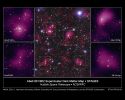
Abell-901_and_902-PM.jpgAbell 901 and 902 Supercluster65 visiteAstronomers are using NASA's Hubble Space Telescope to dissect one of the largest structures in the universe as part of a quest to understand the violent lives of galaxies. Hubble is providing indirect evidence of unseen dark matter tugging on galaxies in the crowded, rough-and-tumble environment of a massive supercluster of hundreds of galaxies.
Dark matter is an invisible form of matter that accounts for most of the universe's mass. Hubble's Advanced Camera for Surveys has mapped the invisible dark matter scaffolding of the supercluster Abell 901/902, as well as the detailed structure of individual galaxies embedded in it.
The images are part of the Space Telescope Abell 901/902 Galaxy Evolution Survey (STAGES), which covers one of the largest patches of sky ever observed by the Hubble telescope. The area surveyed is so wide that it took 80 Hubble images to cover the entire STAGES field. The new work is led by Meghan Gray of the University of Nottingham in the United Kingdom and Catherine Heymans of the University of British Columbia in Vancouver, along with an international team of scientists.
The Hubble study pinpointed four main areas in the supercluster where dark matter has pooled into dense clumps, totaling 100 trillion times the Sun's mass. These areas match the location of hundreds of old galaxies that have experienced a violent history in their passage from the outskirts of the supercluster into these dense regions. These galaxies make up four separate galaxy clusters.
"Thanks to Hubble's Advanced Camera for Surveys, we are detecting for the first time the irregular clumps of dark matter in this supercluster," Heymans said. "We can even see an extension of the dark matter toward a very hot group of galaxies that are emitting X-rays as they fall into the densest cluster core."
The dark matter map was constructed by measuring the distorted shapes of over 60,000 faraway galaxies. To reach Earth, the galaxies' light traveled through the dark matter that surrounds the supercluster galaxies and was bent by the massive gravitational field. Heymans used the observed, subtle distortion of the galaxies' shapes to reconstruct the dark matter distribution in the supercluster using a method called weak gravitational lensing. The dark matter map is 2.5 times sharper than a previous ground-based survey of the supercluster.
"The new map of the underlying dark matter in the supercluster is one key piece of this puzzle," Gray explained. "At the same time we're looking in detail at the galaxies themselves." The survey's broader goal is to understand how galaxies are influenced by the environment in which they live.
On Earth, the pace of quiet country life is vastly different from the hustle of the big city. In the same way, galaxies living lonely isolated lives look very different from those found in the most crowded regions of the universe, like a supercluster. "We've known for a long time that galaxies in crowded environments tend to be older, redder, and rounder than those in the field," Gray said. "Galaxies are continually drawn into larger and larger groups and clusters by the inevitable force of gravity as the universe evolves."
In such busy environments galaxies are subject to a life of violence: high-speed collisions with other galaxies; the stripping away of gas, the fuel supply they use to form new stars; and distortion due to the strong gravitational pull of the underlying invisible dark matter. "Any or all of these effects may play a role in the transformation of galaxies, which is what we're trying to determine," Gray said.
The STAGES survey's simultaneous focus on both the big picture and the details can be likened to studying a big city. "It's as if we're trying to learn everything we can about New York City and New Yorkers," Gray explained. "We're examining large-scale features, like mapping the roads, counting skyscrapers, monitoring traffic. At the same time we're also studying the residents to figure out how the lifestyles of people living downtown differ from those out in the suburbs. But in our case the city is a supercluster, the roads are dark matter, and the people are galaxies."
Further results by other team members support this view. "In the STAGES supercluster we clearly see that transformations are happening in the outskirts of the supercluster, where galaxies are still moving relatively slowly and first feel the influence of the cluster environment," said Christian Wolf, an Advanced Research Fellow at the University of Oxford in the U.K.
Assistant professor Shardha Jogee and graduate student Amanda Heiderman, both of the University of Texas in Austin, concur. "We see more collisions between galaxies in the regions toward which the galaxies are flowing than in the centers of the clusters," Jogee said. "By the time they reach the center, they are moving too fast to collide and merge, but in the outskirts their pace is more leisurely, and they still have time to interact."
The STAGES team also finds that the outer parts of the clusters are where star formation in the galaxies is slowly switching off and where the supermassive black holes at the hearts of the galaxies are most active.
Added Heiderman: "The galaxies at the centers of the clusters may have been there for a long time and have probably finished their transformation. They are now old, round, red, and dead."
The team plans more studies to understand how the supercluster environment is responsible for producing these changes.
Abell 901/902 resides 2.6 billion light-years from Earth and measures more than 16 million light-years across.
MareKromium
(6 voti)
|
|
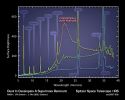
SN-Cassiopeia_A_-PIA10207.jpgCassiopeia "A": Dissecting the Wake of a Supernova Explosion61 visiteThe elements and molecules that flew out of the Cassiopeia A star when it exploded about 300 years ago can be seen clearly for the first time in this plot of data, called a Spectrum, taken by NASA's SST.
The Spectrum, which was created by splitting light into its basic components, reveals the composition of gas and dust that were synthesized in the explosion. It also provides some of the best evidence yet that stellar explosions, called Supernovae, were a significant source of fresh dust in the very young universe.
Prior to these observations, nobody was certain where this early dust — the same dust that ultimately made its way into future stars, planets and people — came from.
One of the most interesting features of the plot is a bump labeled Cassiopeia A Dust Feature. This bump is actually the signature of a collection of dust composed of proto-silicates, Silicon Dioxide and Iron Oxide. The Spectrum reveals that the brightness of the dust feature is correlated to that of Argon gas (yellow vertical line at left), known to have been expelled and synthesized during the star's explosion. The fact that the dust is associated with the expelled gas, or ejecta, tells astronomers that this Supernova manufactured new dust.
Each of the 3 lines of this plot represents a different layer of the Supernova remnant, with the top yellow and red line being the outermost layer.
Similar correlations between gas and dust are also seen in the middle layer (green line). For example, neon gas correlates with dust composed of Carbon and Aluminum Oxide.MareKromium
(6 voti)
|
|
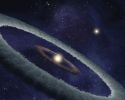
HD-113766-PIA09931.jpgHD 11376675 visiteThis artist's conception shows a binary-star, or two-star, system, called HD 113766, where astronomers suspect a rocky Earth-like planet is forming around one of the stars. At approximately 10 to 16 MY old, astronomers suspect this star is at just the right age for forming rocky planets. The System is located approx. 424 LY away from Earth.
The two yellow spots in the image represent the System's two stars. The brown ring of material circling closest to the central star depicts a huge belt of dusty material, more than 100 times as much as in our asteroid belt, or enough to build a Mars-size planet or larger. The rocky material in the belt represents the early stages of planet formation, when dust grains clump together to form rocks, and rocks collide to form even more massive rocky bodies called planetesimals. The belt is located in the middle of the system's terrestrial Habitable Zone, or the region around a star where liquid water could exist on any rocky planets that might form.
Earth is located in the middle of our sun's terrestrial habitable zone.
Using NASA's Spitzer Space Telescope, astronomers learned that the belt material in HD 113766 is more processed than the snowball-like stuff that makes up infant solar systems and comets, which contain pristine ingredients from the early solar system. However, it is not as processed as the stuff found in mature planets and asteroids. This means that the dust belt is made out of just the right mix of materials to be forming an Earth-like planet. It is composed mainly of rocky silicates and metal sulfides (like fool's gold), similar to the material found in lava flows.
The white outer ring shows a concentration of icy dust also detected in the system. This material is at the equivalent position of the asteroid belt in our solar system, but only contains about one-sixth as much material as the inner ring. Astronomers say it is not clear from the Spitzer observations if anything is occurring in the icy belt, but they believe it could be a source of water later on for the planet that grows from the inner warm ring.
MareKromium
(6 voti)
|
|
| 157 immagini su 14 pagina(e) |
|
|
|
5 | |
|
|
|
|
|
|
|
|





