| |

| Piú votate - The Universe in Super Definition |
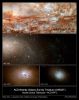
Galaxies-HST.jpgGalaxies!63 visiteThese images taken with NASA's Hubble Space Telescope are close-up views of four galaxies from a large survey of nearby galaxies.
The galaxies have very different masses and sizes and showcase the diversity of galaxies found in the ANGST study. Although the galaxies are separated by many light-years, they are presented as if they are all at the same distance to show their relative sizes.
The images, taken with Hubble's Advanced Camera for Surveys, reveal rich detail in the stellar populations and in the interstellar dust scattered between the stars. Hubble's sharp views reveal the colors and brightnesses of individual stars, which astronomers used to derive the history of star formation in each galaxy.
In the composite image at the top, NGC 253 is ablaze with the light from thousands of young, blue stars. The spiral galaxy is undergoing intense star formation. The image demonstrates the sharp "eye" of the Advanced Camera, which resolved individual stars. The dark filaments are clouds of dust and gas. NGC 253 is the dominant galaxy in the Sculptor Group of galaxies and it resides about 13 million light-years from Earth.
In the view of the spiral galaxy NGC 300, second from top, young, blue stars are concentrated in spiral arms that sweep diagonally through the image. The yellow blobs are glowing hot gas that has been heated by radiation from the nearest young, blue stars. NGC 300 is a member of the Sculptor Group of galaxies and it is located 7 million light-years away.
The dark clumps of material scattered around the bright nucleus of NGC 3077, the small, dense galaxy at bottom, left, are pieces of wreckage from the galaxy's interactions with its larger neighbors. NGC 3077 is a member of the M81 group of galaxies and it resides 12.5 million light-years from Earth.
The image at bottom, right, shows a swarm of young, blue stars in the diffuse dwarf irregular galaxy NGC 4163. NGC 4163 is a member of a group of dwarf galaxies near our Milky Way and is located roughly 10 million light-years away.
These galaxies are part of a detailed survey called the ACS Nearby Galaxy Survey Treasury program (ANGST). In the census, Hubble observed roughly 14 million stars in 69 galaxies. The survey explored a region called the "Local Volume," and the galaxy distances ranged from 6.5 million light-years to 13 million light-years from Earth. The Local Volume resides beyond the Local Group of galaxies, an even nearer collection of a few dozen galaxies within about 3 million light-years of our Milky Way Galaxy.
The natural-color images were constructed using observations taken in infrared, visible, and blue light. The observations of NGC 253 and NGC 300 were taken in September 2006; of NGC 3077 in November 2006; and of NGC 4163 in December 2006.
Object Names: NGC 253, NGC 300, NGC 3077, NGC 4163
MareKromium
(7 voti)
|
|

GRB-080319B.jpgSpace "Flash"! GRB-080319B64 visiteCaption NASA:"Peering across 7,5 BLY (Billion Light-Years) and halfway back to the Big Bang, NASA's Hubble Space Telescope has photographed the fading optical counterpart of a powerful Gamma Ray Burst (GRB) that holds the record for being the intrinsically brightest naked-eye object ever seen from Earth. For nearly a minute this single star was as bright as 10 million galaxies.
Hubble Wide Field and Planetary Camera 2 (WFPC2) images of GRB 080319B, taken on Monday, April 7, 2008, show the fading optical counterpart of the titanic blast. The object erupted in a brilliant flash of Gamma Rays and other electromagnetic radiation at 2:12 a.m. EDT on March 19, and was detected by Swift, NASA's Gamma Ray Burst "Watchdog Satellite". Immediately after the explosion, the Gamma Ray Burst glowed as a dim 5th magnitude "star" in the spring constellation Bootes.
Designated GRB 080319B, the intergalactic firework has been fading away ever since then. Hubble astronomers had hoped to see the host galaxy where the burst presumably originated, but were taken aback that the light from the GRB is still drowning out the galaxy's light even three weeks after the explosion.
This is particularly surprising because it was such a bright GRB initially. Previously, bright bursts have tended to fade more rapidly, which fits in to the theory that brighter GRBs emit their energy in a more tightly confined beam. The slow fading leaves astronomers puzzling about just where the energy came from to power this GRB, and makes Hubble's next observations of this object in May 2008 all the more crucial.
Called a Long-Duration GRB, such events are theorized to be caused by the death of a very massive star, perhaps weighing as much as 50 times our Sun. Such explosions, sometimes dubbed "hypernovae", are more powerful than ordinary supernova explosions and are far more luminous, in part because their energy seems to be concentrated into a blowtorch-like beam that, in this case, was aimed directly at Earth. The Hubble exposure also shows field galaxies around the fading optical component of the gamma ray burst, which are probably unrelated to the burst itself".MareKromium
(7 voti)
|
|

Abell-1763-PIA10227.jpgCelestial Cities and the Roads that connect Them69 visiteThis is a representation of galaxies in and surrounding a galaxy cluster called Abell 1763. The placement of each dot is based on the actual coordinates of galaxies in the region. Blue dots are active star-forming galaxies; red dots show galaxies that are not actively forming stars.
Galaxies across the universe reside in cosmic communities big and small. Large, densely populated galactic communities are called galaxy clusters (highlighted in the orange circle). Like cities on Earth, galaxy clusters are scattered throughout the universe and are connected by a web of dusty highways called filaments (highlighted in purple). Smaller galactic communities are sprinkled along the filaments, creating celestial suburbs.
Over time, astronomers suspect that all galactic suburbanites make their way to a galaxy cluster by way of filaments. Observations from NASA's Spitzer Space Telescope show that filamentary galaxies form stars at twice the rate of their densely clustered counterparts.
NASA's Jet Propulsion Laboratory, Pasadena, Calif., manages the Spitzer Space Telescope mission for NASA's Science Mission Directorate, Washington. Science operations are conducted at the Spitzer Science Center at the California Institute of Technology, also in Pasadena. Caltech manages JPL for NASA.
MareKromium
(7 voti)
|
|
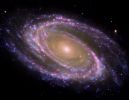
M-081-PIA09579.jpgThe M 81 Galaxy is "Pretty in Pink"62 visiteThe perfectly picturesque Spiral Galaxy known as Messier 81, or M81, looks sharp in this new composite from NASA's Spitzer (SST) and Hubble Space Telescopes (HST) and NASA's Galaxy Evolution Explorer.
M81 is a "grand design" spiral galaxy, which means its elegant arms curl all the way down into its center. It is located about 12 MLY away in the Ursa Major Constellation and is one of the brightest galaxies that can be seen from Earth through telescopes.
The colors in this picture represent a trio of light wavelengths: blue is ultraviolet light captured by the Galaxy Evolution Explorer; yellowish white is visible light seen by Hubble; and red is infrared light detected by Spitzer.
The blue areas show the hottest, youngest stars, while the reddish-pink denotes lanes of dust that line the spiral arms. The orange center is made up of older stars. MareKromium
(7 voti)
|
|
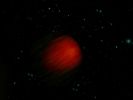
HD149026b_-PIA09378.jpgHot, Black and (relatively) Close...63 visiteThis artist's concept illustrates the hottest planet yet observed in the universe.
The scorching ball of gas, a "Hot Jupiter" called HD 149026b, is a sweltering 3700° Fahrenheit (2040° Celsius) -- about 3 times hotter than the rocky surface of Venus, the hottest planet in our Solar System. The Planet is so hot that astronomers believe it is absorbing almost all of the heat from its star and reflecting very little to no light. Objects that reflect no sunlight are black. Consequently, HD 149026b might be the blackest known planet in the universe, in addition to the hottest.
The temperature of this dark and balmy planet was taken with NASA's SST. While the planet reflects no visible light, its heat causes it to radiate a little visible and a lot of infrared light. Spitzer, an infrared observatory, was able to measure this infrared light through a technique called secondary eclipse. HD 149026b is what is known as a transiting planet, which means that it crosses in front of in front of and passes behind its star -- the secondary eclipse -- when viewed from Earth. By determining the drop in total infrared light that occurs when the planet disappears, astronomers can figure out how much infrared light is coming from the planet alone.
The Spitzer observations of HD 149026b also suggest a hot spot in the middle of the side of the planet that always faces its star. Even though the planet is black, the spot would glow like a black lump of charcoal. HD 149026b is thought to be tidally locked, just as our moon is to Earth, such that one side of the planet is perpetually baked under the heat of its sun.
Astronomers think that HD 149026b is probably blazing hot on its sunlit side, and much cooler on its dark side. A similar phenomenon was observed previously by Spitzer for the planet Upsilon Andromedae b.
In the case of both planets, heat is not being evenly distributed across their surfaces. This is the opposite of what happens on Jupiter, where temperature differences are minimal all around.
HD 149026b is located 256 light-years away in the constellation Hercules. It is the smallest known transiting planet, with a size similar to Saturn's and a suspected dense core 70 to 90 times the mass of Earth. It speeds around its star every 2.9 days.
MareKromium
(7 voti)
|
|
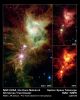
NGC-2264.jpgNGC 2264 - The "Snowflake Cluster" versus the "Cone Nebula"62 visiteCaption NASA:"Strange shapes and textures can be found in the neighborhood of the Cone Nebula.
These patterns result from the tumultuous unrest that accompanies the formation of the open cluster of stars known as NGC 2264, the Snowflake Cluster. To better understand this process, a detailed image of this Region was taken in two colors of infrared light by the orbiting Spitzer Space Telescope (SST). Bright stars from the Snowflake cluster dot the field. These stars soon heat up and destroy the gas and dust mountains in which they formed. One such dust mountain is the famous Cone Nebula, visible in the above image on the left, pointing toward a bright star near the center of the field.
The entire NGC 2264 Region is located about 2500 LY away toward the constellation of the Unicorn (Monoceros)".MareKromium
(7 voti)
|
|

YoungStar-PIA09266.jpgThe "O"-Star76 visite"The further on the edge, the hotter the intensity," sings Kenny Loggins in "Danger Zone," a song made famous by the movie "Top Gun." The same words ring true for young, cooler stars like our sun that live in the danger zones around scorching hot stars, called O-stars. The closer a young, maverick star happens to be to a super hot O-star, the more likely its burgeoning planets will be blasted into space.
This artist's animation illustrates how this process works. The movie begins by showing an O-star in a murky star-forming region. It then pans out to show a young, cooler star and its swirling disk of planet-forming material. Disks like this one, called protoplanetary disks, are where planets are born. Gas and dust in a disk clumps together into tiny balls that sweep through the material, growing in size to eventually become full-grown planets.
The young star happens to lie within the "danger zone" around the O-star, which means that it is too close to the hot star to keep its disk. Radiation and winds from the O-star boil and blow away the material, respectively. This process, called photoevaporation, is sped up here but takes anywhere from 100,000 to about 1,000,000 years. Without a disk, the young star will not be able to produce planets.
Our own sun and its suite of planets might have grown up on the edge of an O-star's danger zone before migrating to its current, spacious home. However, we know that our young sun didn't linger for too long in any hazardous territory, or our planets, and life, wouldn't be here today.
NASA's Spitzer Space Telescope surveyed the danger zones around five O-stars in the Rosette nebula. It was able to determine that the zones are spheres with a radius of approximately 1.6 light-years, or 10 trillion miles.
MareKromium
(7 voti)
|
|

The_Evaporating_Planet.jpgWater Claimed in Evaporating Planet HD 209458b66 visitePlanet HD 209458b is evaporating. It is so close to its parent star that its heated atmosphere is simply expanding away into space. Some astronomers studying this distant planetary system now believe they have detected water vapor among the gases being liberated. This controversial claim, if true, would mark the first instance of planetary water beyond our Solar System, and indicate anew that life might be sustainable elsewhere in the universe. HD 209458b is known as a hot Jupiter type system because it involves a Jupiter-type planet in a Mercury-type orbit. Although spectroscopic observations from the Hubble Space Telescope are the basis for the water detection claim, the planetary system is too small and faint to image. Therefore, an artist's impression of the HD 209458b system is shown above. Research into the atmospheric composition of HD 209458b and other extrasolar planets is continuing.MareKromium
(7 voti)
|
|
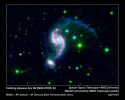
NGC-2535-PIA09106.jpgNGC 2535 and NGC 2536 (alias Arp 82)60 visiteA pair of interacting galaxies might be experiencing the galactic equivalent of a mid-life crisis. For some reason, the pair, called Arp 82, didn't make their stars early on as is typical of most galaxies. Instead, they got a second wind later in life -- about 2 billion years ago -- and started pumping out waves of new stars as if they were young again.
Arp 82 is an interacting pair of galaxies with a strong bridge and a long tail. NGC 2535 is the big galaxy and NGC 2536 is its smaller companion. The disk of the main galaxy looks like an eye, with a bright "pupil" in the center and oval-shaped "eyelids." Dramatic "beads on a string" features are visible as chains of evenly spaced star-formation complexes along the eyelids. These are presumably the result of large-scale gaseous shocks from a grazing encounter. The colors of this galaxy indicate that the observed stars are young to intermediate in age, around 2 million to 2 billion years old, much less than the age of the universe (13.7 billion years).
The puzzle is: why didn't Arp 82 form many stars earlier, like most galaxies of that mass range? Scientifically, it is an oddball and provides a relatively nearby lab for studying the age of intermediate-mass galaxies.
This picture is a composite captured by Spitzer's infrared array camera with light at wavelength 8 microns shown in red, NASA's Galaxy Evolution Explorer combined 1530 and 2310 Angstroms shown in blue, and the Southeastern Association for Research in Astronomy Observatory light at 6940 Angstroms shown in green.
(7 voti)
|
|

Dark_Matter.jpgBright Universe, Dark Matter66 visiteAn international team of astronomers using NASA's Hubble Space Telescope has created a three-dimensional map that provides the first direct look at the large-scale distribution of dark matter in the universe.
Dark matter is an invisible form of matter that accounts for most of the universe's mass.
The map provides the best evidence yet that normal matter, largely in the form of galaxies, accumulates along the densest concentrations of dark matter. The map reveals a loose network of filaments that grew over time and intersect in massive structures at the locations of clusters of galaxies.
The map stretches halfway back to the beginning of the universe and shows how dark matter has grown increasingly "clumpy" as it collapses under gravity.
This milestone takes astronomers from inference to direct observation of dark matter's influence in the universe. Previous studies of dark matter are based largely on numerical simulations of the expected evolution of large-scale structure. This evolution is driven by the gravitational attraction of dark matter.
Mapping dark matter's distribution in space and time is fundamental to understanding how galaxies grew and clustered over billions of years. Tracing the growth of clustering in the dark matter may eventually also shed light on dark energy, a repulsive form of gravity that influences how dark matter clumps.
The new maps of dark matter and galaxies will provide critical observational underpinnings to future theories for how structure formed in the evolving universe under the relentless pull of gravity. Theories suggest the universe transitioned from a smooth distribution of matter into a sponge-like structure of long filaments.
The research results appeared online today in the journal Nature and were presented at the 209th meeting of the American Astronomical Society in Seattle, Wash., by Richard Massey for the dark matter and Nick Scoville for the galaxies. Both researchers are from the California Institute of Technology, Pasadena, Calif.
"It's reassuring how well our map confirms the standard theories for structure formation." said Massey. He calls dark matter the "scaffolding" inside of which stars and galaxies have been assembled over billions of years.
Researchers created the map using Hubble's largest survey of the universe, the Cosmic Evolution Survey ("COSMOS") with an international team of 70 astronomers led by Scoville. The COSMOS survey covers a sufficiently wide area of sky – nine times the area of the Earth's Moon. This allows for the large-scale filamentary structure of dark matter to be evident. To add 3-D distance information, the Hubble observations were combined with multicolor data from powerful ground-based telescopes. "The 3-D information is vital to studying the evolution of the structures over cosmic time," said Jason Rhodes, a collaborator in the study at the Jet Propulsion Laboratory in Pasadena, Calif.
The dark matter map was constructed by measuring the shapes of half a million faraway galaxies. To reach us, the galaxies' light has traveled through intervening dark matter. The dark matter deflected the light slightly as it traveled through space. Researchers used the observed, subtle distortion of the galaxies' shapes to reconstruct the distribution of intervening mass along Hubble's line of sight — a method called weak gravitational lensing. This effect is analogous to deducing the rippling pattern in a glass shower door by measuring how light from behind it is distorted as it passes through the glass.
"Although this technique has been employed previously, the depth of the COSMOS image and its superior resolution enables a more precise and detailed map, covering a large enough area to see the extended filamentary structures," said co-investigator Richard Ellis of the California Institute of Technology.
For astronomers, the challenge of mapping the universe has been similar to mapping a city from nighttime aerial snapshots showing only streetlights. Dark matter is invisible, so only the luminous galaxies can be seen directly. The new images are equivalent to seeing a city, its suburbs and country roads — in daylight, for the first time. Major arteries and intersections become evident, and a variety of neighborhoods are revealed.
A separate COSMOS team led by Scoville presented images of the large scale galactic structures in the same area with the dark matter. Galaxies appear in visible light seen with Hubble and in ground-based Subaru telescope images by Yoshiaku Taniguchi and colleagues. The hot gas in the densest galaxy clusters was imaged in X-rays by Gunther Hasinger and colleagues using the European Space Agency's XMM-Newton telescope.
Galaxy structures inside the dark matter scaffolding show clusters of galaxies in the process of assembly. These structures can be traced over more than 80 million light-years in the COSMOS survey – approximately five times the extent of the nearby Virgo galaxy cluster. In the densest early universe structures, many galaxies already have old stellar populations, implying that these galaxies formed first and accumulated the greatest masses in a bottom-up assembly process where smaller galaxies merge to make bigger galaxies — like tributaries converging to form a large river.
The COSMOS survey shows that galaxies with on-going star formation, even to the present epoch, dwell in less populated voids and dark matter filaments. "It is remarkable how the environment on the enormous cosmic scales seen in the dark matter structures can influence the properties of individual stars and galaxies — both the maturity of the stellar populations and the progressive 'downsizing' of star formation to smaller galaxies is clearly dependent on the dark matter environment," said Scoville.
"The comparison is of fundamental importance," said Massey. "Almost all current scientific knowledge concerns only baryonic matter. Now that we have begun to map out where dark matter is, the next challenge is to determine what it is, and specifically its relationship to normal matter."
In making the COSMOS survey, Hubble photographed 575 slightly overlapping views of the universe using the Advanced Camera for Surveys' (ACS) Wide Field Camera onboard Hubble. It took nearly 1,000 hours of observations. Thousands of galaxies' spectra were obtained by using the European Southern Observatory's Very Large Telescope in Chile, and the Subaru telescope in Hawaii. The distances to the galaxies were accurately determined through their spectral redshifts. The distribution of the normal matter was partly determined with the European Space Agency's XMM-Newton telescope.
MareKromium
(7 voti)
|
|

Upsilon Andromedae-PIA01937.jpgUpsilon Andromedae62 visiteThe top graph consists of infrared data from NASA's Spitzer Space Telescope. It tells astronomers that a distant planet, called Upsilon Andromedae b, always has a giant hot spot on the side that faces the star, while the other side is cold and dark. The artist's concepts above the graph illustrate how the planet might look throughout its orbit if viewed up close with infrared eyes.
Spitzer was able to determine the difference in temperature between the two sides of this planet by measuring the planet's infrared light, or heat, at five points during its 4.6-day-long trip around its star. The temperature rose and fell depending on which face, the sunlit or dark, was pointed toward Spitzer's cameras. Those temperature oscillations are traced by the wavy orange curve. They indicate that Upsilon Andromedae b has an extreme range of temperatures across its surface, about 1,400 degrees Celsius (2,550 degrees Fahrenheit). This means that hot gas moving across the bright side of the planet cools off by the time it reaches the dark side.
The bottom graph and artist's concepts represent what astronomers might have seen if the planet had bands of different temperatures girdling it, like Jupiter. Some astronomers had speculated that "hot-Jupiter" planets like Upsilon Andromedae b, which circle very closely around their stars, might resemble Jupiter in this way. If Upsilon Andromedae b had been like this, there would have been no difference between the average temperatures of the sunlit and dark sides to detect, and Spitzer's data would have appeared as a flat line.
(7 voti)
|
|

M 74-PIA08533.jpgM 74 - Spiral Galaxy60 visite
(7 voti)
|
|
| 157 immagini su 14 pagina(e) |
|
|
4 | |
|
|
|
|
|
|
|
|
|





