| |

| Piú votate - The Universe in Super Definition |
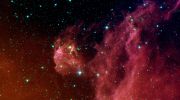
M-042-PIA09412.jpgOut of Orion's Head (2)61 visiteThis image from NASA's SST shows infant stars "hatching" in the Head of the Hunter constellation, Orion. Astronomers suspect that shockwaves from a supernova explosion in Orion's head, nearly 3 MY ago, may have initiated this newfound birth
The Region featured in this Spitzer image is called Barnard 30.
It is located approximately 1300 LY away and sits on the right side of Orion's "Head" just North of the massive star Lambda Orionis. Wisps of red in the cloud are organic molecules called polycyclic aromatic hydrocarbons. These molecules are formed anytime carbon-based materials are burned incompletely. On Earth, they can be found in the sooty exhaust from automobile and airplane engines. They also coat the grills where charcoal-broiled meats are cooked.
This image shows infrared light captured by Spitzer's infrared array camera. Light with wavelengths of 8 and 5.8 microns (red and orange) comes mainly from dust that has been heated by starlight.
Light of 4.5 microns (green) shows hot gas and dust; and light of 3.6 microns (blue) is from starlight.
MareKromium
(8 voti)
|
|
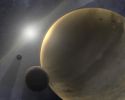
GasGiant-PIA09117.jpgA "young" Gas-Giant71 visiteCaption NASA:"This is an artist's concept of a hypothetical 10-million-year-old star system. The bright blur at the center is a star much like our Sun. The other orb in the image is a gas-giant planet like Jupiter. Wisps of white throughout the image represent traces of gas.
Astronomers using NASA's Spitzer Space Telescope have found evidence showing that gas-giant planets either form within the first 10 million years of a Sun-like star's life, or not at all. The lifespan for sun-like stars is about 10 billion years.
The scientists came to this conclusion after searching for traces of gas around 15 different Sun-like stars, most with ages ranging from 3 to 30 million years. With the help of Spitzer's Infrared Spectrometer Instrument, they were able to search for relatively warm gas in the inner regions of these star systems, an area comparable to the zone between Earth and Jupiter in our own solar system. They also used ground-based radio telescopes to search for cooler gas in the outer regions of these systems, an area comparable to the zone around Saturn and beyond".MareKromium
(8 voti)
|
|
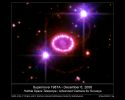
SN-1987A.jpgSupernova 1987A63 visiteTwenty years ago, astronomers witnessed one of the brightest stellar explosions in more than 400 years. The titanic supernova, called SN 1987A, blazed with the power of 100 million suns for several months following its discovery on Feb. 23, 1987.
Observations of SN 1987A, made over the past 20 years by NASA's Hubble Space Telescope and many other major ground- and space-based telescopes, have significantly changed astronomers' views of how massive stars end their lives. Astronomers credit Hubble's sharp vision with yielding important clues about the massive star's demise.
"The sharp pictures from the Hubble telescope help us ask and answer new questions about Supernova 1987A," said Robert Kirshner, of the Harvard-Smithsonian Center for Astrophysics in Cambridge, Mass. "In fact, without Hubble we wouldn't even know what to ask."
Kirshner is the lead investigator of an international collaboration to study the doomed star. Studying supernovae like SN 1987A is important because the exploding stars create elements, such as carbon and iron, that make up new stars, galaxies, and even humans. The iron in a person's blood, for example, was manufactured in supernova explosions. SN 1987A ejected 20,000 Earth masses of radioactive iron. The core of the shredded star is now glowing because of radioactive titanium that was cooked up in the explosion.
The star is 163,000 light-years away in the Large Magellanic Cloud. It actually blew up about 161,000 B.C., but its light arrived here in 1987.
Kirshner has used the Hubble telescope to monitor the supernova. "The Hubble observations have helped us rewrite the textbooks on exploding stars. We found that the actual world is more complicated and interesting than anyone dared to imagine. There are mysterious triple rings of glowing gas and powerful blasts sent out from the explosion that are just having an impact now, 20 years later."
Before SN 1987A, astronomers had a "simplified, idealized model of a supernova," Kirshner explained. "We thought the explosions were spherical and we didn't think much about the gas a star would exhale in the thousands of years before it exploded. The actual shreds of the star in SN 1987A are elongated — more like a jellybean than a gumball, and the fastest-moving debris is slamming into the gas that was already out there from previous millennia. Who would have guessed?"
Hubble wasn't even around when astronomers first spotted the supernova in 1987. When Hubble was launched three years later, astronomers didn't waste any time in using the telescope to study the stellar blast. Its first peek was in 1990, the year the observatory launched. Since then, the telescope has taken hundreds of pictures of the doomed star.
The Hubble studies have revealed the following details about the supernova:
*A glowing ring, about a light-year in diameter, around the supernova. The ring was there at least 20,000 years before the star exploded. X-rays from the explosion energized the gas in the ring, making it glow for two decades.
*Two outer loops of glowing gas, which had been imaged by ground-based telescopes, were seen more clearly by Hubble.
*A dumbbell-shaped central structure that has now grown to one-tenth of a light-year long. The structure consists of two blobs of debris in the center of the supernova racing away from each other at roughly 20 million miles an hour.
*The onrushing stellar shock wave from the stellar explosion is slamming into, heating up, and illuminating the inner regions of the narrow ring surrounding the doomed star.
Hubble continues to watch as the blast debris moves through the ring. The light show makes the glowing ring look like a pearl necklace. Astronomers think the whole ring will be illuminated in a few years.
The glowing ring is expected to become bright enough to illuminate the star's surroundings, which will provide astronomers with new information on how the star ejected material before the explosion.
Astronomers are analyzing images by NASA's Spitzer Space Telescope to try to understand the fate of the dust that surrounds the exploded star and in the neighborhood around the blast.
"We will learn more in the future when the shock wave moves through the inner ring and slams into the outer rings and illuminates them," Kirshner said. "It could lead to clues about the last 20,000 years of the star. But there are many things that are still a mystery. We still do not understand the evolution of the star before the explosion or how the three rings formed. We also think that the star may be part of a binary system."
Astronomers also are still looking for evidence of a black hole or a neutron star left behind by the blast. The fiery death of massive stars usually creates these energetic objects. Most astronomers think a neutron star formed 20 years ago. Kirshner said the object could be obscured by dust or it could have become a black hole.
He plans to use the infrared capabilities of the Wide Field Camera 3 — an instrument scheduled to be installed during the upcoming Hubble servicing mission — to hunt for a stellar remnant. Scientists will use another instrument planned for installment during the mission, the Cosmic Origins Spectrograph, to analyze the supernova's chemical composition and velocities.
The James Webb Space Telescope, scheduled for launch in 2013, will be able to see infrared light from the ring that is 10 times fainter than what astronomers see today. The debris inside the ring will begin to brighten, and astronomers will get another chance to study the interior of an exploded star.
(8 voti)
|
|

M-016-PIA09109.jpgM 16 - The "Eagle Nebula"61 visiteThis image composite highlights the pillars of the Eagle Nebula, as seen in infrared light by NASA's Spitzer Space Telescope (bottom) and visible light by NASA's Hubble Space Telescope (top insets).
The top right inset focuses on the 3 famous pillars, dubbed the "Pillars of Creation", which were photographed by Hubble in 1995. Hubble's optical view shows the dusty towers in exquisite detail, while Spitzer's infrared eyes penetrate through the thick dust, revealing ghostly transparent structures. The same effect can be seen for the pillar outlined in the top left box.
In both cases, Spitzer's view exposes newborn stars that were hidden inside the cocoon-like pillars, invisible to Hubble. These stars were first uncovered by the European Space Agency's Infrared Satellite Observatory. In the Spitzer image, two embedded stars are visible at the tip and the base of the left pillar, while one star can be seen at the tip of the tallest pillar on the right.
(8 voti)
|
|
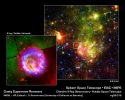
N76-PIA08516-2.jpgThe "N 76 Nebula"59 visiteThe supernova remnant1E0102.2-7219 sits next to the Nebula N76 in a bright, Star-Forming Region of the Small Magellanic Cloud, a satellite galaxy to our Milky Way galaxy located about 200.000 LY from Earth. A Supernova Remnant is made up of the messy bits and pieces of a massive star that exploded, or went Supernova. This image shows glowing dust grains in three wavelengths of infrared radiation: 24 microns (red) measured by the Multiband Imaging Photometer aboard NASA's Spitzer Space Telescope; and 8.0 microns (green) and 3.6 microns (blue) measured by Spitzer's infrared array camera. The red bubble is a dust envelope around the supernova remnant E0102, which is being heated by the shock wave created in the explosion of the remnant's massive progenitor star some 1,000 years ago. Most of the blue stars are in the Small Magellanic Cloud, though some are in our own galaxy.
(8 voti)
|
|
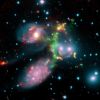
Stephan_s Quintet-PIA02587.jpgStephan's Quintet62 visiteThis false-color composite image of the Stephan's Quintet galaxy cluster clearly shows one of the largest shock waves ever seen (green arc). The wave was produced by one galaxy falling toward another at speeds of more than one million miles per hour. The image is made up of data from NASA's Spitzer Space Telescope and a ground-based telescope in Spain.
Four of the five galaxies in this picture are involved in a violent collision, which has already stripped most of the hydrogen gas from the interiors of the galaxies. The centers of the galaxies appear as bright yellow-pink knots inside a blue haze of stars, and the galaxy producing all the turmoil, NGC7318b, is the left of two small bright regions in the middle right of the image. One galaxy, the large spiral at the bottom left of the image, is a foreground object and is not associated with the cluster.
The titanic shock wave, larger than our own Milky Way galaxy, was detected by the ground-based telescope using visible-light wavelengths. It consists of hot hydrogen gas. As NGC7318b collides with gas spread throughout the cluster, atoms of hydrogen are heated in the shock wave, producing the green glow.
Spitzer pointed its infrared spectrograph at the peak of this shock wave (middle of green glow) to learn more about its inner workings. This instrument breaks light apart into its basic components. Data from the instrument are referred to as spectra and are displayed as curving lines that indicate the amount of light coming at each specific wavelength.
The Spitzer spectrum showed a strong infrared signature for incredibly turbulent gas made up of hydrogen molecules. This gas is caused when atoms of hydrogen rapidly pair-up to form molecules in the wake of the shock wave. Molecular hydrogen, unlike atomic hydrogen, gives off most of its energy through vibrations that emit in the infrared.
This highly disturbed gas is the most turbulent molecular hydrogen ever seen. Astronomers were surprised not only by the turbulence of the gas, but by the incredible strength of the emission. The reason the molecular hydrogen emission is so powerful is not yet completely understood.
Stephan's Quintet is located 300 million light-years away in the Pegasus constellation.
This image is composed of three data sets: near-infrared light (blue) and visible light called H-alpha (green) from the Calar Alto Observatory in Spain, operated by the Max Planck Institute in Germany; and 8-micron infrared light (red) from Spitzer's infrared array camera.
(8 voti)
|
|
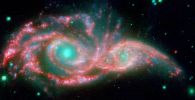
NGC-2207-PIA08097.jpgNGC 2207 and IC 2163: Colliding Galaxies62 visiteThese shape-shifting galaxies have taken on the form of a giant mask. The icy blue eyes are actually the cores of two merging galaxies, called NGC 2207 and IC 2163, and the mask is their spiral arms. The false-colored image consists of infrared data from NASA's Spitzer Space Telescope (red) and visible data from NASA's Hubble Space Telescope (blue/green).
NGC 2207 and IC 2163 met and began a sort of gravitational tango about 40 million years ago. The two galaxies are tugging at each other, stimulating new stars to form. Eventually, this cosmic ball will come to an end, when the galaxies meld into one. The dancing duo is located 140 million light-years away in the Canis Major constellation.
The infrared data from Spitzer highlight the galaxies' dusty regions, while the visible data from Hubble indicates starlight. In the Hubble-only image (not pictured here), the dusty regions appear as dark lanes.
The Hubble data correspond to light with wavelengths of .44 and .55 microns (blue and green, respectively). The Spitzer data represent light of 8 microns.
(8 voti)
|
|

M 84.jpgM 84 - Galactic nucleus and... a Black Hole?71 visiteIs this "almost artistic graph" the signature of a supermassive Black Hole in the center of distant galaxy M 84 (based on data recorded by Hubble's new Space Telescope Imaging Spectrograph (STIS)?. The presence of a Black Hole can also be revealed by watching matter fall into it.
In fact, material spiraling into a Black Hole would find its speed increasing at a drastic rate. These extreme velocity increases provide what we call a 'signature' of the Black Hole's presence. The STIS data show that radiation from approaching gas, shifted to blue wavelengths left of the centerline, is suddenly redshifted to the right of center indicating a rapidly rotating disk of material near the galactic nucleus. The resulting sharp S-shape is effectively the signature of a Black Hole estimated to contain at least 300 million solar masses. Now the question is: do all galaxies have central Black Holes? And, if "Yes", then "Why"?
(8 voti)
|
|

Galactic_Center-PIA12074.jpgNewborn Stars found near the Galactic Centre64 visiteThis InfraRed image from NASA's Spitzer Space Telescope shows 3 "baby stars" in the bustling center of our Milky Way galaxy.
The three stars are the first to be discovered in the region — previous attempts to find them were unsuccessful because there is so much dust standing between us and our galaxy's core.
Spitzer was able to find the newborn stars with its sharp InfraRed eyes, which can cut through dust.
The center of our galaxy is a hectic place. It's stuffed with stars, gas and dust. Astronomers have long wondered how stars can form in such chaotic circumstances. While they have known that stars are born there, they weren't able to see the stars forming until now. Astronomers plan to search for more newborn stars in the region, and ultimately learn more about stellar births at the center of the Milky Way.MareKromium
(7 voti)
|
|

Cassiopeia_A-PIA11748.jpgSNR Cassiopeia "A"68 visiteFor the first time, a multiwavelength three-dimensional reconstruction of a SuperNova Remnant has been created. This stunning visualization of Cassiopeia A, or Cas A, the result of an explosion approximately 330 years ago, uses data from several telescopes: X-ray data from NASA's Chandra X-ray Observatory, InfraRed data from NASA's Spitzer Space Telescope and optical data from the National Optical Astronomy Observatory 4-meter telescope at Kitt Peak, Ariz., and the Michigan-Dartmouth-MIT 2.4-meter telescope, also at Kitt Peak. In this visualization, the green region is mostly Iron observed in X-rays. The yellow region is a combination of Argon and Silicon seen in X-rays, optical, and infrared — including jets of Silicon — plus outer debris seen in the optical. The red region is cold debris seen in the infrared. Finally, the blue reveals the outer blast wave, most prominently detected in X-rays.
Most of the material shown in this visualization is debris from the explosion that has been heated by a shock moving inwards. The red material interior to the yellow/orange ring has not yet encountered the inward moving shock and so has not yet been heated. These unshocked debris were known to exist because they absorb background radio light, but they were only recently discovered in infrared emission with Spitzer. The blue region is composed of gas surrounding the explosion that was heated when it was struck by the outgoing blast wave, as clearly seen in Chandra images.
To create this visualization, scientists took advantage of both a previously known phenomenon — the Doppler effect — and a new technology that bridges astronomy and medicine. When elements created inside a supernova, such as Iron, Silicon and Argon, are heated they emit light at certain wavelengths. Material moving towards the observer will have shorter wavelengths and material moving away will have longer wavelengths. Since the amount of the wavelength shift is related to the speed of motion, one can determine how fast the debris are moving in either direction.
Because Cas A is the result of an explosion, the stellar debris is expanding radially outwards from the explosion center. Using simple geometry, the scientists were able to construct a 3-D model using all of this information. A program called 3-D Slicer — modified for astronomical use by the Astronomical Medicine Project at Harvard University in Cambridge, Mass. — was used to display and manipulate the 3-D model. Commercial software was then used to create the 3-D fly-through.
The blue filaments defining the blast wave were not mapped using the Doppler Effect because they emit a different kind of light —synchrotron radiation — that does not emit light at discrete wavelengths, but rather in a broad continuum. The blue filaments are only a representation of the actual filaments observed at the blast wave.
This visualization shows that there are two main components to this supernova remnant: a spherical component in the outer parts of the remnant and a flattened (disk-like) component in the inner region. The spherical component consists of the outer layer of the star that exploded, probably made of helium and carbon. These layers drove a spherical blast wave into the diffuse gas surrounding the star.
The flattened component — that astronomers were unable to map into 3-D prior to these Spitzer observations — consists of the inner layers of the star. It is made from various heavier elements, not all shown in the visualization, such as Oxygen, Neon, Silicon, Sulphur, Argon and Iron.
High-velocity plumes, or jets, of this material are shooting out from the explosion in the plane of the disk-like component mentioned above. Plumes of Silicon appear in the North/East and South/West, while those of Iron are seen in the South/East and North. These jets were already known and Doppler velocity measurements have been made for these structures, but their orientation and position with respect to the rest of the debris field had never been mapped before now.
This new insight into the structure of Cas A gained from this 3-D visualization is important for astronomers who build models of supernova explosions. Now, they must consider that the outer layers of the star come off spherically, but the inner layers come out more disk-like with high-velocity jets in multiple directions.MareKromium
(7 voti)
|
|
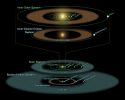
Epsilon_Eridani-PIA11376.JPGSolar Systems63 visiteThis artist's diagram compares the Epsilon Eridani System to our own Solar System. The two systems are structured similarly, and both host asteroids (brown), comets (blue) and planets (white dots).
Epsilon Eridani is our closest known planetary system, located about 10 LY away in the constellation Eridanus. Its central star is a younger, fainter version of our Sun, and is about 800 million years old — about the same age of our Solar System when life first took root on Earth.
Observations from NASA's Spitzer Space Telescope show that the System hosts two Asteroid Belts, in addition to previously identified candidate planets and an Outer Comet Ring.
Epsilon Eridani's inner Asteroid Belt is located at about the same position as ours, approximately 3 AU from its star (aone AU is the distance between Earth and Sun). The system's second, denser Belt lies at about the same place where Uranus orbits in our Solar System, or 20 AU from the star.
In the same way that Jupiter lies just outside our Asteroid Belt, shepherding its rocky debris into a ring, Epsilon Eridani is thought to have planets orbiting near the rims of its two Belts. The first of these planets was identified in 2000 via the Radial Velocity Technique.
Called "Epsilon Eridani b", it orbits at an average distance of 3,4 AU — placing it just outside the System's inner Asteroid Belt.
The second planet orbiting near the rim of the outer Asteroid Belt at 20 AU was inferred when Spitzer discovered the belt.
A third planet might orbit in Epsilon Eridani at the inner edge of its outermost Comet Ring, which lies between 35 and 90 AU. This planet was first hinted at in 1998 due to observed lumpiness in the Comet Ring.
The outer Comet Ring around Epsilon Eridani is denser than our Comet Ring, called Kuiper Belt, because the system is younger.
Over time, Epsilon Eridani's ring will become wispier like the Kuiper Belt. Its comets will collide with each other and break up, or get pushed out of the ring by the gravitational influences of the planets. MareKromium
(7 voti)
|
|
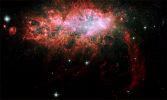
NGC-1569.jpgStarburst Galaxy NGC 156962 visiteThis image taken by NASA's Hubble Space Telescope showcases the brilliant core of one of the most active galaxies in our local neighborhood. The entire core is 5,000 light-years wide.
The galaxy, called NGC 1569, sparkles with the light from millions of newly formed young stars. NGC 1569 is pumping out stars at a rate that is 100 times faster than the rate observed in our Milky Way Galaxy. This frenzied pace has been almost continuous for the past 100 million years.
The core's centerpiece is a grouping of three giant star clusters, each containing more than a million stars. (Two of the clusters are so close they appear as one grouping.) The clusters reside in a large, central cavity. The gas in the cavity has been blown out by the multitude of massive, young stars that already exploded as supernovae. These explosions also triggered a violent flow of gas and particles that is sculpting giant gaseous structures. The sculpted structure at lower right is about 3,700 light-years long.
Huge bubbles of gas, such as the two at left, appear like floating islands. The largest bubble is about 378 light-years wide and the smallest 119 light-years wide. They are being illuminated by the radiation from the bright, young stars within them. Some of those stars are peaking through their gaseous cocoons.
The biggest and brightest objects surrounding the core are stars scattered throughout our Milky Way Galaxy. In contrast, the thousands of tiny white dots in the image are stars in the halo of NGC 1569. The galaxy is 11 million light-years from Earth.
A new analysis of NGC 1569 shows that it is one and a half times farther from Earth than astronomers previously thought. The extra distance places the galaxy in the middle of a group of about 10 galaxies centered on the spiral galaxy IC 342. Gravitational interactions among the group's galaxies may be compressing gas in NGC 1569 and igniting the star-birthing frenzy.
MareKromium
(7 voti)
|
|
| 157 immagini su 14 pagina(e) |
|
3 | |
|
|
|
|
|
|
|
|
|
|





